

“BBB” - LIMITED EDITION PRINTS WITH A MISSION
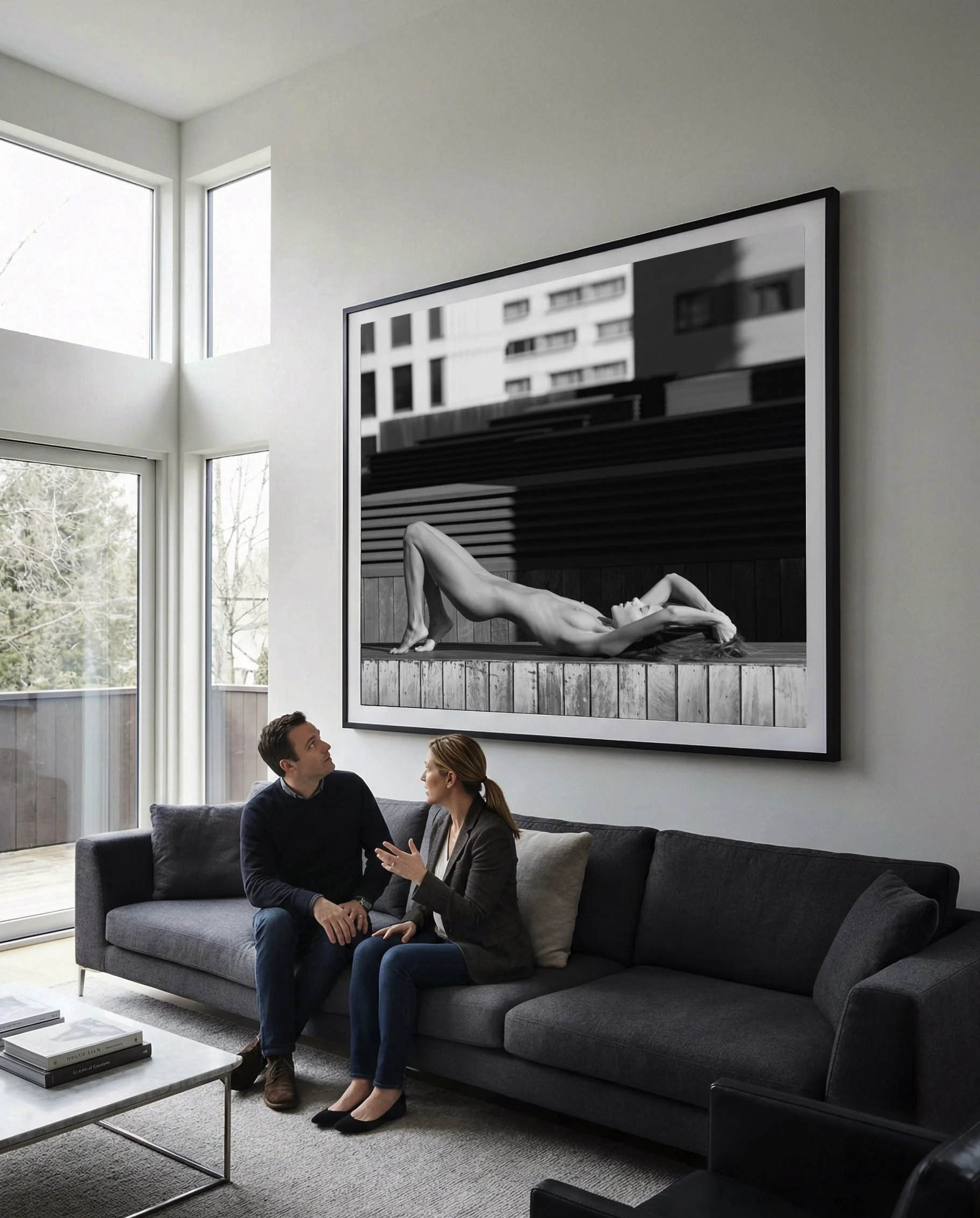
The Titan (140×200cm)
Big, Bold, and Beautiful, or BBB, as we call them — is a limited-edition series of large-format prints. Each edition comprises roughly 15 copies, spread across a range of sizes. But the concept behind BBB isn't about luxury, exclusivity, or rarity. It's about communication. These prints exist to bring human sexuality back to the surface — in-your-face messages designed to start conversations, break taboos, and unite people around our shared humanity.
The name says it all: Big for their size and their power to demand attention. Bold for their uncompromising openness and authenticity. Beautiful for their deep connection to art, aesthetics, and the human form.
THE MISSION STATEMENT.
At Nudicci, we've long felt that nude photography has never been taken as seriously as other photographic disciplines. Whether in prints, magazines, or gallery shows, it always feels slightly self-censored — modest, hushed, kept at arm's length. Even people who buy the work, attend the exhibitions, or subscribe to the publications rarely discuss it the way they would any other art form. The result is a striking absence of common language: most of us simply don't know how to talk about nude and erotic art.
Lot of people experience nude art intuitively — they feel it in their bodies, no intellectual interpretation required. However, our society enforces the self-censorship and our culture fails to teach us how to put words to those feelings, to articulate what we sense and why. No wonder, that discouraged from even having the conversation, we never get the practice needed to develop the mindset.
That's what we are trying to change with those large format edition. We can point the way, but we can't hand you a script. Each of you will need to find your own voice — first for yourself, then for the people around you. The BBB prints are a tool in that mission: large enough to be impossible to ignore, and honest enough to make avoidance feel like the stranger choice.
Our assumption is that BBB will work like a wise old teacher. First, you'll have to convince yourself why this print is worth your hard-earned money. Then you'll have to face objections and comments from friends and guests. Having to justify a purchase — especially as unconventional as a large nude print— does force genuine self-reflection. And navigating social objections is a real and well-documented way people clarify and articulate their own values. And in doing both, you may find yourself face to face with all the ways a culture quietly numbs us from our own sense of beauty and sexuality. This will be a huge win. Mission accomplished.
All of which brings us to the print itself. Because as much as BBB is an idea, it is also an object — a physical thing that will live on your wall, spark conversations, and quietly do its work every day. The decisions you make about size, paper, framing, and glass will affect the way you feel about the artwork. They are part of the same intention – what print will do the best job for you? A print that is too small to command attention, or dulled behind cheap glass, or left curled in a tube, cannot do what it was made to do. What follows is everything you need to know to be fully satisfied in your choice. Let’s walk through a few important details about choosing the BBB prints.
ORIENTATION.
Before settling on a specific image, it's worth thinking about orientation first. It sounds like a minor detail — but it isn't. A great print that has no natural home on your walls is just a source of frustration. A print that fits badly is worse. A little planning upfront saves a lot of regret later
Horizontal is what most people picture when they think of a large print, largely because the landscape printsthey grew up seeing were horizontal. It's also the format of the television screen — which may explain why wide compositions feel so instinctively comfortable and familiar on a wall. Horizontal frames sit naturally above a sofa or bed, and work well for landscapes, wide compositions, and reclining nudes.For nude photographs, the horizontal format is less common and often becomes an afterthought when it comes to printing - vertical often feels more natural when the body is the primary subject.
Vertical frames are more versatile in terms of placement, and carry a different visual weight — less screen, more window or classical painting. They suit portraits and full-body shots naturally, since the vertical frame mirrors the standing human form. A series of vertical prints grouped together can build a cohesive theme across a wall. They also have a subtle architectural effect: a tall frame makes a room feel slightly higher, lifting the perceived ceiling. It's worth noting that vertical is now the default format of the smartphone and social media — yet long before that, it was the dominant format of the nude, for the simple reason that it is the most natural way to photograph a standing body.
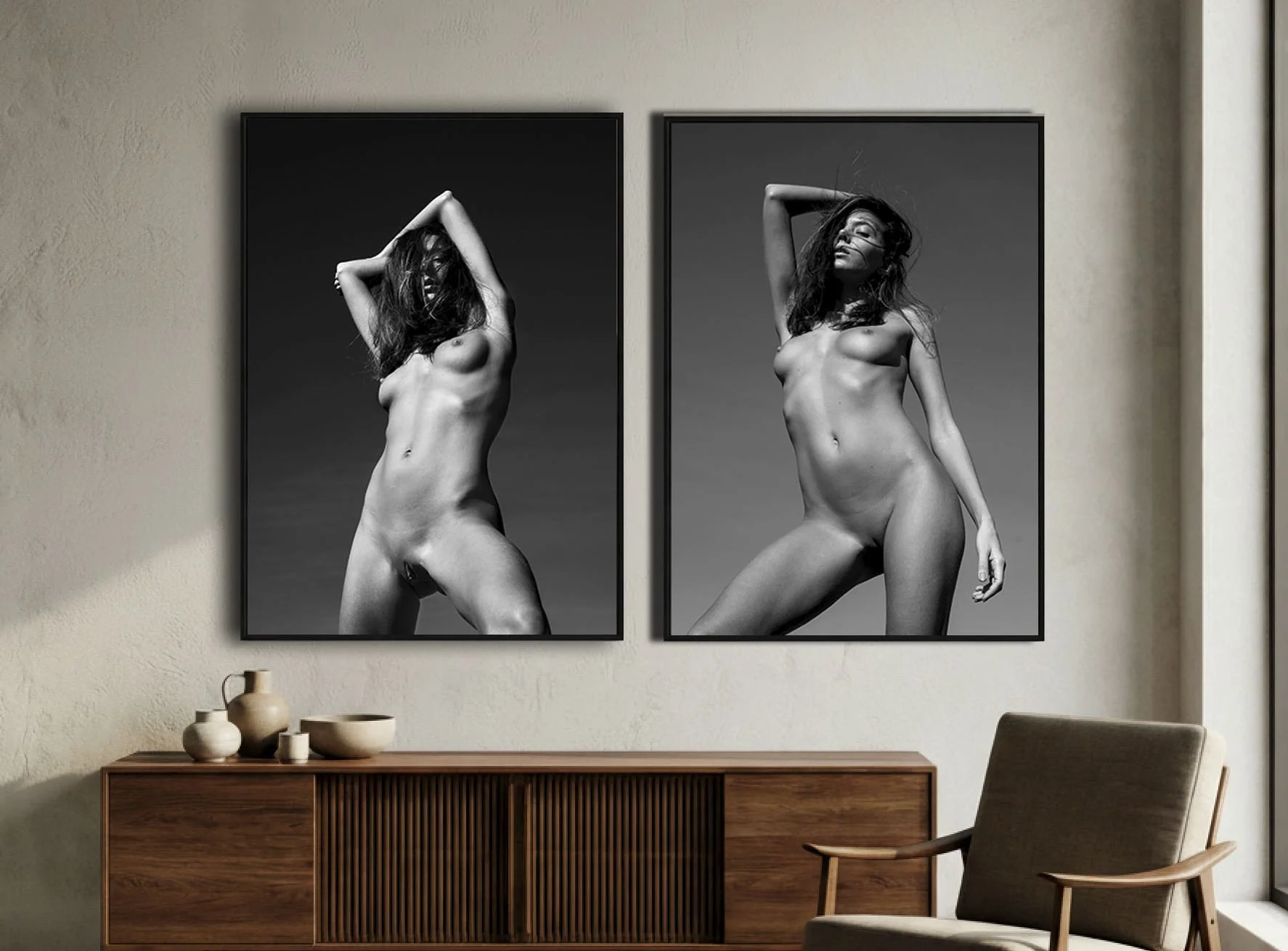
If you place multiple images in a vertical arrangement, you can influence how the viewer reads them. The sequence can feel more connected and intentional, creating a dialogue between the images.
Square formats occupy their own distinct territory. Visually balanced, equal on all sides — nothing to add, nothing to remove. There is something almost ideal about a perfect square, which is perhaps why Instagram launched with it, and why the medium format 6×6 cameras that defined fashion and advertising photography for decades used it. But the square is also the most demanding format to fill well. Not every image was composed with that geometry in mind, and forcing a square crop onto the wrong image can make it feel like something is missing. When it works, it’s quietly perfect. When it doesn’t, you’ll always notice the imbalance. Yet, the best thing about square prints is the endless ways you can arrange them. They’re the most versatile format when it comes to layout and grouping.
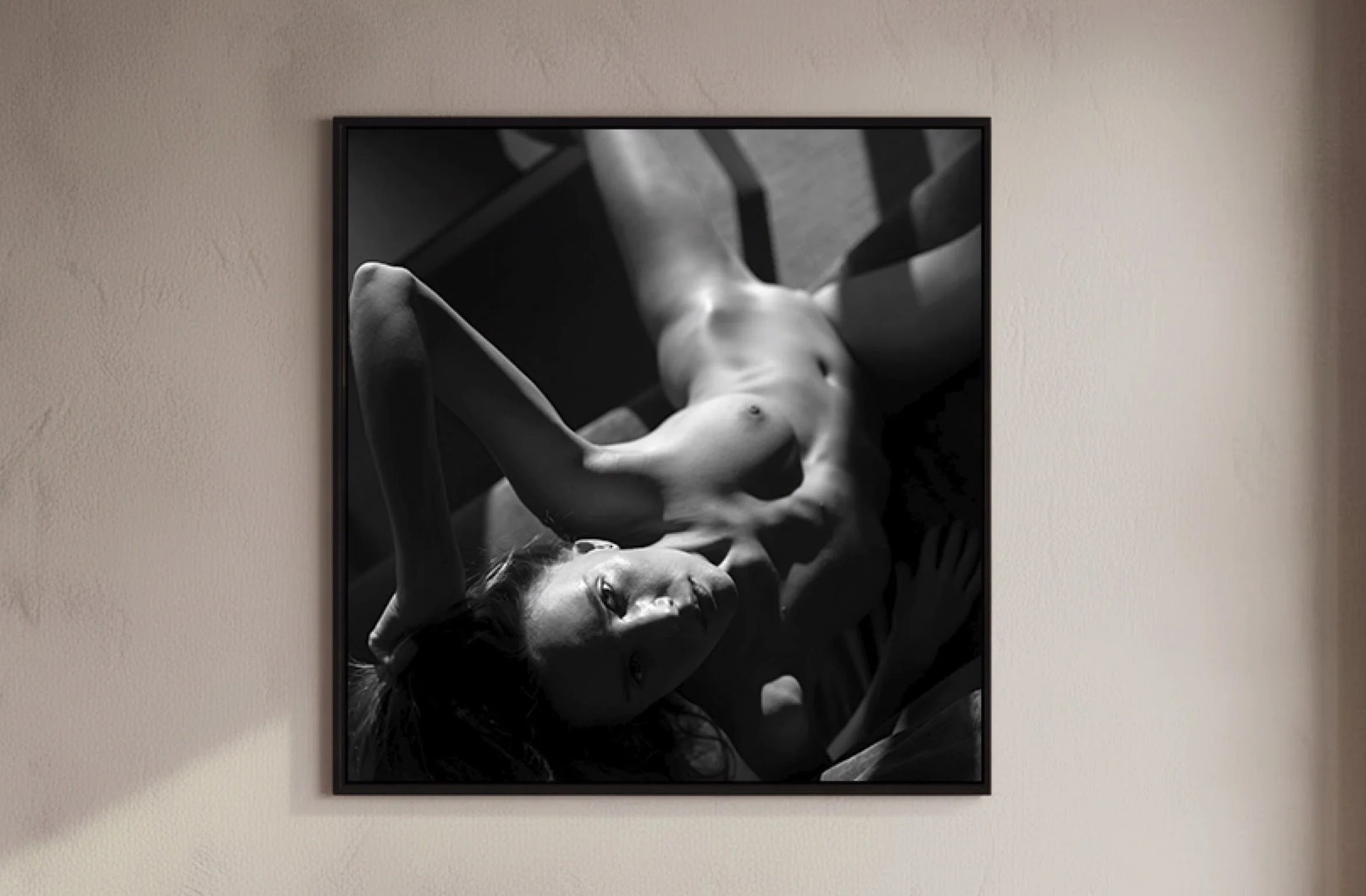
A good example of a square image: it’s not only harmonious, it also doesn’t have a clear up or down, so it can be displayed in more than one way.
SIZE.
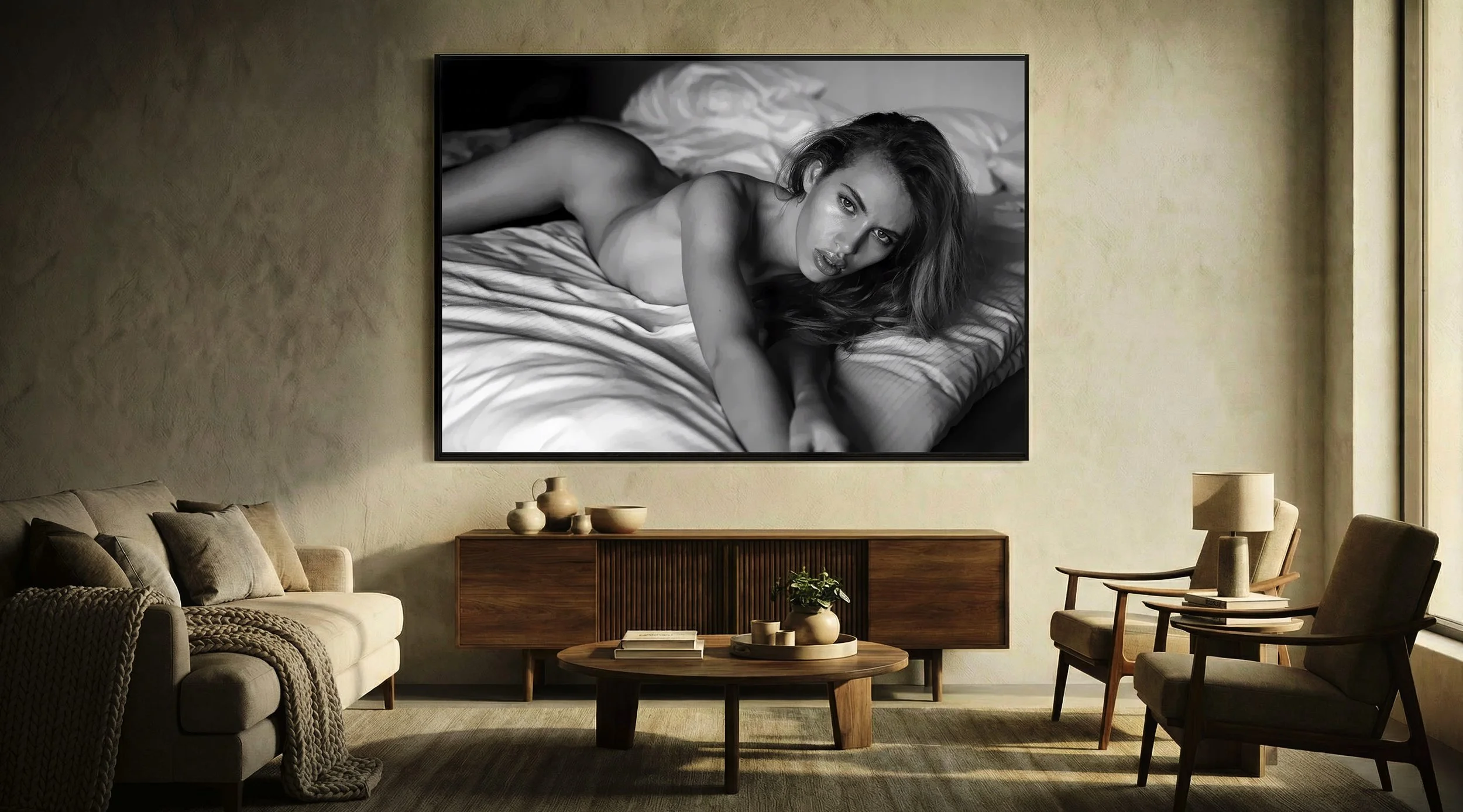
An “Epic” 100×140cm limited edition BBB print.
Once you've settled on orientation, the next question is scale — and the same principle applies: what size will make your wall look its best?
We offer three standard sizes: 50 × 70 cm (Grand), 70 × 100 cm (Ultra), and 100 × 140 cm (Epic). Each was designed to match the most common frame sizes available in stores, so DIY framing is straightforward. They also follow a clean progression — each size is double the area of the previous one, which means the Epic is effectively four Grand prints combined.
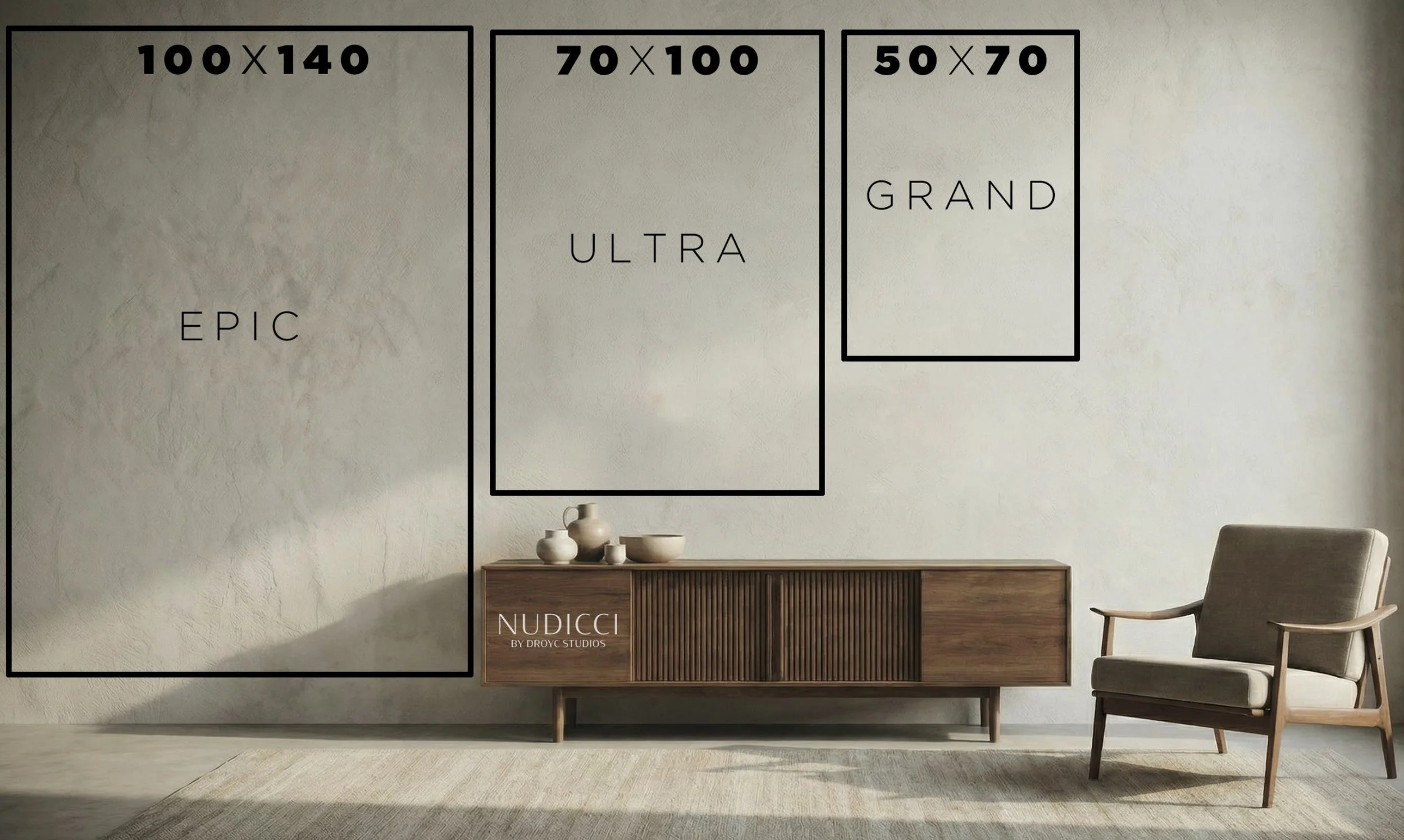
The 3 formats available for BBB Editions. The size logic is simple - with each size step up, the print area doubles.
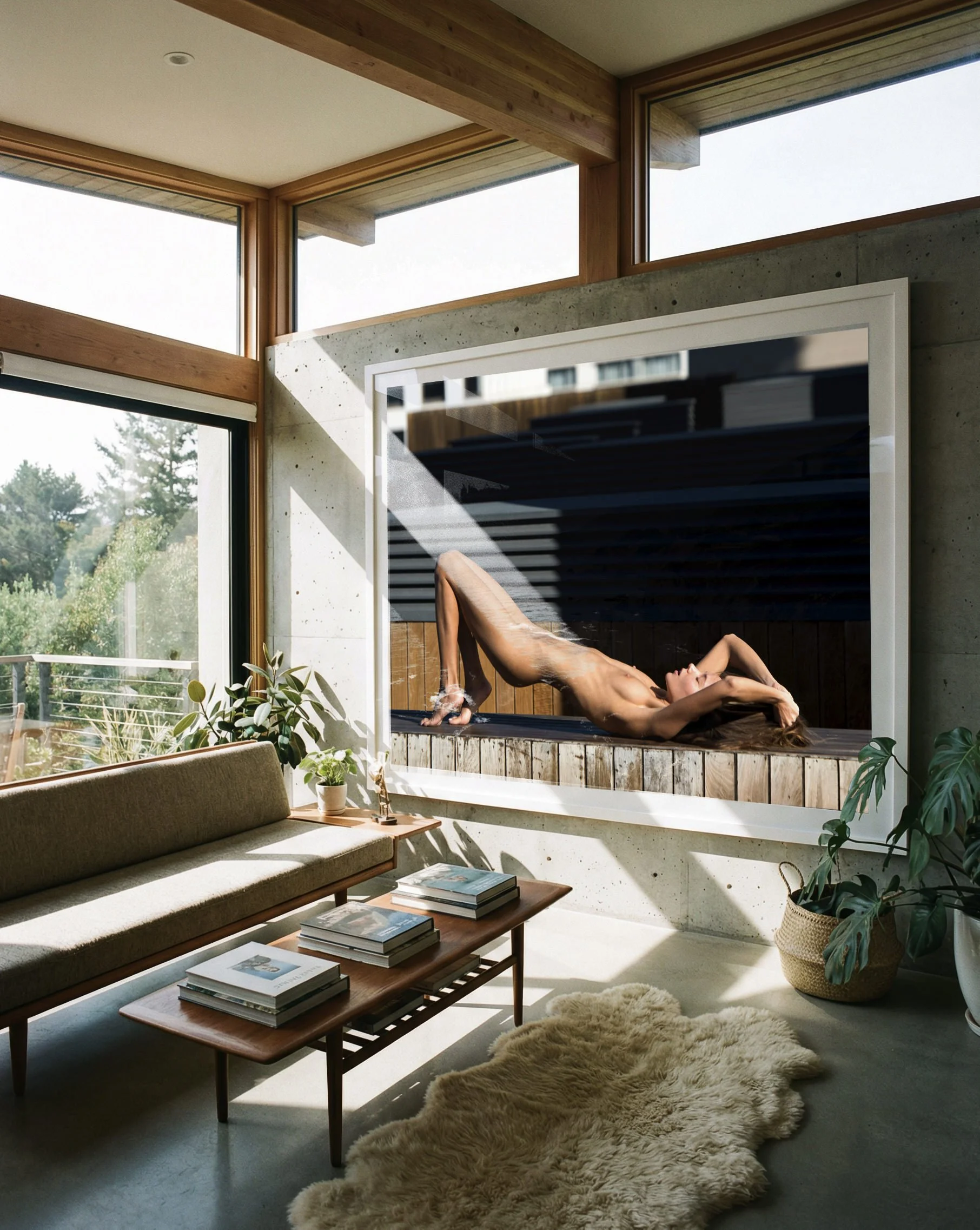
Occasionally, for some prints, we offer a fourth option: the 140 × 200 cm Titan. It is exactly what it sounds like — massive, commanding, and impossible to ignore. But it comes with practical considerations: it requires custom framing, won't fit in most elevators, and demands a home with the space to match. The Titan doesn't decorate a room — it becomes the room, a portal to another world.
But beyond whether it fits your elevator, there are deeper questions worth considering. Primary: what effect do you want the image to have?
The 50 × 70 cm Grand is the classic home poster size. Big enough to be noticed, beautiful enough to belong in almost any room — but it won't stop anyone in their tracks. You could hang two or three of these without your home feeling like a gallery. This format leaves a lot of room for experimentation without a significant financial commitment. It is a smart starting point if you've never owned a large-format print before.
The 70 × 100 cm Ultra is the size of a street movie poster. At home, it's a different proposition entirely — rich in detail, impossible to walk past without registering. Most people have never owned a piece of art this large, yet it's not so overwhelming that it can only go in one place. You'll likely find several walls that can carry it, and owning more than one is not much of a stretch. It's a format that commands attention without dominating the room.
The 100 × 140 cm Epic is the giant in the room — literally. Think of a 68-inch TV, or a standard office desk that is often 80×140cm and you have the scale. It will dominate most spaces, and there will probably be only one or two walls in your home where it can comfortably live. At this size, the image doesn't just hang on the wall — it presides over the room, it dominated the room. The Epic is not for everyone. Few people will want — or dare — to live with a nude print this large. But those who commit to it will understand immediately why it earned its name. This is a print designed to stop people in their tracks and start conversations that don't end quickly.
And then there is the 140 × 200 cm Titan. This is not a large print. It is essentially an entire wall, double of Epic in area or as big as a Queen-size bed or 96-inch TV-screen. It is colossal by any domestic standard — painfully impractical to move, and utterly unlike anything most people have ever encountered in a private home. It is not a statement piece, designed to announce its price tag or its rarity. It is its own reality. You don't hang the Titan and step back to admire it. You enter the room and find yourself in its presence. It becomes your reality, and there is no escaping it. You are captivated — by the art, by the scale, by something that feels older and larger than the moment you're standing in. Forget Instagram. Forget the news. You are in the presence of something timeless.
In addition to these formats, we also offer square ratios in the same size tiers. Grand in square format is 50×50 cm, Ultra is 70×70 cm, and Epic is 100×100 cm. This depends heavily on the image, though. Very few photographs can be cropped to a square without losing visual impact.
PAPER.
Every serious printer will tell you that paper is half the image. The wrong paper can undermine everything the photograph is trying to say.
This is also where most people get lost. So let's start with the one thing that doesn't need to concern you: price. All BBB prints cost the same regardless of paper. That decision has already been made for you
What hasn't been made for you is the choice of effect. Rather than presenting every paper we've ever tested, we only offer papers we know will make that specific image work. Within that selection, the differences are real and meaningful — absolute blacks that disappear into the wall, saturated colors that feel lit from within, tactile surfaces that invite touch, classic matte finishes that read like traditional photography, glossy surfaces that demand clean hands and clean air. Each creates a fundamentally different experience of the same image. Let’s have a look:
RC Glossy (250–310g) This is the most vibrant and high-contrast option — deep blacks, a high-shine finish, and colors that genuinely pop. Best for bold color work and high-contrast black-and-white. Tradeoffs: reflections can be brutal in dark areas, and the surface shows fingerprints easily, that are impossible to remove.
RC Semi-Gloss (250–310g) A family of finishes — pearl, satin, lustre — that sit between glossy and matte. Beautifully rich colors and good contrast, without the hard reflections of full gloss. This most versatile and forgiving surface, and a safe choice for almost any type of print. Probably 80% of all professional prints are printed on this semi-gloss surface. If you can’t decide - this is the safe choice.
RC Metallic (250–310g) A unique finish — almost chrome-like — that gives images a luminous, near three-dimensional quality, with highlights that appear to glow. Particularly striking on skin tones and images with strong light and shadow interplay. Tradeoffs: white areas take on a silver tone, which reduces overall contrast and shifts whites toward grey. Not the right choice for every image or taste, but unforgettable when it works.
Fine-Art Matte (250–400g) A family of heavyweight papers — cotton, bamboo, or alpha-cellulose — with a smooth, non-reflective surface that reads closest to traditional watercolour paper. Colors are subtler and more nuanced, making it ideal for black-and-white work and images where texture and tone matter more than saturation. This is the mother of all papers — the classical art surface that artists have used for centuries, adapted for modern inkjet. It wants to be touched, and it is made to be touched. No fingerprints, just a clear and immediate tactile experience - the print and the paper become one. Tradeoffs: blacks are rarely true black, resulting in lower overall contrast — a tradeoff that suits images with few full black areas.
Fine-Art Baryta (300–400g) A premium fine-art paper that closely resembles the classic silver gelatin prints of traditional darkroom photography. Available in matte or semi-gloss, and typically made from cotton, bamboo, or alpha-cellulose, it combines the depth and richness of glossy with the archival quality of fine-art paper. Worth knowing: the difference between Baryta and a good RC glossy can be subtle to the untrained eye — but for those who know, it's the most photographically authentic surface available, specially for BW prints.
Fine-Art Canvas (350–450g) The same cotton canvas used for oil painting, adapted for inkjet printing. The texture adds depth and warmth — but it comes with a tradeoff: fine details can be lost on the rougher surface, making the result feel less photographically sharp and more painterly. It is typical surface for nude photography — but in the right image, one that might look like a painting, it can be stunning. Available in matte or gloss, canvas prints are typically finished with a UV-protective coating after printing, which means they can be displayed without glass. The prints are shipped unmounted and will require professional help to stretch. Canvas typically displayed without a frame — making it a particularly compelling choice for very large formats where glass would be impractical.
The right choice of paper depends on questions only you can answer. Where will the print hang — a bright room, a dim one? What surrounds it? Do you value depth, subtlety, drama? What type of frame do you have in mind? There is no wrong answer, only the answer that fits your space and your eye. What we can promise is that every paper in our selection is premium and award-winning — 100% cotton-based, alpha-cellulose, or premium RC. The exact specifications will be documented in the Certificate of Authenticity accompanying your print.
Please note that the paper and border options will appear when you click the “Add to Cart” button. For canvas prints, “gallery wrap” borders will be added automatically.
BORDERS AND FRAMING.
The last decision — and one that's easy to overlook until it's too late are boarders. Borders serve two practical purposes. First, handling: when unwrapping or mounting a print, you want to touch the border, not the surface. Glossy papers in particular are unforgiving with fingerprints, and a border gives you a safe margin to work with. Second, mounting: if you mount a borderless print into a passepartout, the mat will inevitably overlap and hide the edges of the image. A border solves this — the passepartout covers the border, and the full printed image remains visible.
Knowing this in advance matters, because your border choice depends entirely on what you plan to do with the print.
Borderless prints fill 100% of the paper. A borderless 50 × 70 cm print fits directly into a 50 × 70 cm frame — glass, print, backboard. Clean and simple, but you'll lose roughly 1 cm of image under the frame lip, and matting isn't really an option, because you will lose a lot of the printed area.
Borders added to the image area keep the printed image the same size but increase the paper dimensions. A 50 × 70 cm image with a 5 cm border becomes a 60 × 80 cm sheet of paper. This gives you full flexibility — you can mount it in a larger frame later, or choose your passepartout size independently of the print size. Even a minimal 2 cm border on each side (making the paper 54 × 74 cm) buys you that freedom without committing to a specific frame size.
Borders subtracted from the image area keep the paper size the same but shrink the printed image. A 50 × 70 cm paper with a 5 cm border leaves a 40 × 60 cm image — useful if you want to stay within a standard frame size while still having a mat, but the image itself becomes smaller.
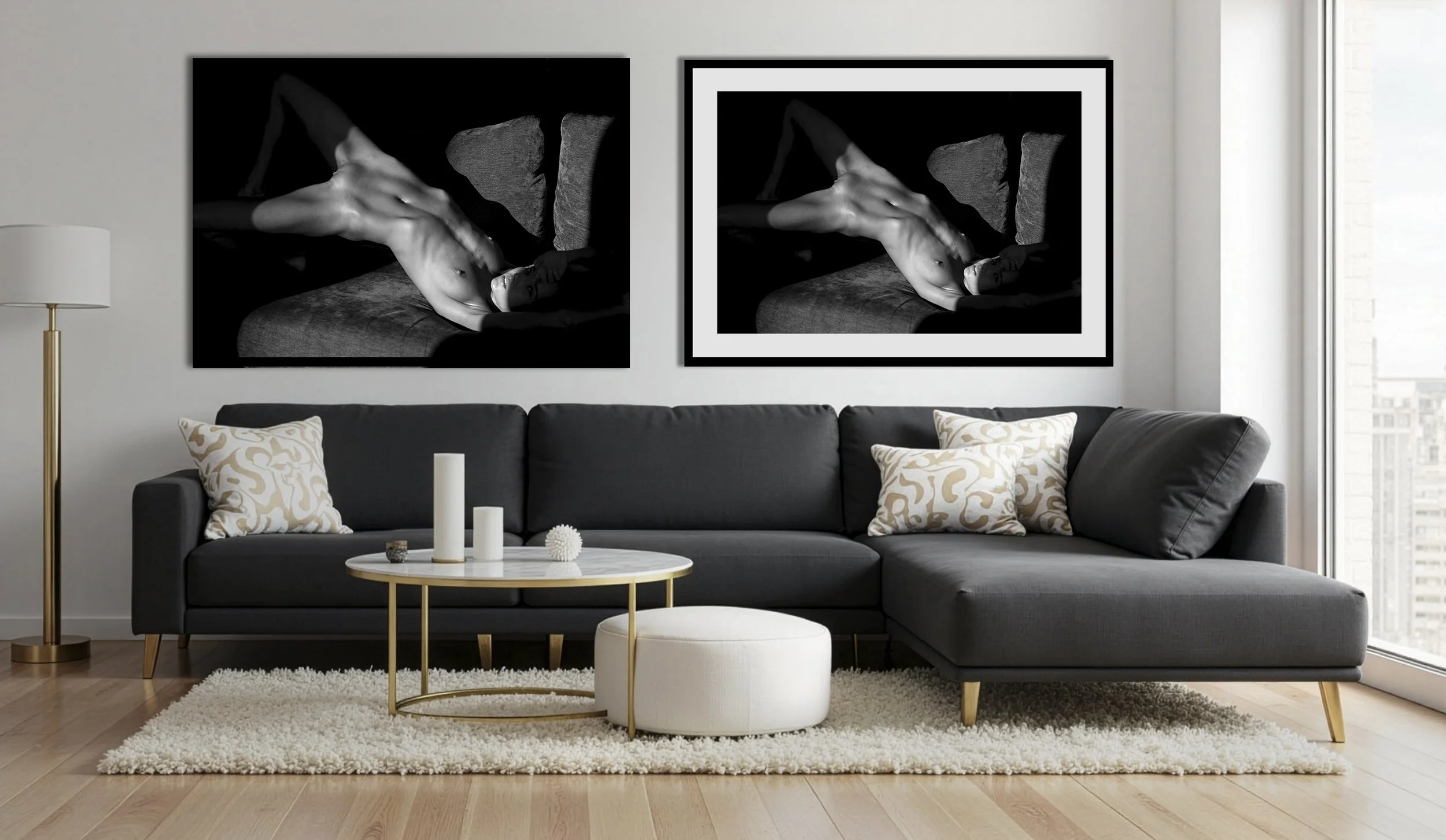
Left: borderless print - image fills the sheet and the frame. Right: bordered by cropping (subtracting) - the same sheet size but the print area decreases by the width of the border. An added border would keep the same print area size but increase the sheet size, so it wouldn’t fit the same frame.
As a general rule: if you're unsure how you'll frame it, opt for added borders. They cost you nothing in image quality and keep your options open. If you end up not needing them, you can just simply trim them.
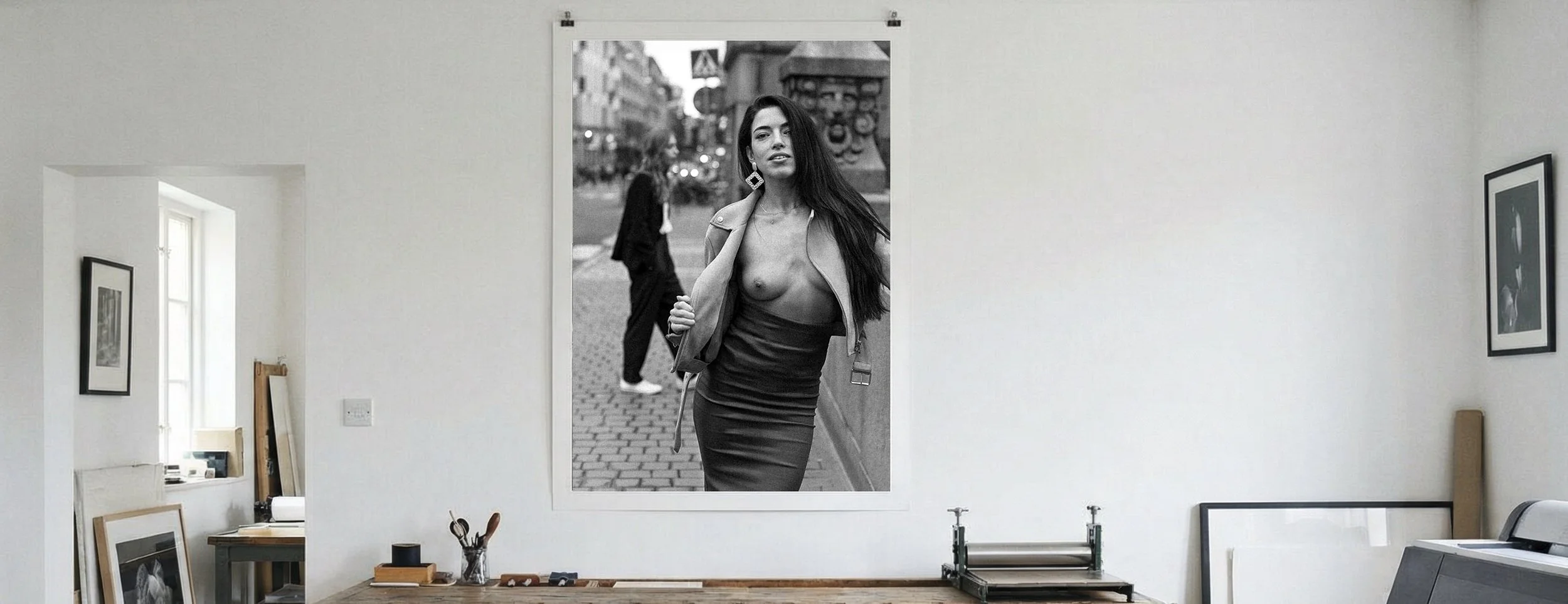
A print with added borders, ready to be mounted in a larger passepartout.
Passepartout or not? We have full article covering framing and passepartout but let me recap it here again and specifically for BBB editions. The case for a passepartout is both practical and aesthetic — and the two reinforce each other more than you might expect.
Practically, a passepartout adds stability and protection on multiple fronts. It holds the print securely in place, prevents it from touching the glass or plexiglass, and acts as a first line of defence against environmental damage — insects, gases, moisture. It also opens up an option many people don't consider: mounting without glass entirely. In some situations glass isn't necessary, but a borderless print without a passepartout has nothing to hold it in place. The mat solves that. A passepartout also makes it easy to swap frames or rotate images. Many collectors have more prints than frames and cycle through them over time. A mounted print can be safely stored and wait its turn. A loose print, by contrast, has to be rolled back into a tube, slipped into a large plastic sleeve, or stored flat in a folder — none of which are ideal for something you plan to return to the wall.
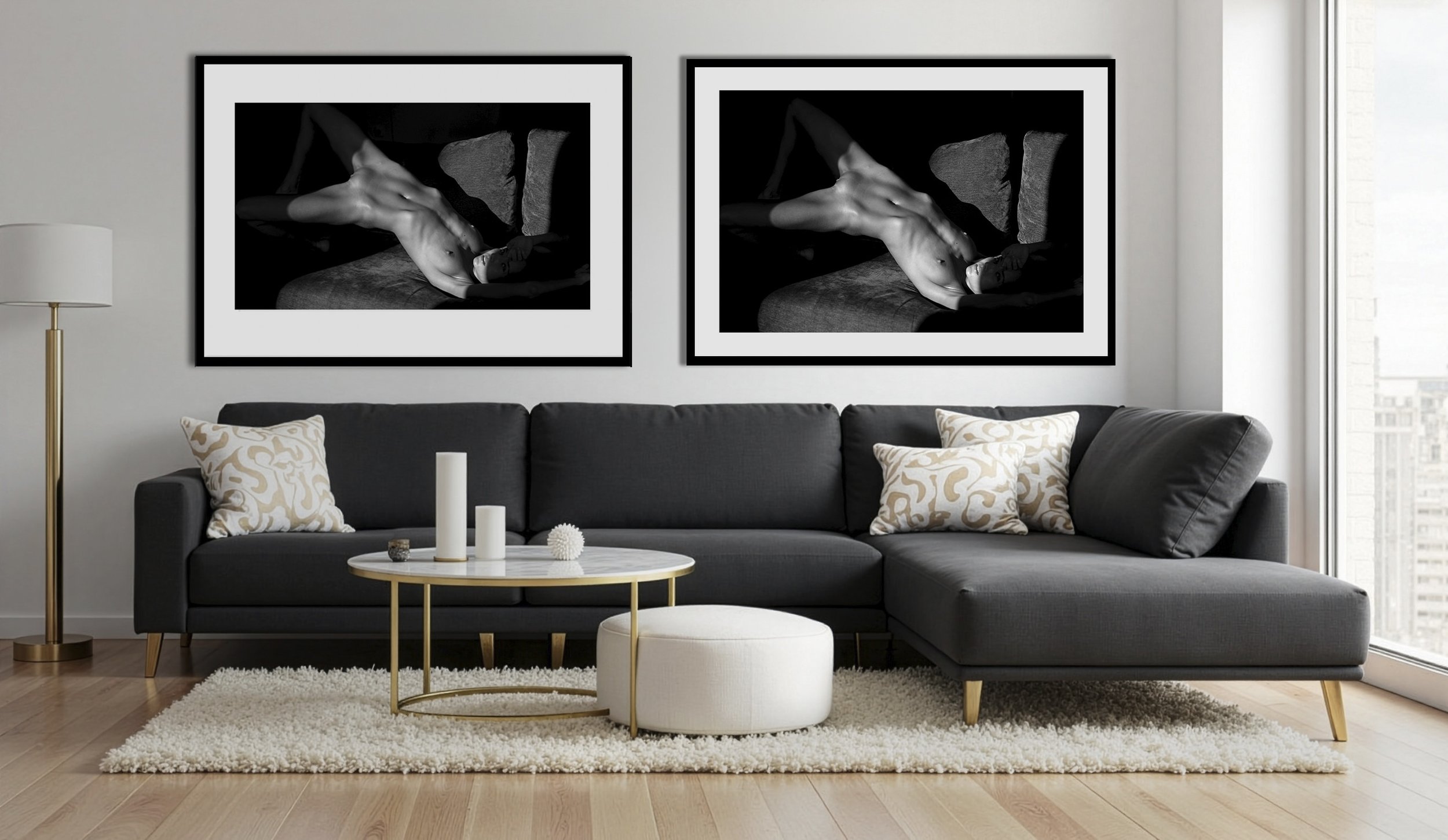
Same frame size: 70×100 cm. The passepartout on the right has a 59×89 cm cutout, with even 5.5 cm borders all around. The passepartout on the left has a 49×84 cm cutout and uneven borders: 7 cm on the sides and 10.5 cm at the top and bottom, which gives it a slightly more dynamic look.
Aesthetically, a passepartout creates a frame within a frame — and that layered separation is deeply associated with how we are used to see art. It signals that what's inside is important, considered, set apart from everything around it. But beyond that classical association, a passepartout offers real creative flexibility. It can alter the perceived proportions of an image, introduce color, and add a sense of depth and dimension. A beautifully crafted passepartout can elevate even an average print into something that reads unmistakably as art.
The case against is essentially one of scale and simplicity. A passepartout adds bulk, cost, and complexity — and at Epicor Titan scale, it can feel unnecessary. At that size, the image commands the room on its own terms, and a mat border risks breaking the immersive illusion rather than enhancing it.
Framing. Framing is a vast subject with no shortage of opinions, but the core principle is straightforward: a frame should protect the print, allow it to be stored and displayed safely, and either disappear into the background or become an art form in its own right.
Most frames fall somewhere on a spectrum between two extremes. At one end, the slim industrial aluminium frame — minimal, utilitarian, with no personality of its own. At the other, the ornate gilded wooden baroque frame, which competes with the image for attention rather than serving it. Between them lies a wide range of options — natural wood, plastic, silver, copper — each suited to a different interior and aesthetic sensibility.
One practical detail worth knowing before you choose: not all frames are built the same depth. Some can only accommodate a print, while others have the internal space to hold a print and a passepartout together. If you plan to mat your print, check this before buying a frame. A beautiful frame that can't accommodate a thick passepartout will leave you choosing between removing the glass or abandoning the mat entirely.
Glass. A final detail that can make or break everything that came before it is the glass. Standard glass will undermine even the most premium print. Reflections take over and you end up looking at the room rather than the photograph - you’ve got yourself another mirror. The solution is either matte acrylic or museum-grade anti-reflective glass, both designed to protect the print without getting in its way. Neither option is cheap, but both will let the print show its true quality
Another option is no glass at all. Our prints are made on premium, award-winning papers using the latest pigment inks, producing a lifespan of at least 70 years unprotected — and many papers rated up to 200 years. UV-protective glass can extend that further to around 400 years — though at that point, there will be no one left to verify the claim
What actually threatens an unprotected print is more immediate: humidity, airborne gases, and physical accidents that can damage the surface. If you can reasonably control those conditions, going glassless is a legitimate choice — and it preserves the full tactile and visual quality of the paper in a way that even the best glass cannot.
Going glasless will also reduce the cost of custom framing. But don't use it as a cost-saving hack. Only choose it if you genuinely believe that glass is getting between the viewer and the work, and you are better off without it.
SHIPPING AND HANDLING.
One last practical matter before you order. All BBB prints are shipped rolled in a tube. It's the most efficient way to transport large-format prints, but it's not the most convenient way to receive them. You'll find a heavily curled print that has no interest in lying flat. Given that most large-format printers work from large rolls to begin with, the curl is already there before it even enters the tube, and several weeks in transit just adds to its curl.
For smaller sizes it's a much less of an issue. For larger prints this can be a genuine challenge — a tightly curled Epic or Titan can be difficult to fit into a frame without a fight. The simplest solution is to take the tube directly to a frame shop and let them handle it. Most framers will mount a print for a small fee if you're buying a ready-made frame from their store. If you're going the passepartout route, expect a higher cost and a turnaround of a few days rather than same-day service.
If you'd rather handle it yourself, roll the print in the reverse direction around the tube and leave it for a few hours under some weight — otherwise it will simply spring back. Place a layer of soft tissue paper, flower wrap, or clean gift wrap between the print and anything it touches while you work. Just make sure whatever you use is clean, flat, and crease-free. Large prints can be stubborn, and any fold or bend risks leaving a permanent mark on the surface.
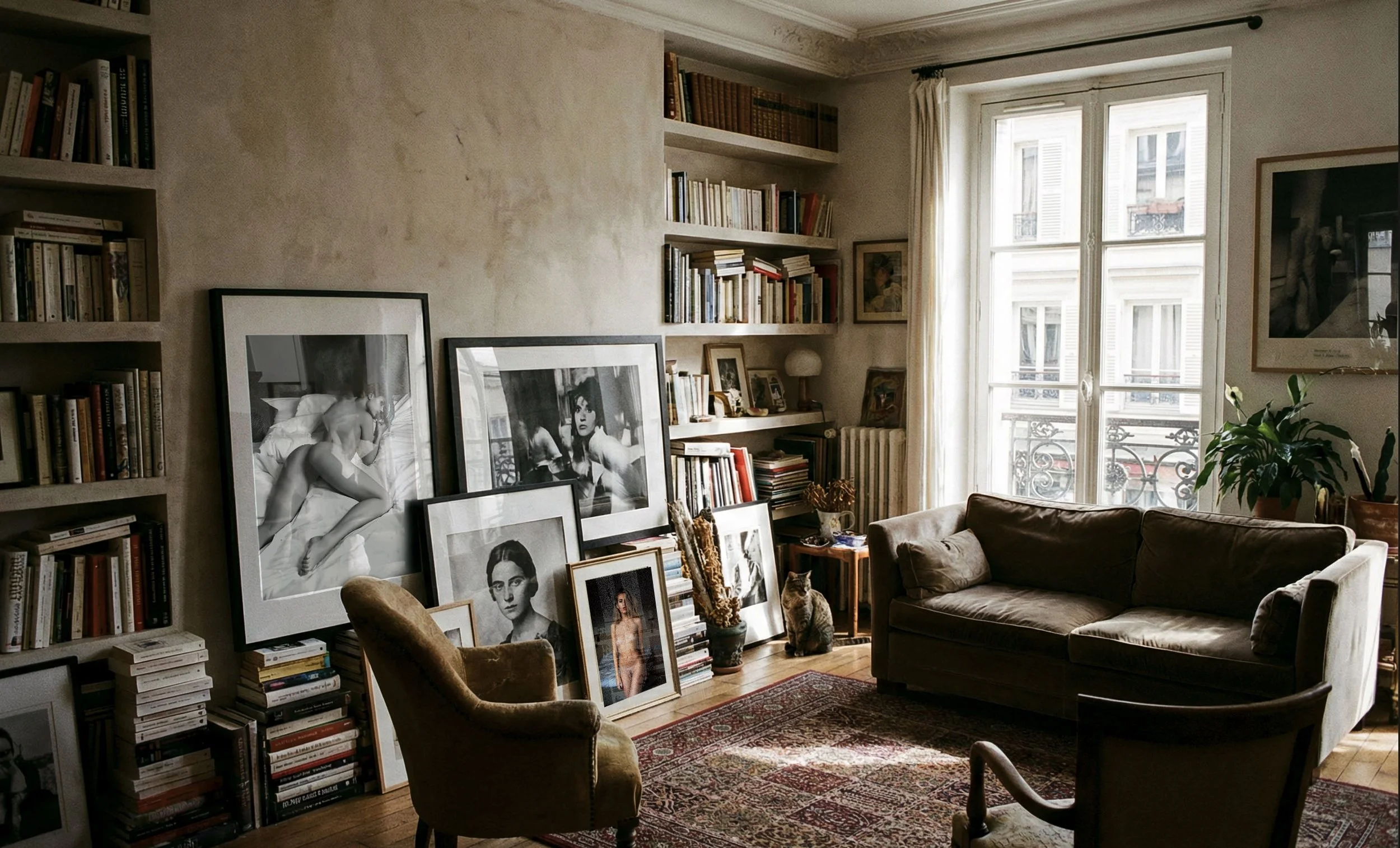
One way to display large prints is to let them stand on the floor, which emphasizes their scale and physical presence.
One final tip: think about where the print will hang before committing to a spot. A new large-format print often triggers a rearrangement of everything around it, and that's not a bad thing — it's part of the process. But consider letting the print stand on the floor for a while, leaning against the wall, before you decide on its permanent home. Let it settle into the room.
But there’s also a case for letting a work live permanently as a floor-standing piece. Many art galleries and design-led hotels use this approach deliberately: it projects a kind of casual confidence that a perfectly hung print can sometimes lose. Aesthetically, the free lean can feel relaxed, contemporary, and assured. By contrast, once something is fixed to the wall it can feel too final, too settled, and therefore too easy to stop seeing.
This can suit large prints especially well, since their scale already pushes them toward being an installation, not just a neat print. It also changes how your body meets the work. A large print hung high can create a polite, sterile, museum-like experience. A large print leaning against a wall invites a different kind of attention and interaction: you can step closer, view it from different angles, touch it and even lift it. It starts to feel closer to visiting an artist’s studio, where finished and unfinished works share the same space - nothing is settled, everything is open for an interpretation. This kind of experience of viewing an art can engage far more than a static wall-hung frame. But it’s not automatically the best choice for every space, it is just one option to consider.
The tradeoffs are obvious: that same open interactivity makes the work easier to damage, so solid framing and glazing become especially important to protect it from dust, bumps, and everyday life.
That is all for now. Be bold!
For questions, feedback, for larger orders, custom sizes and custom framing, or prints on materials other than paper (metal, plexiglass, etc.), use contact us form.