

On Nielson and Halbe Frames
Out of every question we get post-sale, one keeps rising to the top: what frames do you recommend? We already have a guide for selecting a frame, but after years of testing and living with frames, I felt there was space for a more personal recommendation. This is a piece about the frames I actually have on my own walls. It is clearly biased and limited in scope, but consider it a starting point for your own discovery to find what works best for you.
A quick note. I want to be transparent: this is not a sponsored article. No money or incentives of any kind have influenced these recommendations. Anything I say or recommend comes from personal experience. Furthermore, Nudicci is based in Sweden, so this guide is written with EU countries in mind. Other regions may have their own excellent manufacturers, but the principles outlines here should be the same. I'm also sticking to ready-to-hang frames only. Custom framing is a different topic, and honestly, not one I use much myself. I have more prints than frames, so I'm always rotating, and custom framing is really designed for pieces you want to conserve and protect permanently. Once sealed, you can't easily swap it out. It's just not what I need for most of my prints. I stick to ready-to hang frames.
My two favourite manufacturers are Nielsen and Halbe, both German, and both chosen for the same reason: quality. Yet they've taken very different approaches to distribution. Halbe is online only, while Nielsen has a website but no online store, you buy through retailers. Let’s take a look at both of them.
Nielson frames
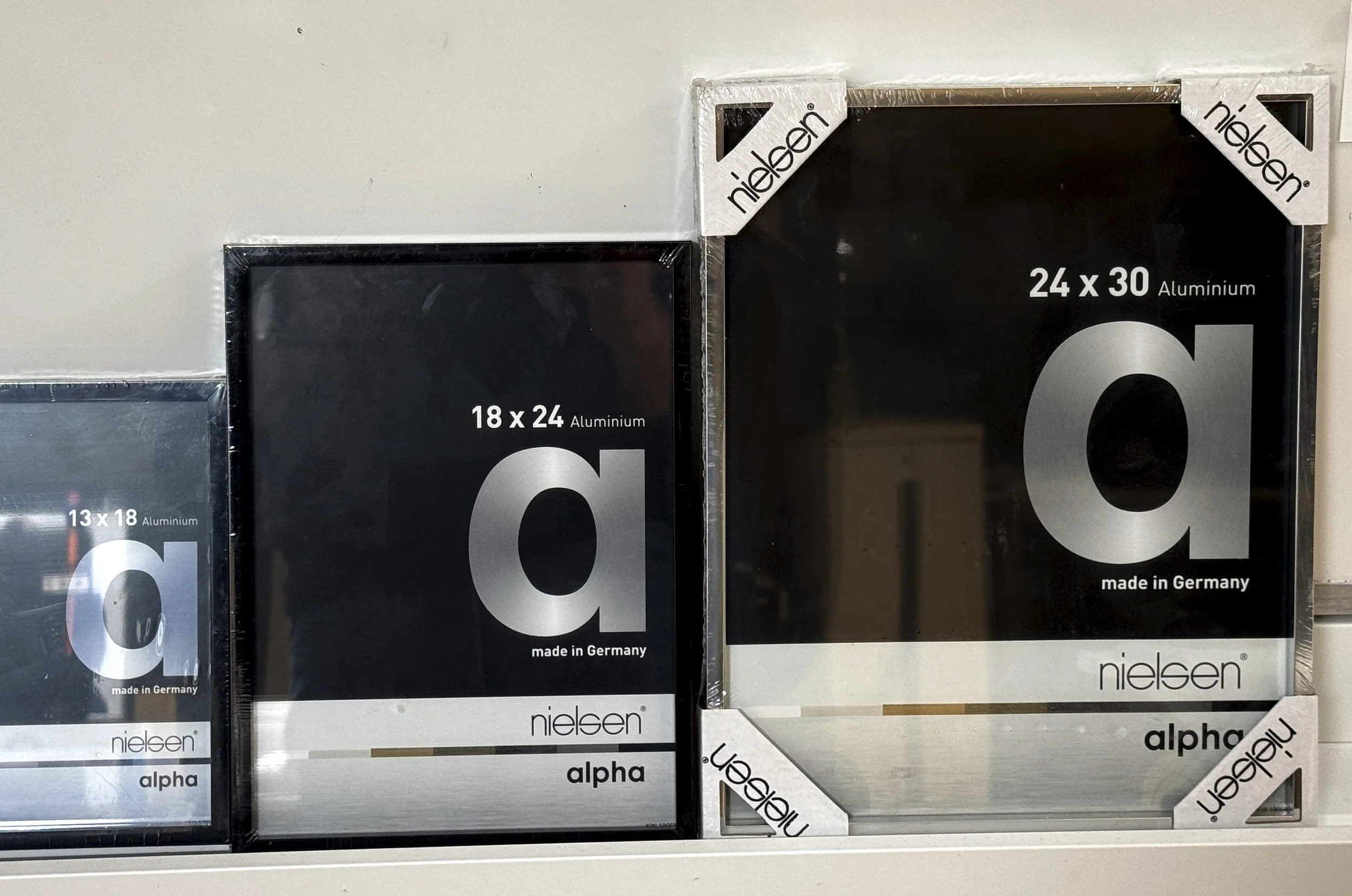
Nielsen’s premium Alpha line.
Nielsen is widely available in frame stores across Europe - you can walk in and see them before you buy. This is a great advantage when starting out on your frame hunt. Getting a feel for a frame in person is invaluable. Their product range spans across several tiers. At the top are the Alpha line for aluminium frames and Quadrum for wood. These are premium, top-of-the-line frames that look and feel the part. The designs are smart and durable, built for the kind of repeated opening and closing that comes with regularly swapping prints. Nielsen frames are highly recognisable due to their distinct use of brushed metal surfaces. Even frames from 20-30 years ago found in thrift stores are unmistakably Nielsen - that brushed aluminium or gold finish is a signature that hasn't changed.
While Quadrum is a solid wood frame, Alpha is primarily an aluminium line, though a few versions come with a wood veneer finish, giving them the look of wood with the strength of metal. The finishing, whether aluminium or wood, is exceptional. I use these frames for my favourite prints, and I'm always struck by how much better a piece looks inside one.
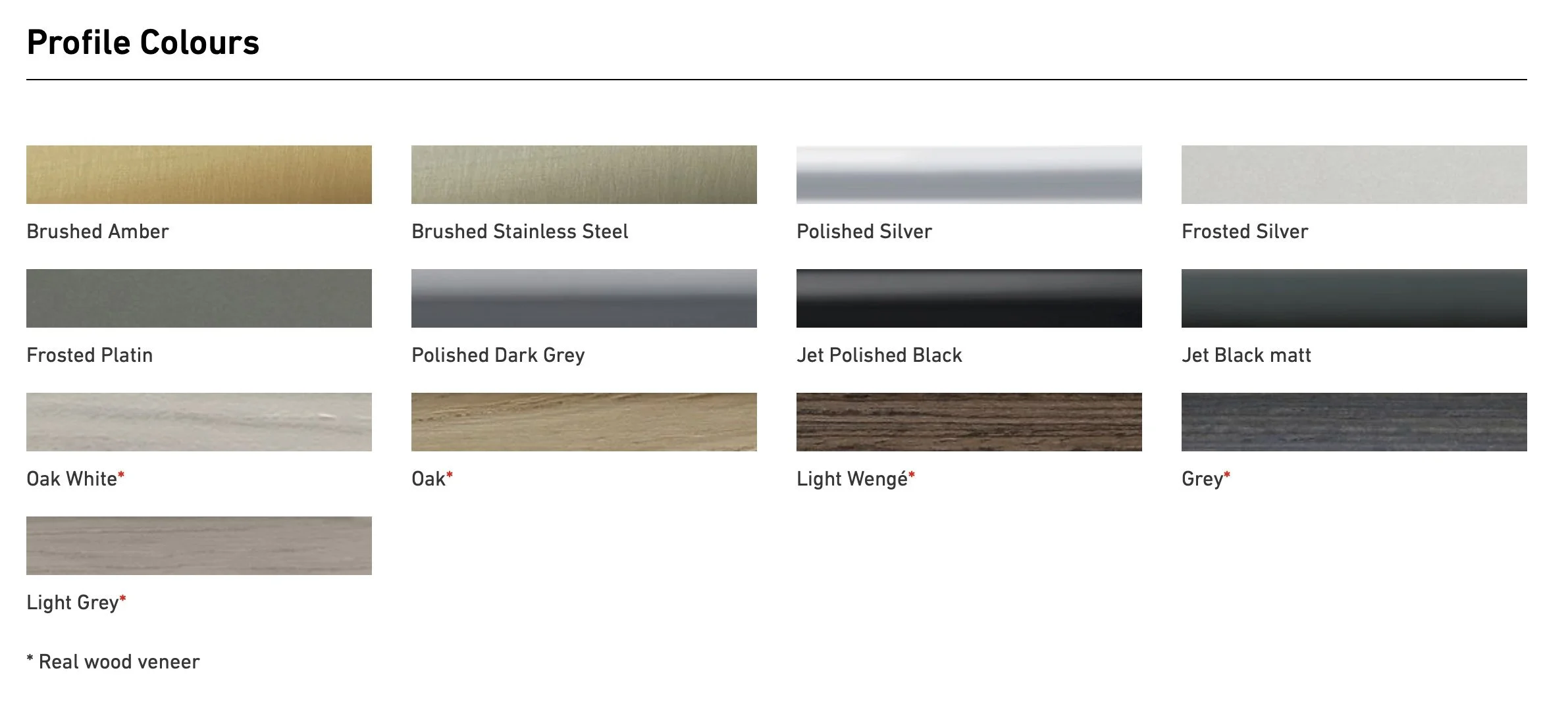
Nielson’s Alpha line: aluminium frame colors. All frames have 7.8mm profile.
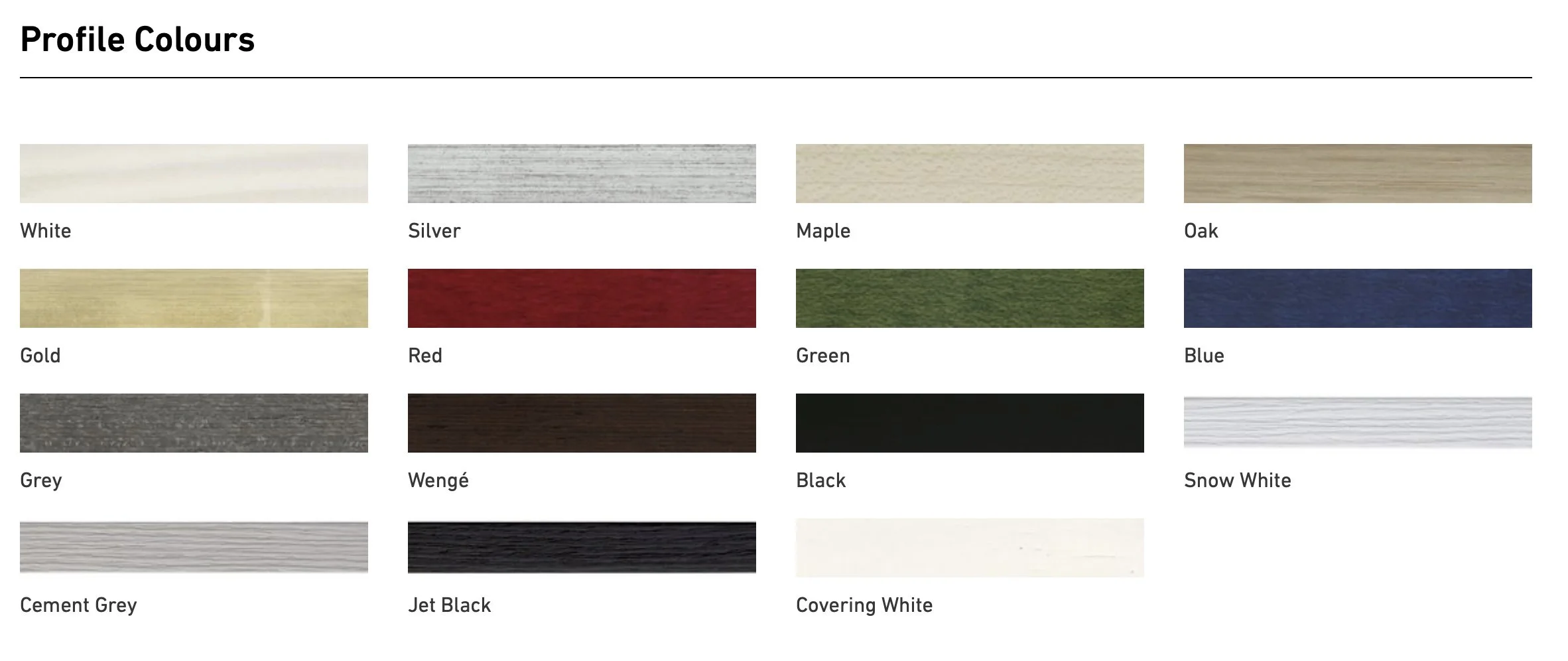
Nielsen’s Quadrum line: types of wood and colors. All frames have 16mm profile.
Step down to the mid-tier Classic and Pixel lines, which offer more colour options and a slimmer design. Both are less prominent than Alpha, but what they lose in presence they gain back in colour options, and both will accommodate a print with a standard passepartout without any issues.
The Classic line is essentially a smaller sibling to Alpha - sharing many colours and finishes, the same lock-in mechanism, and a similar price point, with Classic coming in around 10% cheaper. So the choice between them is less about price and more about profile, size, and colour. The Pixel line is cheaper still, and offers a different design altogether — slimmer, with a bevel towards the image. Due to that slim profile, Pixel is not available in sizes larger than 60×80cm. I never had Pixel, so can’t really say much about it.
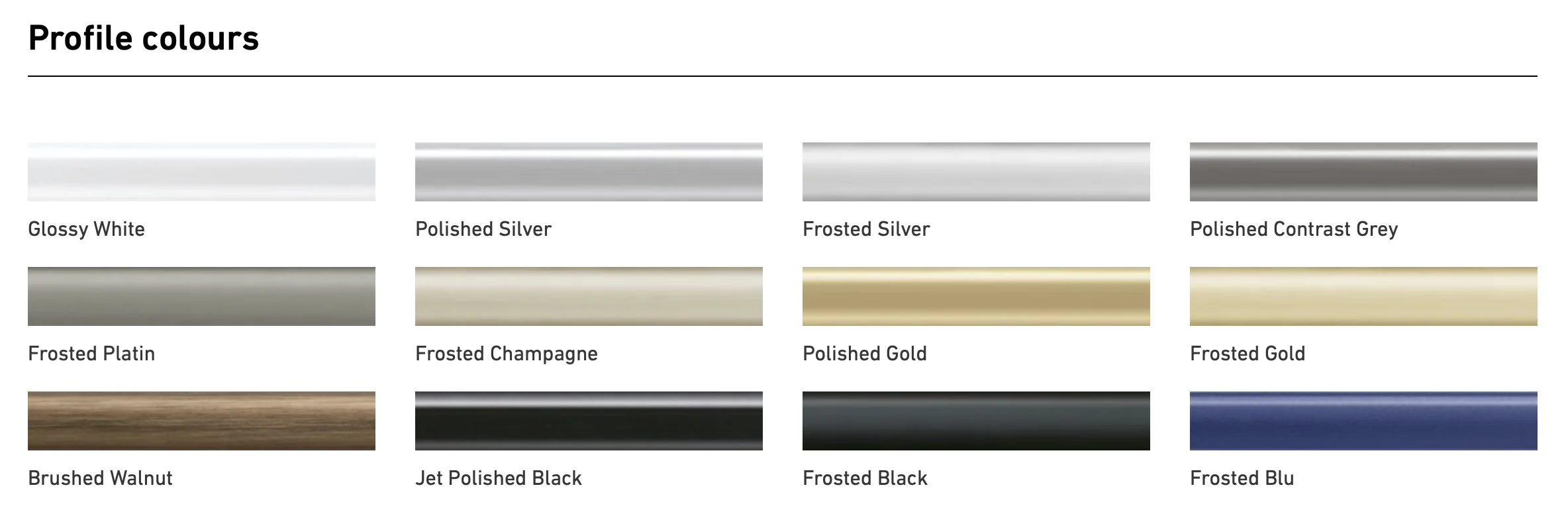
Nielson’s Classic line frame colors.
At the bottom sits the budget-friendly Accent line. It is closer to a generic store-branded frame than to a genuine Nielsen, though the quality is still solid and reliable. Accent comes in just 7 basic colours and without a brushed metal finish. The frame is slim and can only accommodate about 2mm of depth, which should be enough for most passepartout mounted prints. I use Accent as test frames — for trying out a new size or when I just need something framed for protection and storage. They're not where my favourite prints end up, but costing 3-4 times less than the Alpha line, they're absolutely worth considering.
Beyond these five lines, Nielsen has at least as many more — lesser known and often market specific. The five I've covered should be available in most well-established frame stores.
Nielsen has a strong reputation, and that trust is well earned - whichever line you choose, you'll end up with a good frame. Personally, I had to buy across all the lines just to understand the real differences between them. What I found is that size matters: at 30×40cm, there's hardly any difference except in colours and finishes. But at 50×70cm and larger, the quality that Alpha stands for becomes hard to ignore. If you think of a frame as serving three functions — protecting your print, isolating it from its surroundings, and adding value to it — then Alpha does all three perfectly. Any print that goes into Alpha frame just looks so much better. If you have a budget, go for Alpha — you won't regret it. If money is tight, I'd consider a new Classic, or hunt for a used Alpha.
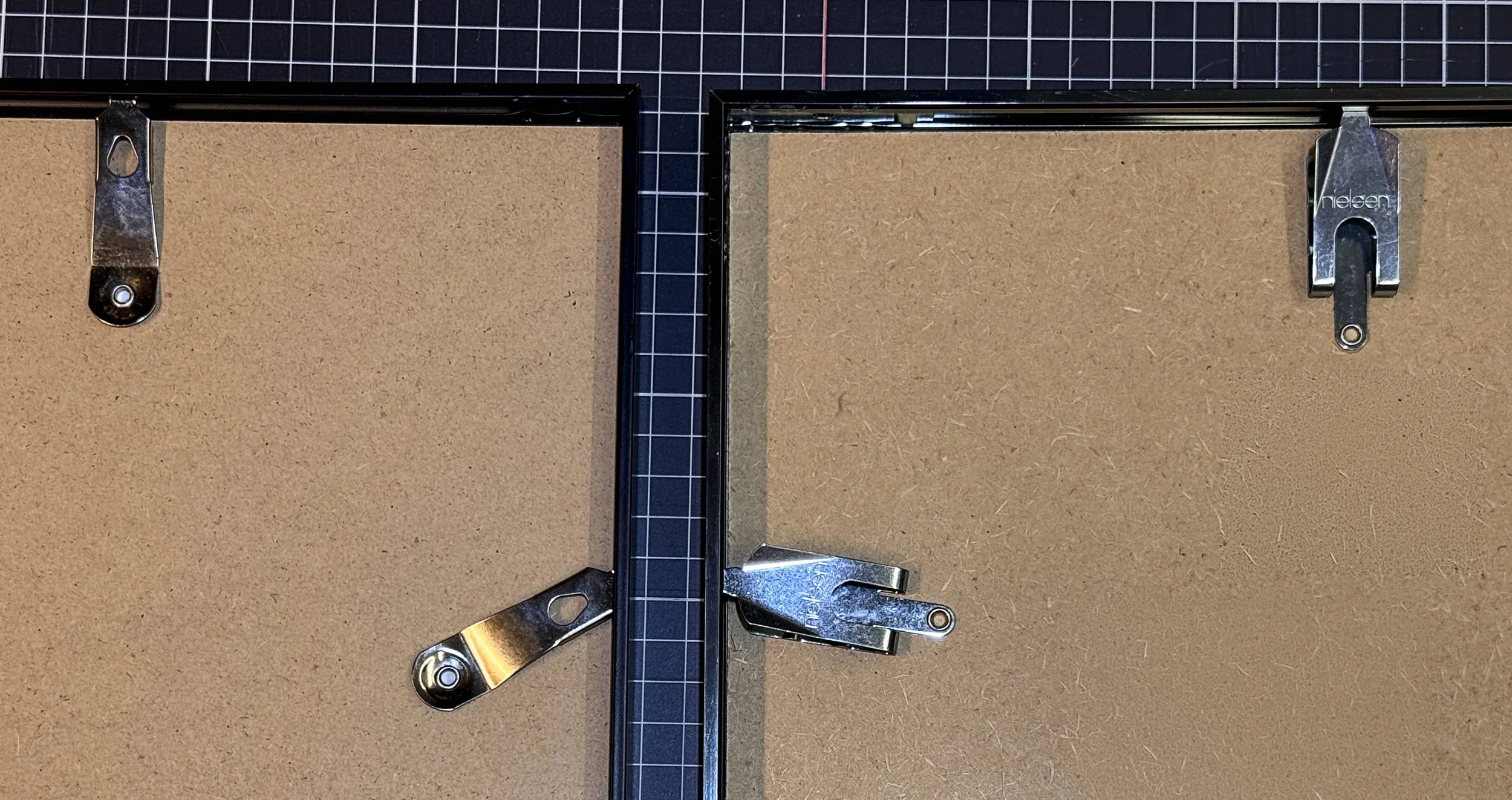
Nielsen Accent on the left, Nielsen Alpha on the right. The sturdier build quality of the Alpha is immediately visible.
As I mentioned in the intro, wide availability is a big part of why Nielsen is so easy to recommend. These are high quality frames you can see for yourself in store and compare against other options in person. But they do have one significant limitation: a complete lack of customisation. You can't change the glass type, or adjust the profile or insert depth. You just have to settle for what's available, and if it doesn't work for you, well, bad luck then. And that's exactly where Halbe comes in.
Halbe frames
Like Nielsen, Halbe offers many types of frames — fireproof, conservation, object framing, and standard fine-art (Classic), which is what I use. They sell exclusively online. At least, I've never come across them in any store. Ordering online might feel like a leap of faith at first, but I promise you they're worth it. Halbe has an extensive knowledge section on their website, with guides and visuals covering everything you need to make an informed decision before buying.
So what sets Halbe apart for me? Two things: customisation and unique design. Halbe is the only frame I know of that uses magnets to hold the front to the base, which means you can swap prints from the front without ever taking the frame off the wall. For anyone who rotates pictures frequently, this is a game-changer. Taking a frame off the wall, opening it, swapping the print, hanging it back, and straightening it again — it's all tedious. With Halbe, you can do it all directly on the wall, if that is what you want.
With Halbe’s design, you can also store unused prints behind the one on display. I find it a really convenient way to keep my rotation ready to go. If you have several large prints, where do you store the ones not on display? It was always a headache for me to keep prints safe and flat without them getting bent or damaged. Storing them in Halbe frames eliminated that problem entirely. Naturally, you can store unused prints in some Nielsen frames too, but they weren't designed for this use case in mind.
As someone who both prints and displays a lot of work, Halbe's storage and swapping convenience is a big part of the appeal for me personally. But setting that aside, Halbe is more expensive than Nielsen — so is it worth it? For me, yes, but not always. Many times I've had to replace standard glass on a Nielsen frame with a reflection-free type, and there's simply no smooth way to do it. With Halbe, you choose the glass type, the depth, and even add a custom passepartout from the start. So for me, Halbe is a complete framing service that can accommodate all my needs. Nielsen is a premium frame that I love, when it fits.
To summarise - the key benefits of Halbe frames for me are the convenience of storing and swapping prints, and a level of customisation that Nielsen simply can't match. And it's that customisation we'll be covering in the next section.
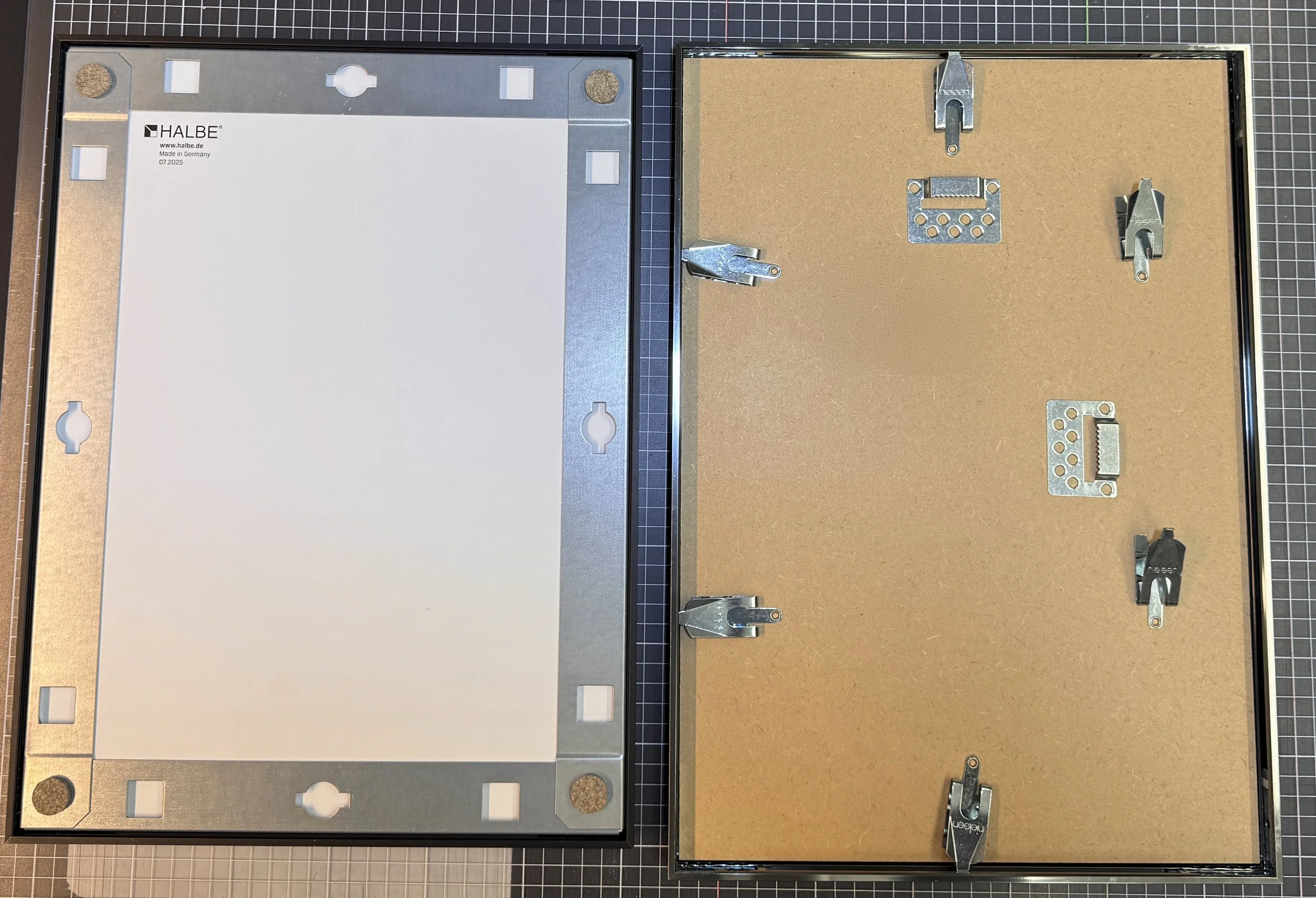
The backs compared. While the front of a Nielsen and Halbe frame may look similar, the back of a Halbe is unmistakably different — it's completely sealed, because you're meant to open it from the front.
Halbe’s configurator.
Halbe has gone to great lengths to create a truly fully customisable frame-building experience. The options can look a little intimidating at first, but they are well explained with help text, knowledge articles, pictures, and videos. Let's walk through a few of them.
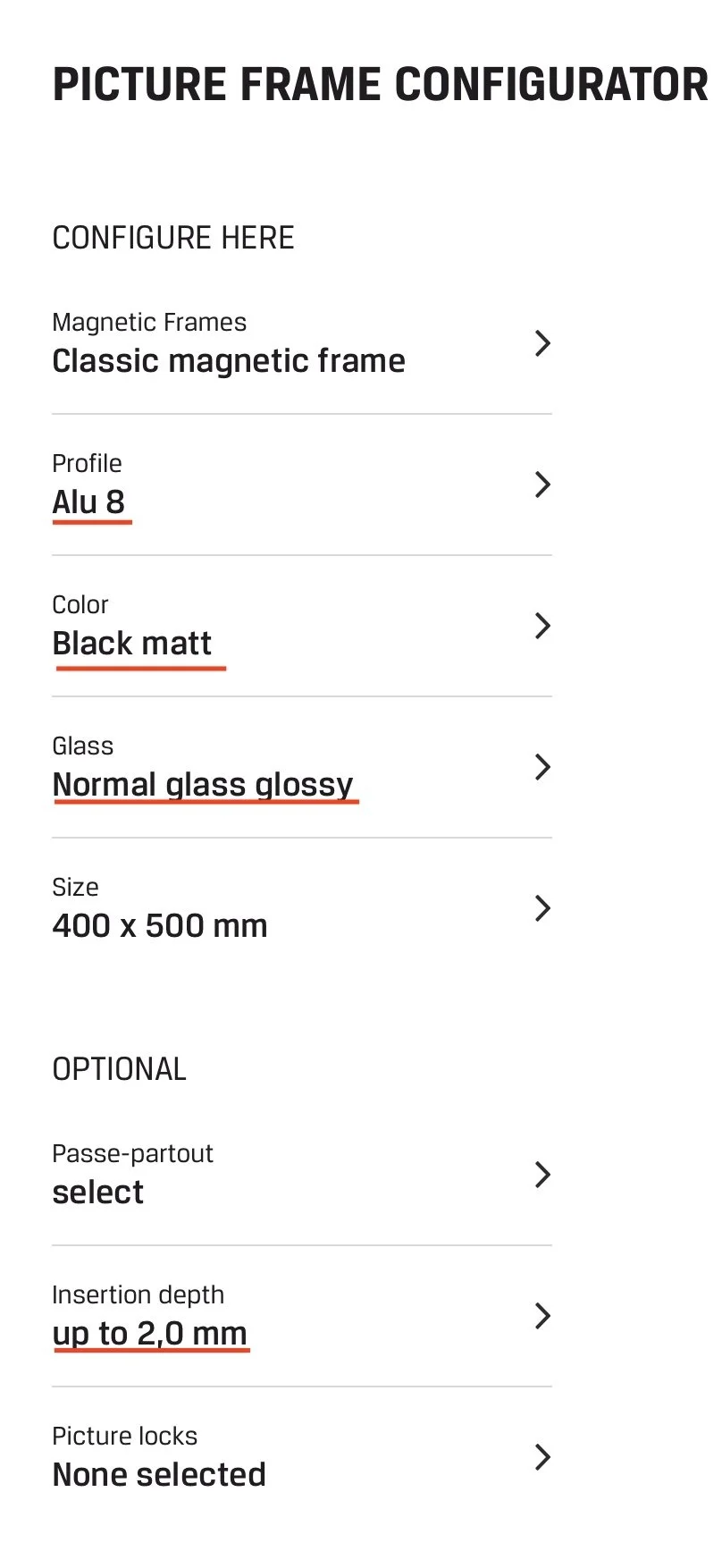
To start, go to Halbe’s website and select Frames in the menu, then Frame Configurator. For the frame type, I always go with the Classic Magnetic Frame — which is also what's preselected by default.
Halbe’s Picture Frame Configurator.
Profile. This is where you select the frame type. See the section below for more details.
Colour. Choose from the available colours for your selected frame type.
Glass. Choose from 9 types of glass. See the overview further down the page.
Insertion depth. This is where you select how deep the frame needs to be, up to 14mm. An average print in a passepartout is about 2mm thick. If you want to store extra prints behind, go for a larger depth. Keep in mind that some glass types are thicker and will eat into the default 2mm gap. I usually order at least 5mm depth, which gives me room to store one extra mounted print, or 5-7 unmounted prints behind the one on display.
Passepartout. One of Halbe's genuinely unique offerings is the ability to create a custom passepartout — you can specify your own opening size and position, which is a service that's hard to come by. The default thickness is 1.5mm, but for larger pieces you may want to go to 3mm, which is what museums typically use - it adds extra depth, but also offers a better protection. If you opt for a folded passepartout (with the backboard), this adds another 1mm to the total thickness, making your package 2.5mm — something to factor in when selecting your insertion depth. Halbe got a nice guide for creating a custom-made passepartout.
Picture hooks. These are designed as theft deterrents. Because Halbe frames open from the front without needing to be taken off the wall, they could be an easy target for art theft in public spaces. Halbe has thought of this and offers both a locking system to prevent the frame from being opened and a mechanism to stop it being snatched off the wall entirely. I've never needed these myself, but it's great that the option is there for those who need it.
Make it truly your’s.
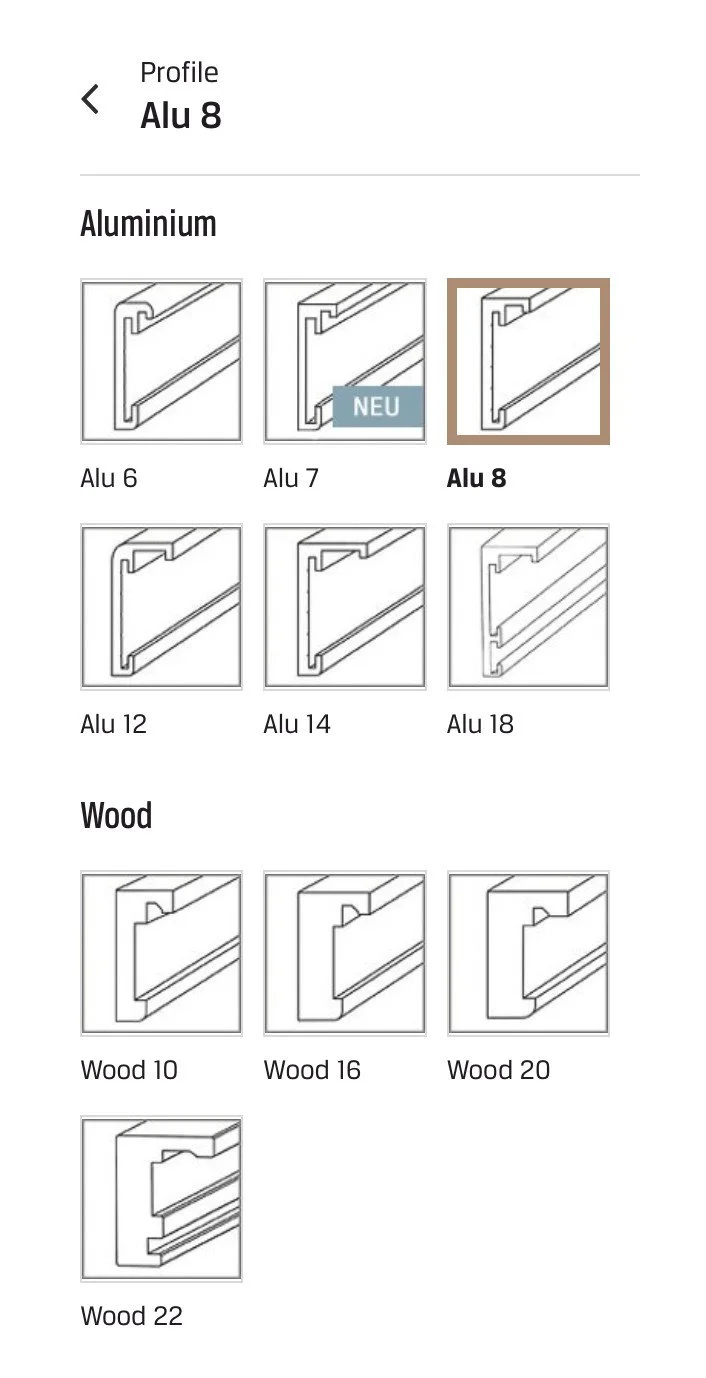
The frame selector is organised by type, with the number indicating the width of the frame's edge. Think of it as how much frame you want to see: should it be part of the artwork, or simply a carrying structure? The larger the number, the more prominent the frame: not just wider, but with a larger overall footprint too.
For example, Alu 6 has a slim 6mm edge. It covers just a few millimetres of the print and adds very little to the overall size, so a 50x70cm print becomes roughly 50.5x70.5cm when framed and is hardly draws any attention. Wood 22, by comparison, has a 22mm edge, covers about 1cm of the print on each side, and adds around 2cm to the total dimensions — making that same 50x70cm print approximately 52x72cm. It is a big frame, and definitely noticeable. For the reference, Nielson Alpha line has 7.8mm profile, while Nielson Classic is 9.5mm.
On weight, aluminium frames are the heaviest, while wood frames are lighter — though the type of glass you choose will also play a role in the total weight.
For wood frames, Halbe has a story behind each type of wood used - a short profile of each wood and where it comes from.
Color wise, wood frames offer a few more options. Frame colour will influence how thick a frame should be. For example, a thin gold frame can be elegant, but a thick one will draw too much attention. Luckily, Halbe's website has great visuals to help you see the full range before deciding.
Aesthetics are a matter of taste, but keep in mind that larger prints benefit from a more substantial frame. Choosing Alu 6 for a 100x140cm print might feel too flimsy, while Alu 18 can start to look too heavy. Personally, Alu 12 or 14 would be my choice. Notice, that Alu 12 and Alu 6 have a different curved edge design compared to the rest of the range. This is worth keeping in mind if you want a consistent look across all your frames.
Type of glass
The type of glass can make or break a frame. Reflections can kill a great print, and easily scratched plexiglass can ruin the premium feel the moment marks start showing. With Nielsen frames, if you want reflection-free glass you have to buy the frame with standard glass first, then purchase museum glass separately and swap it out yourself. Why not just have the right glass from the start? That's exactly what Halbe offers and you can choose between many different types of glass.
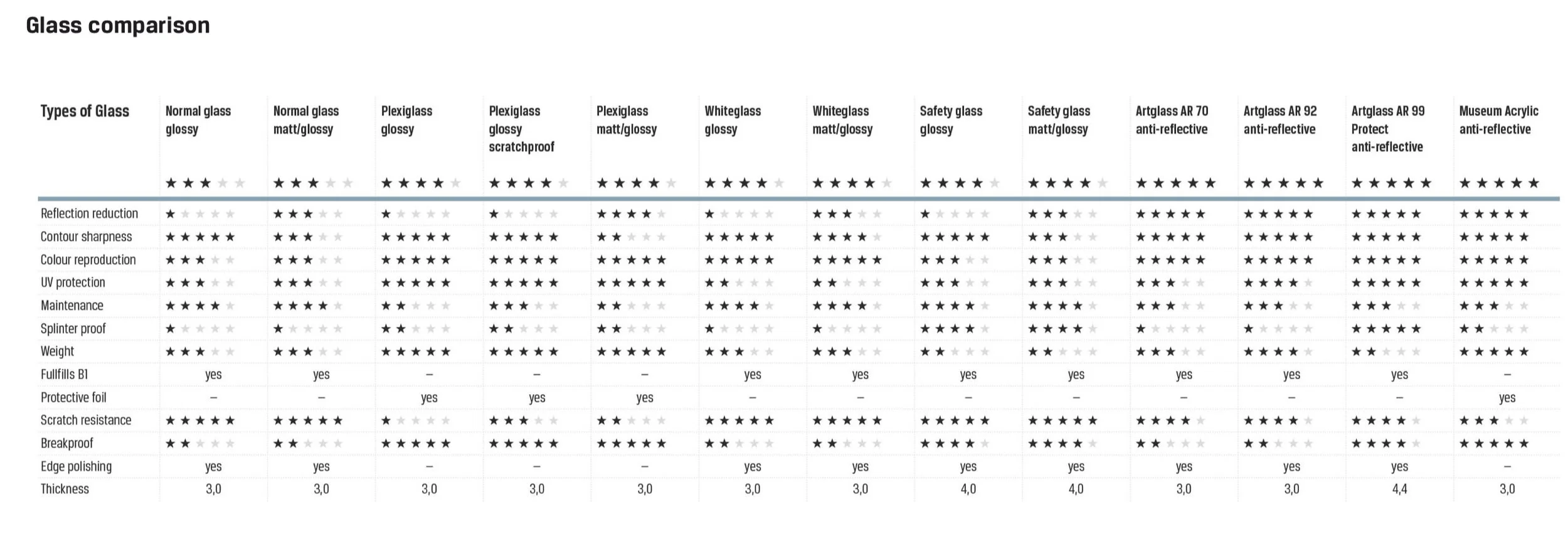
Glass comparison table by Halbe. There is also an extensive glass selection guide by Halbe here.
Get Halbe’s sample packs
Selecting a frame online isn't easy, even with Halbe’s frame configurator, but there are a few shortcuts. Black aluminium frames are almost universally applicable - they are a safe bet for practiacally any photo. Shiny frames like gold or silver add a touch of dynamism by reflecting light, which may or may not be what you're after, making them a slightly riskier choice. White and platinum matt colours can be very elegant for the right print and environment as they take a step back and don't compete with the artwork. That said, while aluminium frame is a safe choice, at some point you might find yourself wanting something warmer and more natural — wood. Halbe offers four types of wood: oak, alder, walnut, and maple. They come both natural and painted. Honestly, it's genuinely hard to imagine how these frames will look in real life. Few of us are experts in wood grain, texture, and light reflecting properties of a wood, so all the pictures and descriptions can feel rather abstract.
This is where their sample packs come in. For around €50 you can get a sample of their full range: metal and wood frames, glass types, and passepartout papers. Personally, it was some of the best money I've spent, especially when I was stuck deciding on the type of glass I wanted. The physical samples are absolutely worth it.
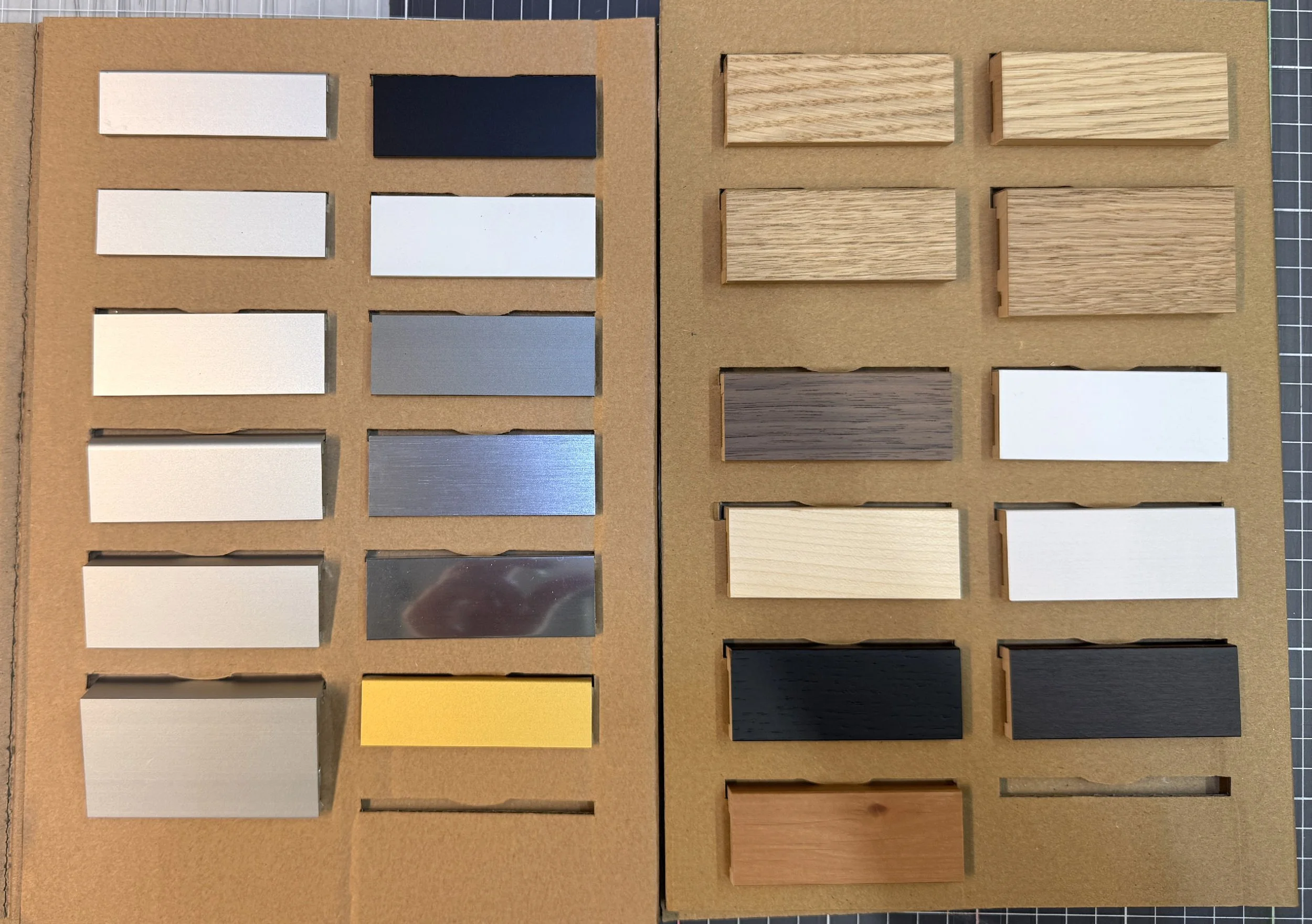
A sample pack is a great way to get a feel for the available materials, shapes, and surfaces. Framing mistakes can be costly, and a sample pack goes a long way in reducing that risk.
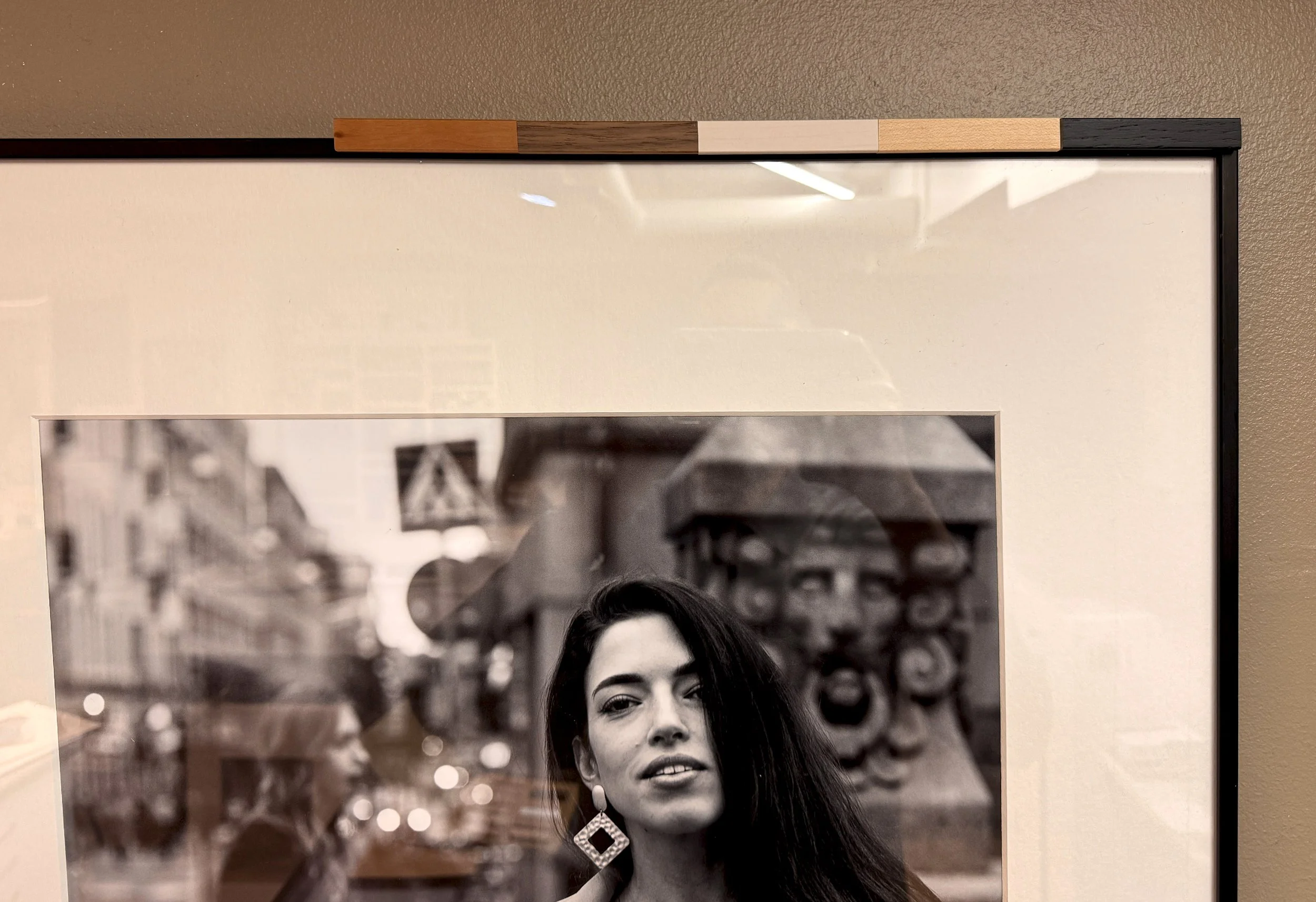
Having a sample pack makes it easy to try different types and colours until you find the one that suits your print and your wall.
A few words on wood frames
A lot of what looks like wood frames are not real wood but MDF or composite materials with a printed wood-effect finish. These are cheap materials designed to look like real wood, but they break, peel, and damage easily. Real wood offers genuine stability and character, but sourcing high quality timber for framing at scale is expensive. The compromise that premium manufacturers have landed on is veneer. Both Nielsen and Halbe use real wood veneer on their wood frames. These are thin sheets of the finest wood layered over alder or pine strips — allowing them to maintain consistent, knot-free quality while using far less raw material than solid wood would require. Veneering has been used for centuries, partly for aesthetics and partly for practicality. High-quality, knot-free timber is genuinely scarce and expensive, so using veneer over a more stable base material is a well-established way to achieve a premium look without the waste or cost of solid wood throughout.
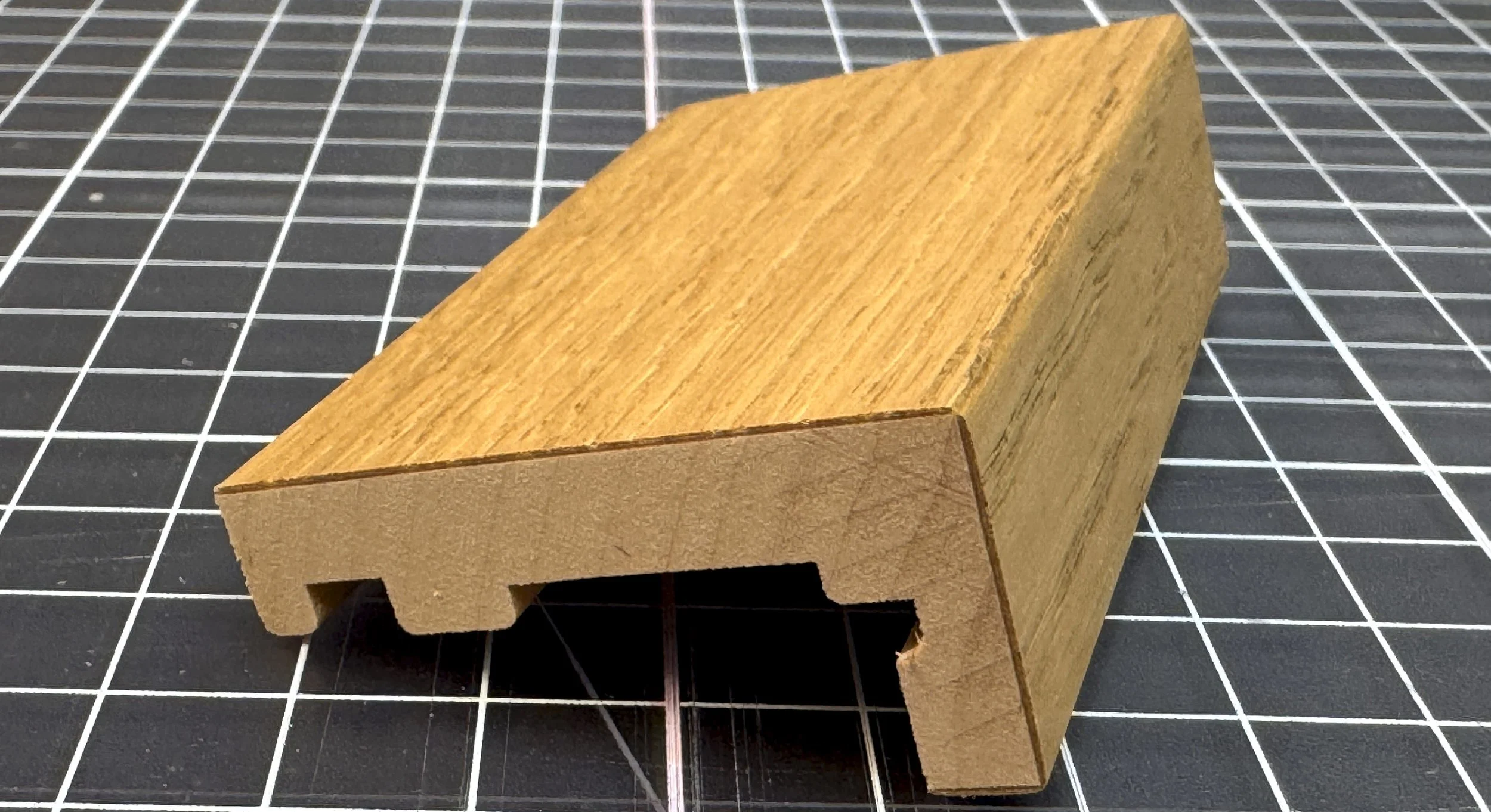
Thin sheets of veneer are layered over alder strips, allowing Halbe to use less premium wood while retaining all the qualities of solid wood. In a finished frame, you would never notice the difference.
Nielsen's Alpha line uses wood veneer on an aluminium frame — it looks like wood, but at its core it's metal. The veneer is purely decorative; it won't behave or age like real wood. Nielsen's Quadrum and Halbe, on the other hand, use real wood veneer — Halbe on an alder base, Quadrum on pine. Neither is a single solid piece of timber (some of the frame are), but both are wood through and through. They will act, breathe, and age like wood. Alpha leads with structural stability and uses wood purely as a finish. Quadrum and Halbe give you the real thing. So which approach is better?
Depends on what you value. Nielsen Alpha is more dimensionally stable. Aluminium doesn't warp, expand, or contract with changes in humidity or temperature. If you're hanging in a room with variable conditions, or you want a frame that stays perfectly rigid over decades, the aluminium foundation is genuinely an advantage. The wood veneer is there for aesthetics only, and that's fine. For conservation and longevity in variable conditions — Nielsen Alpha is probably a better choice.
Quadrum and Halbe give you real wood character — they will age, breathe, and develop in the way wood does. It is a real material, and for many people the authenticity and genuine feel of wood is exactly what they want from a wood frame. But wood can crack, twist, burn, and fall victim to insects or mould. It will not outlast aluminium. But maybe that vulnerability is precisely what makes wooden frames so appealing.
Going borderless? You’ll need the Insert Frame
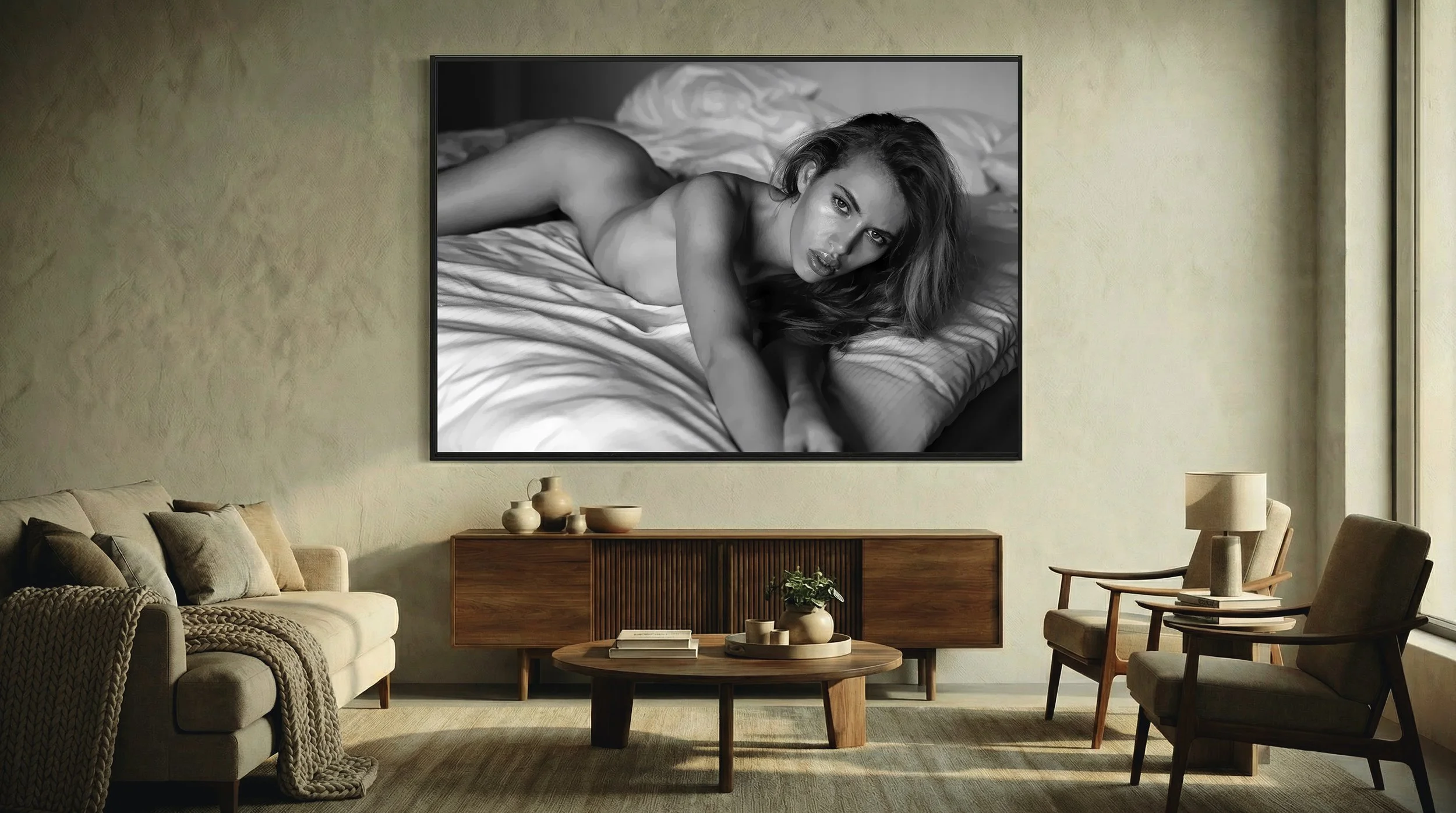
A high quality borderless print should not touch the glass. The standard conservation recommendation is a minimum 2-3mm gap — which is exactly why passepartouts exist. For a borderless print, the way to create that gap is with a spacer or insert frame placed between the print and the glass.
There is one more thing Halbe offers that Nielsen doesn't — insert frames or spacers. Imagine you want to display a borderless print. Prints without a border can look stunning, but there's a problem: without a passepartout, the print sits directly against the glass. Direct contact with glass causes prints eventually stick to it, and glass conducts temperature changes which can lead to condensation and moisture damage over time. This isn't great for longevity, hence keeping artwork away from the glass is standard conservation practice.
The solution for a orderless print is to keep the print away from the glass. That's exactly what an insert frame does. It sits on top of the print's edges, with the glass resting on top of it, creating a 5mm gap between the print and the glass.
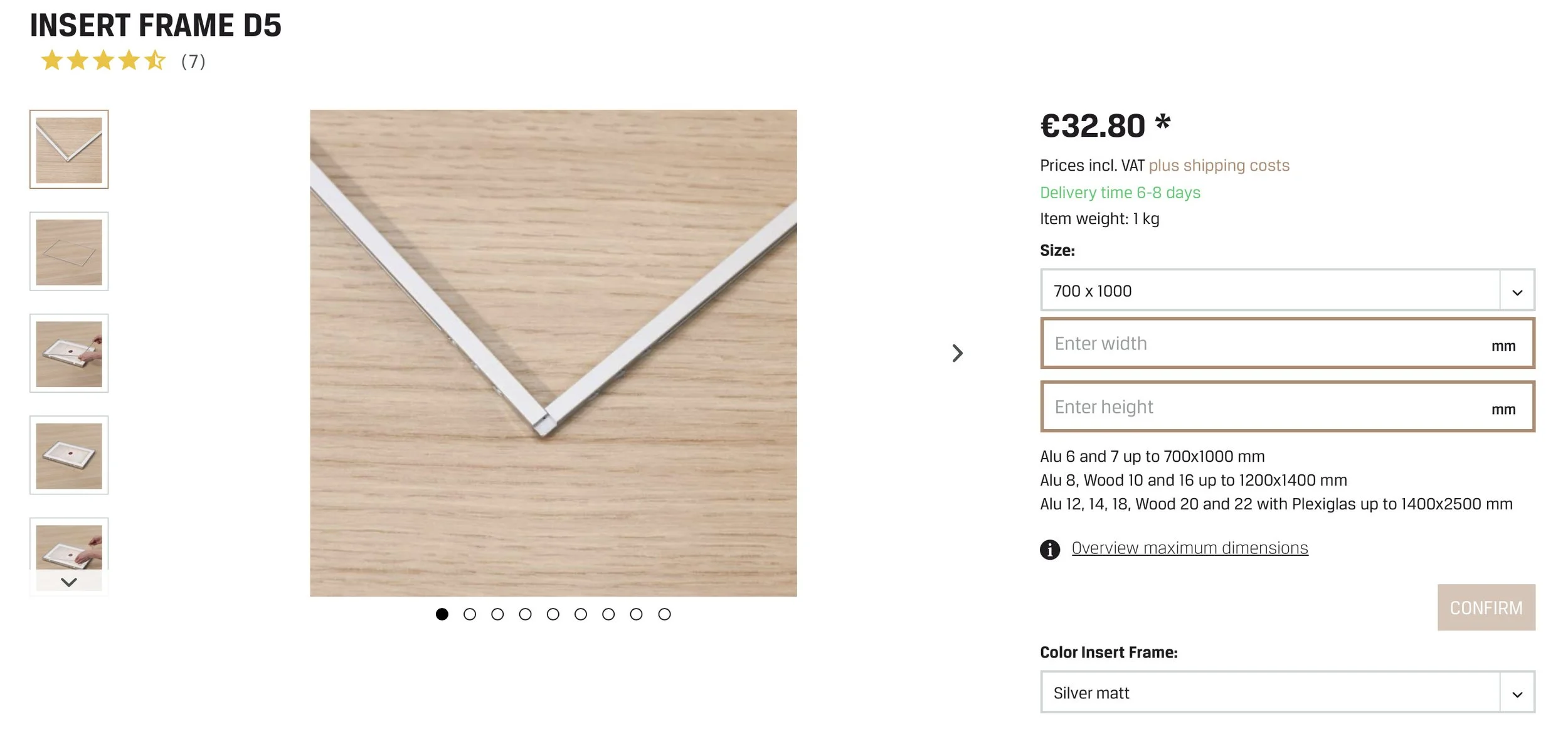
Each insert frame is made specifically for your frame type and size, so you'll need to select the right dimensions and a colour that matches your frame. Keep in mind that not all frames can accommodate an insert — only Alu 12 and above, and Wood 20 and 22. You'll also need to increase your insertion depth by 5mm to account for it. Read more at Halbe.
Other framing options to consider
While Nielsen and Halbe are both excellent manufacturers that I'd recommend to anyone serious about their art collection, it's worth knowing that limiting yourself to their ranges alone means missing out on a lot of exciting choices. Art should be fun and exciting, and sometimes a new frame is all that is needed to bring a new life to your work.
Both brands specialise in modern style framing. These minimalist inspired frames won't draw attention to themselves, but won't add much character either. They're safe bets, largely inspired by the gallery setting: clean lines, neutral colours, white walls. But our homes rarely look like galleries. We have colourful wallpapers, messy bookshelves, creative lamps, cosy sofas, and large TVs. In that context, a polite industrial frame can easily get lost in the noise of our homes.
This is where frames from local manufacturers come in. These are frames that compete for attention — pointed, angular, baroque, Victorian, gilded, carved wood — offering more decorative, ornate styles that frames had before modern aluminium came into fashion. These are also available as ready-to-hang and custom made. The ready-to-hang versions may not be as easy to open or print swap-friendly, and they might not accommodate thicker passepartouts — but they can usually be customised to some degree. The point is that these frames are made for oil, acrylic, or watercolour paintings and sometimes having your print framed in one creates exactly the kind of attention it deserves.
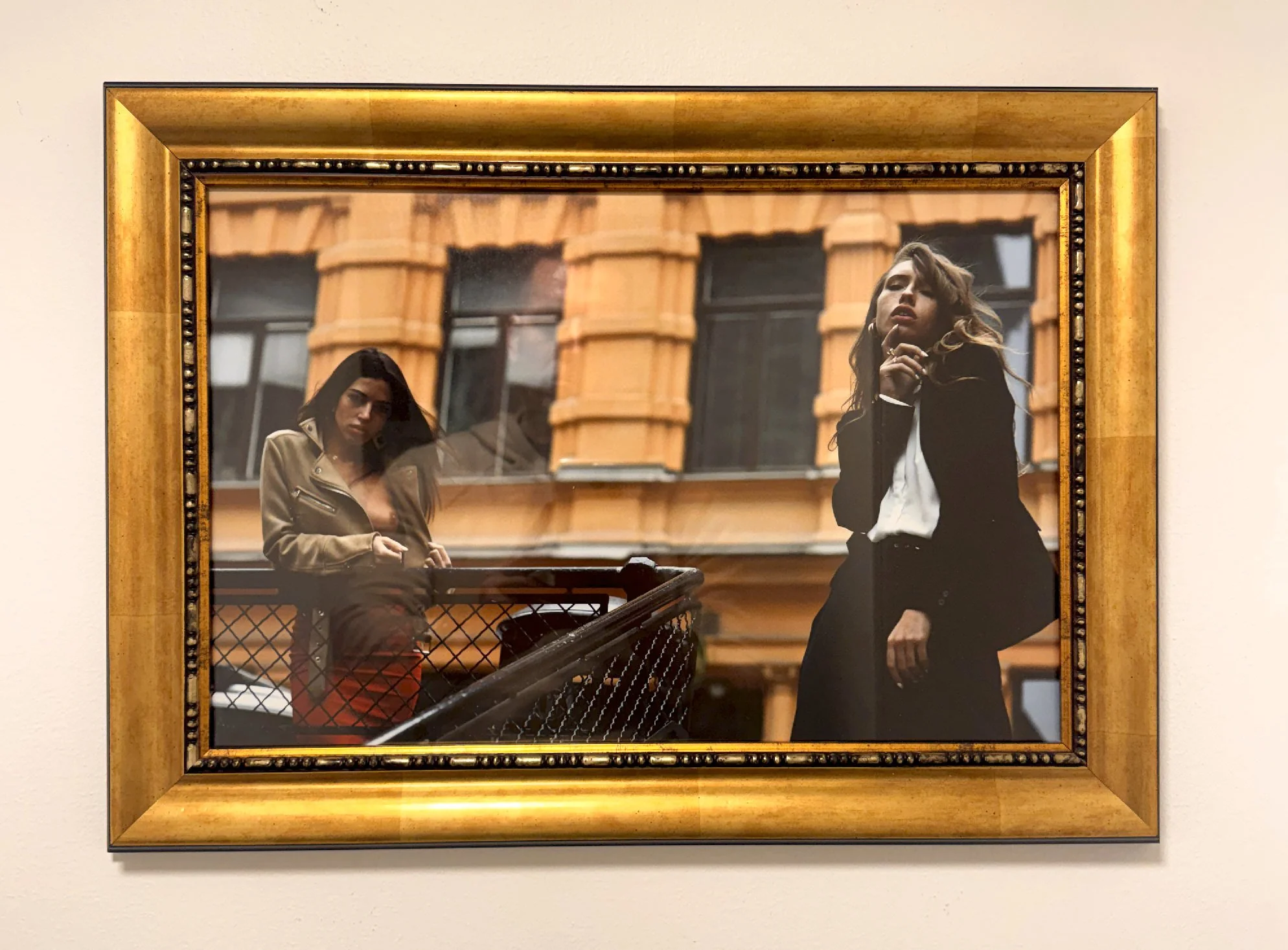
Don't underestimate what a creative frame can do for a print. Here, a gold frame echoes the building behind it. This frame would look even more stunning against a dark wall.
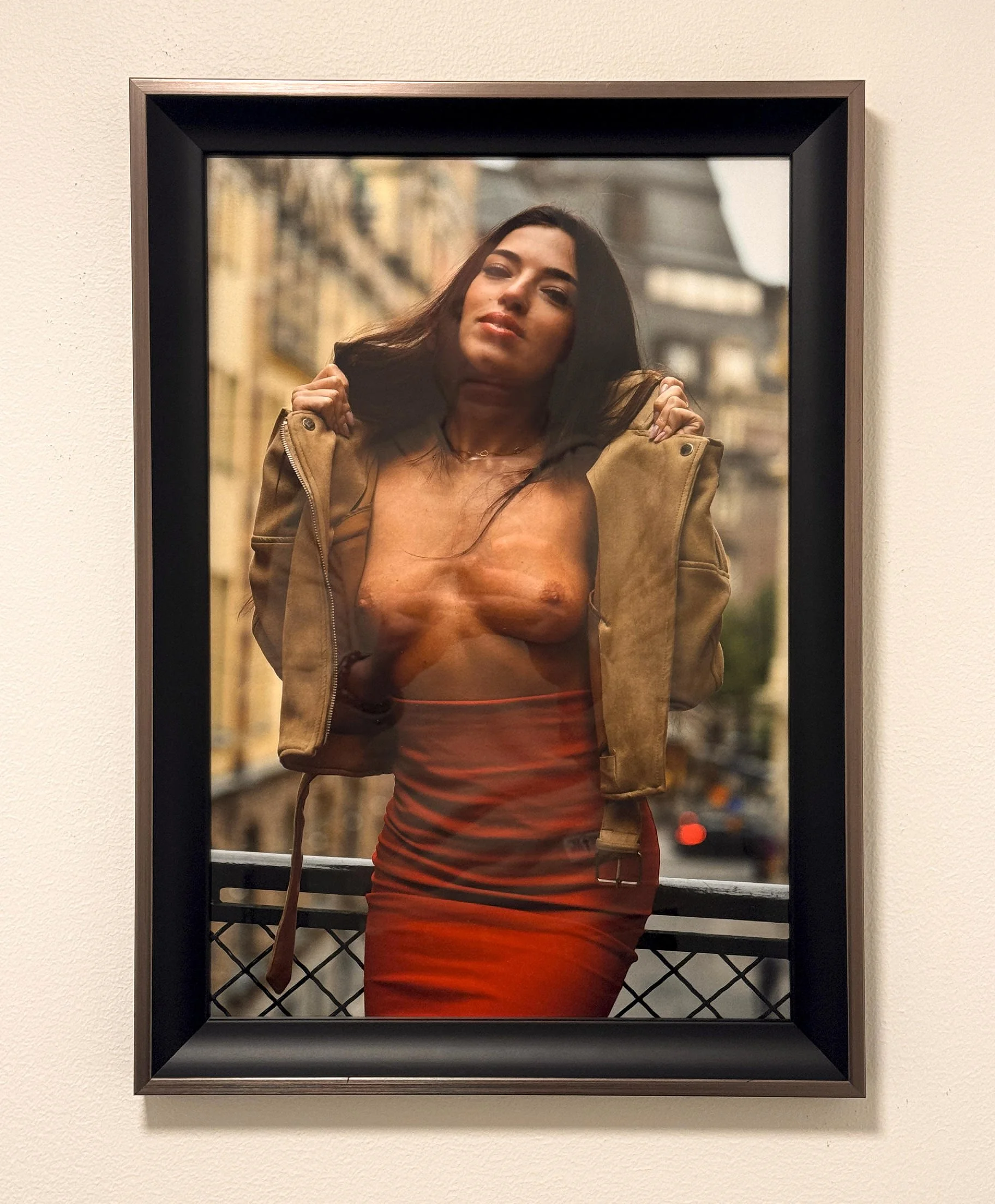
Here, the bevelled edges design draw the viewer in, while the platinum stripe at the outer edge cleanly separates the frame from the background.
Conclusion
I wrote this article not as an ultimate guide to framing, but as a starting point for your own journey. Sometimes it's easier to just start somewhere than to plan forever. I can't emphasise enough that framing is what turns a print into art. Framing has a well-established influence on how art is perceived — museums and galleries spend considerable time and expertise on framing decisions for exactly this reason. The same image can read as significantly more or less valuable, emotional, or impressive depending on how it's framed. Context and presentation matter.
And framing is something you can master and fall in love with entirely on your own. There are thousands of frames out there and a whole industry dedicated to helping you find the right one. No advisor, consultant, or formal education needed. It's deeply personal and contextual, and mistakes are only visible to you. Ultimately, it all depends on your walls, your lighting, your furniture, and what you're trying to say with the piece. Just go out, look, touch, and try a few frames. You'll find what speaks to you.
Your framing to-do list
Visit Nielsen and Halbe's websites to get familiar with their products.
Watch the videos below — they will help you start thinking about framing.
Decide on your framing philosophy. Why do you want to frame? Do you rotate prints frequently? Do you frame to conserve and protect, to enhance, or both? Are your prints mostly small? Your answers will point you towards Nielsen or Halbe.
Check out our article on the art of framing here. It offers a broader overview so you'll be better equipped when you visit a frame store
Visit your local frame stores and get a feel for what's available: sizes, types of frames and materials, glass options, and so on. Notice what types of frames draws you in and what you keep coming back to. Does it suit your art? Does it suit your home?
If a store carries Nielsen, compare an Alpha or Classic frame to others in the same store, specially for a large size frames. What do you notice first? Trust your hands and eyes, not just your brain.
Buy at least one frame home. If you're new to framing, start with a black aluminium frame — it's the safest bet while you develop your own taste.
Think about glass early, not as an afterthought — reflection-free glass can transform how a print looks on the wall. Many frame stores have a display with museum glass to demonstrate the difference in a real frame.
If you're displaying borderless prints, check whether your frame supports an insert frame — and remember to add 5mm to your insertion depth.
Order a Halbe sample pack (~€50) before committing to a frame, especially if you're undecided on glass type or wood finish.
Try a few frames, make a few mistakes, and trust the process. Framing taste develops with experience, not planning.
Start noticing frames — in museums, films, hotels, and other people's homes. Do you agree with the choices? The frame, the arrangement, the wall? This will help to develop your eye for your own framing choices.
Recommended videos for education and inspiration:
A good general overview on how to think about framing and hanging art, and the principles of arranging art at home.
A good interview with a framer on the mindset behind framing decisions.