A Guide to Print Sizes and Quality Levels at NUDICCI
Whether you’re just starting out or building a serious collection we probably have something for you. Our artworks are designed to cater to different tastes, spaces, and budgets - from affordable professional prints to high-end premium pieces.
Traditional online print stores offer many options to let you have your perfect print: sizes, papers, passepartouts, frames, and glass types. This level of customization may be reasonable and well-intended for advanced collectors, but all too often, too many choices create an overwhelming and frustrating buying experience. The decision-making is detracting from the joy of acquiring art. We take a different approach: one print, one product. Each piece is designed to be its best version, freeing you from unnecessary decisions.
Our Philosophy:
We limit artwork options to only the best, helping you focus on the art. Through hands-on experience, we know which sizes, materials, and formats suit each image best. We’ve tested them. We’ve evaluated their visual impact. If an image shines in 3 configurations, we present 3 distinct products. In developing this system, we made several assumptions. We assumed collectors have a clear budget and intent - whether they want a large or small print, a premium or standard quality print. That’s why we offer only a few quality and size levels for each print.
Before we begin, let’s look at how our product images are typically presented. They include five key information fields that describe the artwork. Beyond these five, there are other details of lesser importance, which are shown on the product page. Let’s start with the five most important ones:

The bottom bar in our product listings.
Artwork Quality: Can be Silver, Gold, or Platinum
Paper Texture: Can be Matt, Fine-Art Matt, Glossy, Semi-glossy, Pearl, Satin, Lustre, Metallic, Baryta.
Image size: can be any
Frame Size is typically one of this: 13×18cm, 15×21cm, 18×24cm, 24×30cm, 21×30cm(A4), 20×30cm, 20×25cm, 28×35cm, 30×30cm, 30×40cm, 30×42cm(A3), 40×50cm, 50×60cm, 50×70cm, 70×100cm, 100×100cm, 100×140cm.
Edition Type: Can be Open, Limited, Unique/One-Off, Test/Proof, Monoprint, and Monotype.
Now let’s look at each at more details.
1.Quality Levels
We offer three levels of print quality: Silver, Gold and Platinum.
In printmaking, there are roughly three broad categories the industry is built around: everyday or hobby prints, professional prints, and fine art prints made to last for a very long time. Our Silver level sits in the professional category. Gold is the fine art level, and Platinum is what we consider a skill level rather then the material level - this is the level of master printers.
When we designed our levels, we wanted them to indicate 4 things: print quality, print presentation, rarity, and price. Print quality includes paper and inks, presentation includes mounting, and rarity refers to whether a print is open or limited edition. The level is therefore set by the final product. It is not just about the paper, inks, or size, but about how these elements come together that defines the rating. By clearly defining quality levels and setting expectations, we aim to help you narrow your choice. To summarize:
Silver (think “professional”): prints done on high-quality professional print papers.
Gold (think “premium”): Premium quality with enhanced papers (Fine-art) and paper materials with museum quality standards.
Platinum (think “prestige”): Top-tier craftsmanship designed for serious collectors and exceptional presentations. Each print paper has its own story and legacy.
Now, let’s look at each tier in detail.
SILVER level
Silver level is designed to offer an excellent balance between quality and affordability. Silver prints are produced on high-quality, professional photo papers commonly used in photo labs around the world and are available in glossy, semi-gloss, and matte surfaces. The papers we have chosen for this level are ones we believe offer a beautiful surface, a solid paper base, good longevity, and the reliability of being standard papers that are unlikely to disappear from the market any time soon.
Choosing Silver tier means getting a high-quality print that you can frame and hang proudly on your wall. But it also means that if you want to buy the same print again in five years, the paper it was printed on will most likely still be available. Silver is the dependable workhorse of the photo industry.
What separates Silver from the higher tiers is the trade-off in archivability and conservation. This begins with the paper choice. The papers are of high quality, but their base does not meet archival fine art standards. The inks used at this level may be pigment or, in some cases, dye-based, giving the prints vibrant color and sharp detail, but again they may not meet archival fine art standards.
Printing the image is only half the job. It also has to be mounted, and once that happens, the print comes into contact with other materials. True archival conservation requires special tapes, glues, backing papers, and other components chosen to prevent contamination and reduce aging over time. Following these standards adds both cost and time.
But if most buyers do not need or value archivability enough to pay a premium for it, then there is a clear need - quality prints without the requirement to survive into the next century.
Silver tier is therefore meant to be more affordable and more replaceable. If a print shows wear after 5 or 10 years, it can be replaced. All Silver prints are open editions, so the focus here is not on preservation above all else, but on presentation. That does not mean these prints are expected to deteriorate quickly. It simply means they are not produced to the same conservation standards as the higher tiers, and some risks are not eliminated. That is an important difference. We are dealing with probabilities, not certainties. A Silver print might last for 30 years, or it might begin to show problems after five. Much of that will depend on the environment in which it is kept.
Silver tier exists for buyers who want quality without paying for full archival permanence and will be a good fit if:
You are new to art collecting and want an affordable place to begin, most of Silver prints are priced under €100.
You are looking for reliable, well-made prints without the need for archival standards.
To summarise, the logic behind Silver is to keep costs down while maintaining a high enough level of quality. And Silver level is also often an entry point to Gold.
Explore Silver tier prints now.
GOLD-level.
The Gold level represents uncompromising quality. Nothing is spared to create the most striking image possible, and to ensure that it remains so for a very long time. This is what true art prints are meant to be. Prints in this category fall into two groups: inkjet prints and prints made using alternative processes.
Inkjet prints are produced on archival fine art cotton or other natural, acid-free papers, following the same high standards used in galleries, exhibitions, and museums. These papers feel luxurious in the hand and add a tactile quality that strengthens the visual and emotional impact of the artwork. They are also made to last for generations. Some combinations of ink and paper are estimated to remain stable for 200 years or more. That may not matter most in the moment of purchase, but it is still a remarkable quality.
Paper prints in this tier are created using award-winning, premium papers made from luxurious materials such as cotton, bamboo, hemp, or Washi. These exceptional papers come in a variety of textures, ranging from aquarelle-like finishes to ultra-glossy surfaces, each offering a unique aesthetic and tactile experience that enhances and complements the artwork’s visual impact.
The alternative processes we use include various darkroom and printmaking techniques: traditional silver gelatin, cyanotype, lith, platinum and palladium prints, carbon, and even screen printing, and photopolymer. We use modern methods to produce these prints, but we also collaborate with old masters, and prints made through those collaborations receive the designation of Platinum.
Gold level is all about the highest visual standard and the strongest commitment to archival permanence. Archival materials and conservation techniques are used to protect the artwork from damage over time. Every component, from acid-free papers to precise mounting methods, is chosen to preserve the piece for decades. Archival mats and boards are made from high-quality cellulose fibers and are free from lignin and acids, helping to prevent discoloration and other forms of damage. These materials also reduce the risk of fading and ink bleed, helping the artwork maintain its integrity and vibrancy over time. This level offers maximum protection against both physical and chemical harm, allowing collectors to enjoy their prints for generations.
Gold tiers are often priced at roughly twice the level of Silver, and sometimes more. This reflects not only the higher cost of the materials, but also the standard we aim for. The higher the standard, the easier it becomes for something to go wrong during production and for a print to be rejected. Silver prints are relatively simple and fast to produce: print, mount, ship. Gold is more demanding. It requires a flawless print, careful archival mounting, and the creation of a Certificate of Authenticity. All of this adds time and increases the chance of production losses, because no Gold print is shipped unless it is right. But collectors know that when they choose Gold, they are getting the real thing, not Silver dressed up as Gold.
Additionally, prints on aluminium, plexiglass, wood, textile, and other materials will often be placed in the Gold tier. Strictly speaking, these formats are not always fully archival. They fall under Gold mainly because they are limited editions, meet Gold-level quality control, and are priced well above the Silver level.
Consider Gold level if:
You're a serious collector looking for archival quality that can last many generations .
You value luxurious materials like cotton, washi, bamboo, or textured papers.
You want your artwork to feel high-end and sophisticated.
To summarize: Prints in Gold category adhere to the highest visual and archival standards, featuring acid-free matting and materials that ensure longevity. With a lifespan of up to 200 years without fading, these prints are ideal for serious collectors who value timeless quality and preservation. Perfect for those who demand nothing but the best.
Explore Gold and Limited Editions prints now.
PLATINUM-level.
Prints at Platinum level are made for those who want more than just a Gold print. The real value lies not only in the technique or the paper used, but in the story. Platinum prints are stories on the wall. Each one is made by a designated master of a particular print technique, and carries with it the story of that craft. These are modern interpretations of older methods, striking centerpieces that elevate both a space and a personal collection.
All Platinum prints are limited editions or one-offs. They are meant to be rare and appeal only to those who truly love and appreciate the art form. These are not prints designed merely to impress your guests. They are deeper works of art, valued for the skill, mastery, and story they carry. If you are looking for a piece that feels like a true work of art, this is your tier. It is about depth and uniqueness. This is the level that creates a real sense of WOW, once you know what to look for.
Buy Platinum level if:
You want a print with a story, not just a surface.
You care about rare techniques, specialist craftsmanship, and the value of the object itself.
You are looking for one-offs or very small editions with real collector appeal.

Comparison of Silver, Gold and Platinum tiers.
Gold and Platinum level prints come with a Certificate of Authenticity, confirming their status as true art prints. Every element—paper, surface, sizing, aspect ratio, and passepartout—has been carefully chosen to work in harmony with the image, ensuring the highest quality and artistic integrity.
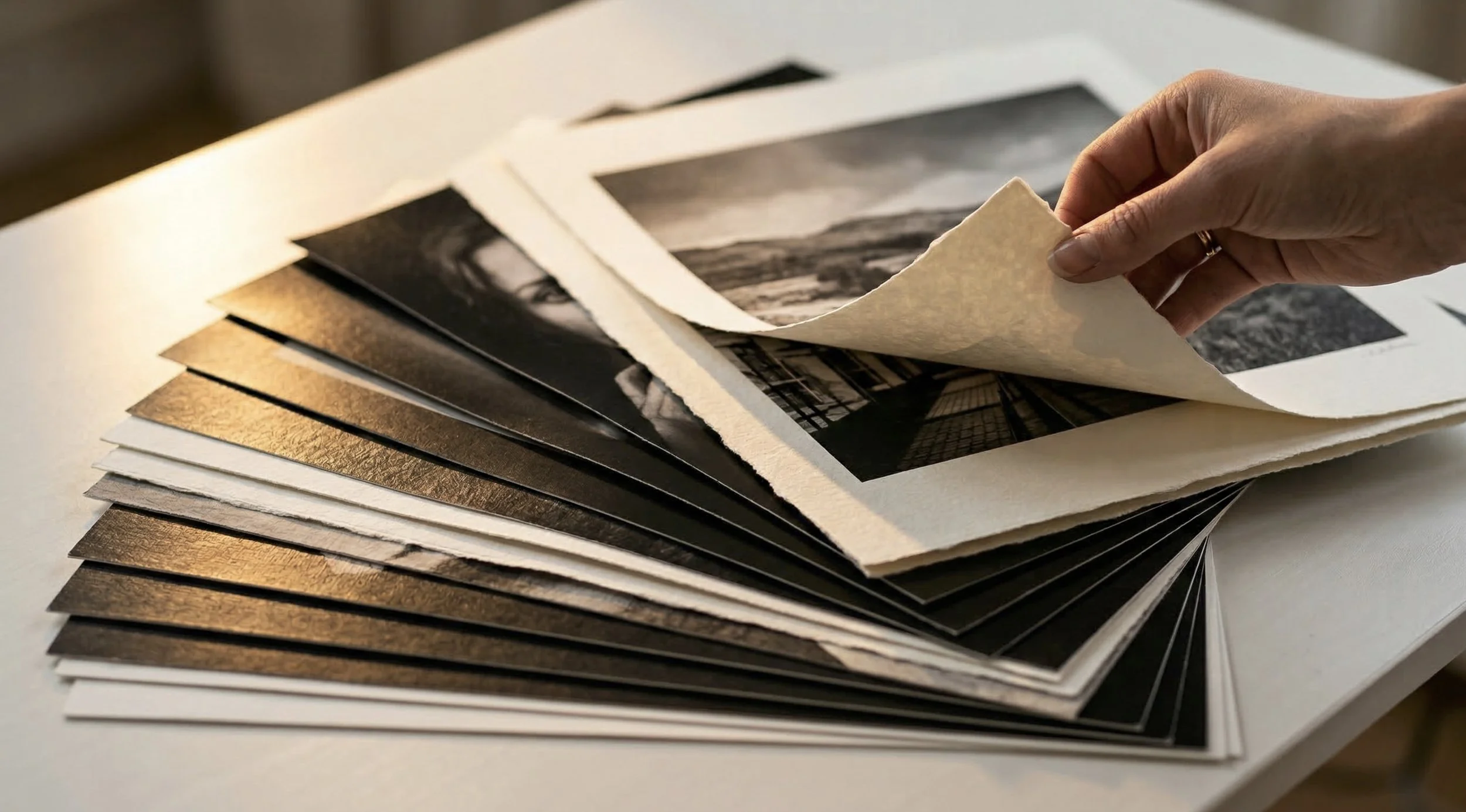
TIP: Much of what sets different paper qualities apart is the tactile experience—how the paper feels in your hands. That’s hard to convey online. That’s why we offer sample packs, where the same image is printed on various papers, so you can compare and feel the differences for yourself. Currently, we offer Silver and Gold tier samples. There’s no Platinum sample for now, as Platinum is more about the uniqueness of each piece than a specific material.
2.Paper types
There is a lot to say about paper, and we have already covered it in several guides, so we link to them here rather than repeat the same information.
Paper, Part I: The Medium of Art
Paper, Part II: How Inkjet Coatings Shape Print Quality
How Paper Weight and Thickness Affect a Print
What is important to understand is that paper types are generally tied to the Silver and Gold levels, but not always, since it is the print as a finished product that is ultimately designated Silver, Gold, or Platinum. In general, Silver tiers are limited to three surface types: glossy, semi-gloss, and matte. These papers are usually either RC-based or paper-based. They may contain OBAs, and therefore the brightness of the white may fade over time. Gold tiers expand the range of surfaces to include fine art matte, baryta, and metallic papers. The base can still be RC, but it is more often cotton, bamboo, or another acid-free paper without OBAs. If OBAs are used, they are generally of a much higher quality than those found in the Silver tier.
We offer paper sample packs so you can get a feel of top papers in our Silver and Gold categories.
3.Sizing Options
The size of a print is probably the main factor in deciding what to buy. After all, most people are not choosing a print in isolation, but something that has to live in a real space, which means size and available room become important constraints.
When it comes to print size, there are three different sizes to keep in mind: the paper size, the frame size, and the visible image size.
The first is the paper size. This is the size of the sheet the image is printed on, and it is usually limited by the standard formats paper manufacturers produce, such as 10 × 15 cm, 13 × 18 cm, A4, A3, and A2. Most printers can print up to A3, some can handle A2, and then there are roll-based printers that can produce prints in custom sizes. As a result, the industry is largely built around A4 and A3 sheet sizes, alongside roll printing, and some papers are available only in roll format, while others are available only as sheets.
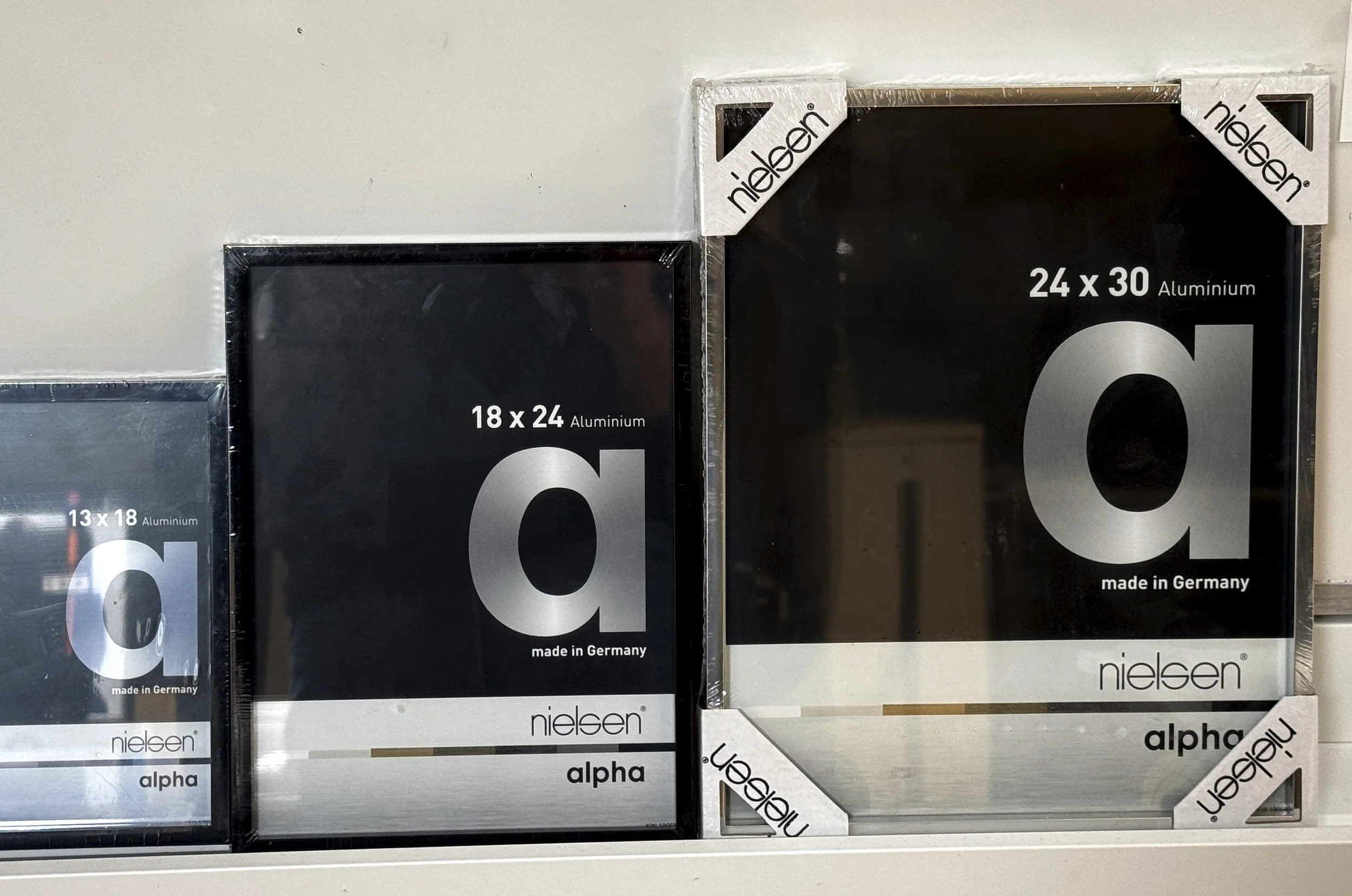
The second is the frame size. This is the size you need to know when buying a frame or planning how the print will be mounted. It is the actual physical size of the artwork that will sit on your wall or desk. Frame sizes can vary, but we usually try to stay close to common standards such as 13 × 18 cm, 15 × 21 cm, 18 × 24 cm, 24 × 30 cm, 30 × 40 cm, and so on.
The third is the passepartout window size. This is the part that determines how much of the printed image is actually visible once the work is mounted. For example, a print may be made on A4 paper (21x30cm), then mounted in a 30x40cm passepartout (the frame size), with a window opening of 18 × 26 cm. In that case, 18 × 26 cm is the visible image area.
In practical terms, the passepartout window is often the size you care about most, because that is what you actually see on the wall. It can also change the perceived proportions of the print quite dramatically, turning a landscape image into a square composition or creating a wide 16:9 view from a standard A4 sheet. But in conservation matting, the full paper size also matters. One reason is that a collector may later want to replace the passepartout, and in that case it helps to know whether the print behind it is really close to 18 × 26 cm, or whether it is actually a full A4 sheet hidden under the mat.
We try to base our sizing on the ISO 216 system, where each step up doubles the area of the previous size. So, for example, A3 is twice the size of A4, and A2 is equal to two A3 sheets. That makes it easier to grasp physical size more intuitively. At the same time, we also translate these formats into something more familiar by assigning them clothing-style sizes: A6 = XS, A5 = S, A4 = M, A3 = L, A2 = XL, and anything larger than A2 = XXL.
Here’s a breakdown of the different sizes we offer, and how they might fit your needs.
XS/A6 (up to 10x15 cm or 4x6 inches): These tiny prints come either framed in a passepartout or as singles. They’re easy to store, fit into standard photo albums, and are perfect for displaying on a desk or bookshelf. If you’ve never bought an art print before, this size is a good way to dip your toes into the world of prints. You can even buy packs with different paper types to get a feel for each one.
S/A5 (15cm baseline: 15x20 cm, 15x15 cm, 13x18 cm): These prints are about twice the size of XS, but still small enough to fit almost anywhere at home. As the image size increases, you start to see more details, and the paper itself plays a bigger role in how the print looks and feels.
M/A4 (20cm baseline such as 20x30 cm, 20x20 cm, 20x25 cm, 20x28 cm): At this size (about twice the area of the S-size), the details in the print and the texture of the paper really start to stand out. These prints are ideal for hanging on the wall, best viewed from about 1 meter away. You can still store unframed prints in standard-sized albums, but they’ll also look great framed on display.
L/A3/A3+ (30cm baseline such as 30x40 cm): This is where you start to get the real “art print” experience. The larger size means the image really pops, and the details and paper make a big impact. This size is meant to be framed and viewed from up to 2 meters away, giving your space a real gallery vibe. It’s the first size where you’re guaranteed to get that “wow” feeling when you hang it up in your room. This is also the last size where we offer prints in Professional quality - prints beyond this size are only available in Premium and Prestige.
XL/A2 (40cm baseline, such as 40x50 cm): This size is common in museum exhibitions and galleries. These prints make a statement in any space but are still manageable in most homes—you can usually find space for one or two of these prints in your home. They’ll likely become a focal point in your interior and express your taste and passions.
XXL/A1 and larger: These are the breathtaking sizes and a very bold statement. Think of them as life-size prints that really take over a room. If you hang one of these, it’s probably the only print you’ll need in that space. The impact is huge—models in the photos are practically life-size, making it feel like they’ve stepped into your room. Due to their enlarged size, only a small number of images can be printed in that size and still look perfect, hence the selection if very limited. Please note, these prints might require special handling and shipping.

The same image is printed in six different sizes, from A6 to A1. Note that these dimensions refer to the unmounted print size; once matted and framed, the final presentation can take up to 50% more space (think S-print mounted in M-frame, M into L and so on).
Print size vs frame size. Print size refers to the actual printed area, while frame size tells you how much space the artwork will occupy on your wall once framed. For example, a single 10×15 cm print is small enough to fit in albums, shoeboxes, or stand easily on a shelf or table in a simple 10×15 frame or acrylic stand. But once it’s mounted in an A4 passepartout, it takes up much more space and requires a proper frame. Clearly, a beautifully mounted print demands more room, but it also carries far more impact than one kept tucked away in a shoebox. You’re trading compact storage for greater visibility and presence. We have a whole category of small and intimate prints that you can browse.
Once you move up to A3 size, both storage and display become more challenging. An unframed A3 print has roughly the same surface area as 8 x 10×15 cm prints. When mounted and framed, it can take up the equivalent wall space of around 12 x 10×15 cm prints. So while a dozen small prints might easily fit on a wall or in a box, a dozen framed A3 prints demand a whole lot more room and quickly become a matter of available wall space.
A2 prints are even larger - double the size of A3 and require a lot more room. Most home will only have space for a couple of A2 prints. These become the pillars of your collection, setting the tone and style for everything else around them.
A1 or larger prints are a different story altogether. These are rare, bold, and take up a lot of space. Unless you live in a mansion or have a dedicated gallery wall, it’s hard to make room for more than one. And large sizes come with their own challenges. They’re not just harder to ship—they can also be difficult to fit through elevators or doorways. So while these formats can be visually striking, they’re often impractical for most everyday living spaces. That’s part of the reason many high-end, expensive prints come in these large formats - they’re made with a specific kind of buyer in mind: institutions, galleries, or wealthy individuals with the space to properly display them. These prints aren’t just art pieces - they’re statements, often meant to dominate a room. Common prints of this size are 50×70cm, 70×100cm, and 100×140cm and are available for example in our Big Bold and Beautiful collection.
TIP. Before you commit to any print, consider taking a trip to your local frame store to check out the sizes of the frames in person. This will give you a much better idea of what to expect and help you visualize how different print sizes will look in your space. As print sizes increase, orientation also plays a role. Large horizontal images tend to be easier to fit than large vertical ones.
4.Passepartout and Frames
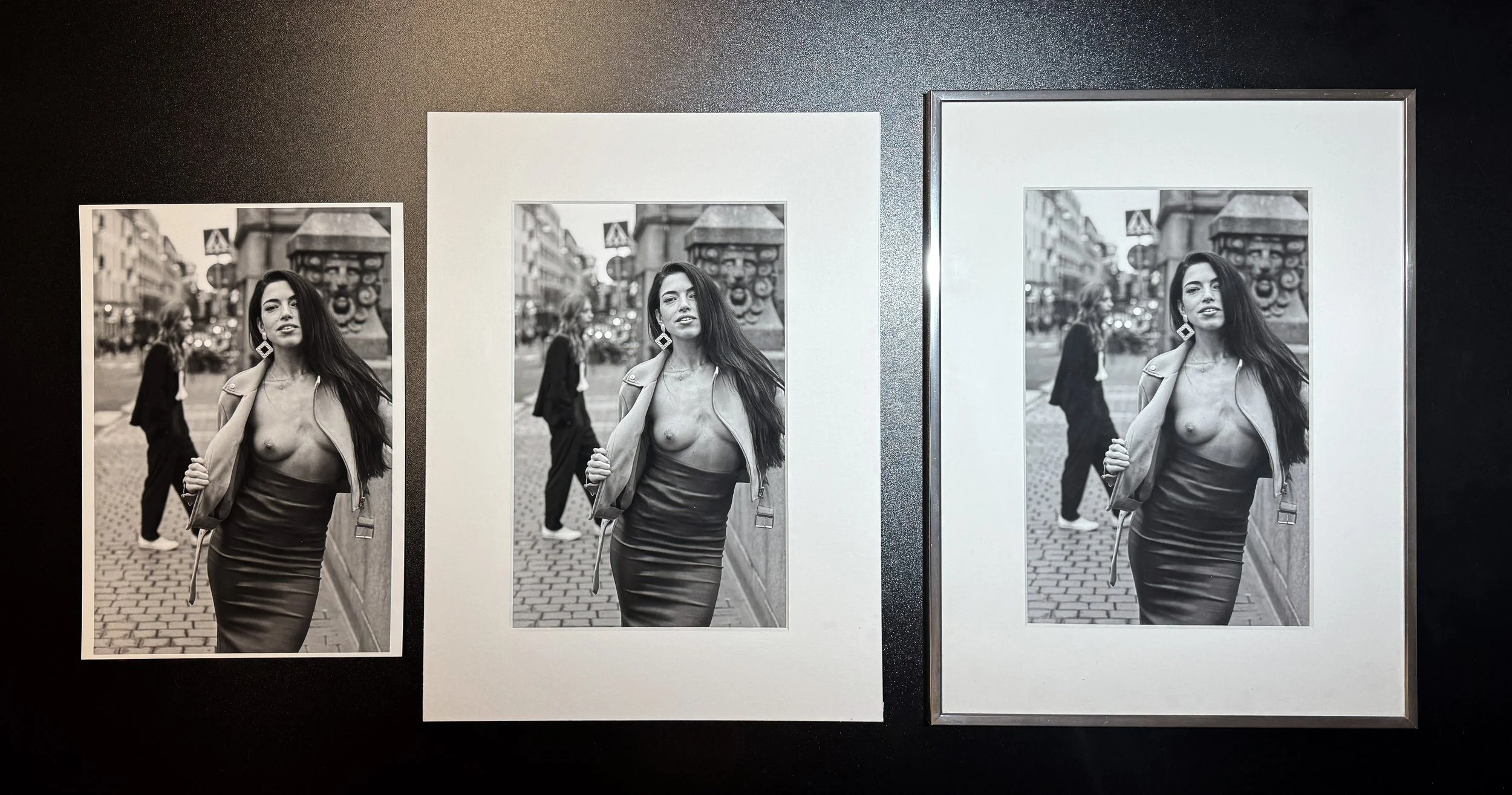
Unframed, matted, and framed prints of the same image.
We sell most of our prints mounted in a passepartout, ready to be placed in a frame of your choice. Many times, the difference between an amateur print and a professional art print is in its presentation. Passepartout is that “fancy” presentation that sets its apart from a home print. But passepartout is not just an artistic choice; it also serves a protective purpose, keeping the print safe from direct contact with the glass and helping to preserve its quality over time.
Normally, passepartout is about one size larger than the print, or have a border of about 5cm. In some cases, a passepartout two sizes up can be used, such as a 10x15 cm print matted into an A4 passepartout. This wider border, which is about 10cm, is typically used for smaller prints to give them a more “important” and focused appearance. Many museums also use oversized passepartouts, where the generous white space helps draw the viewer’s focus to the artwork and sets it apart from the surrounding wall.
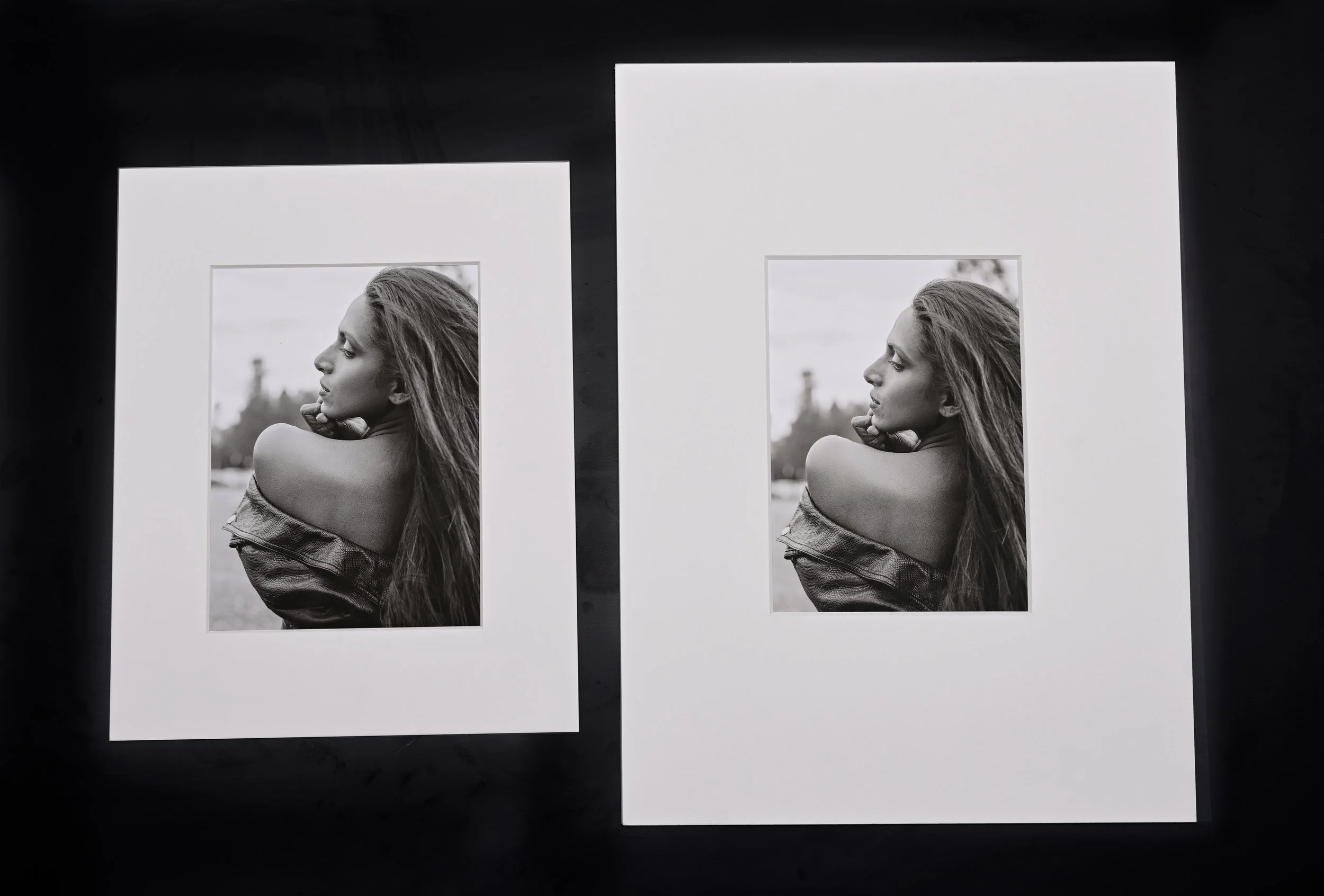
The same size image can feel very different depending on the passepartout width. A one-size-up mat with a 5cm border gives the print a clean, balanced presentation. But a two-sizes-up mat with a 10cm border creates more breathing room around the image, drawing the eye inward and giving the work a more elevated, gallery-like presence. The extra space can shift the mood from casual to refined, even when the image itself stays the same.
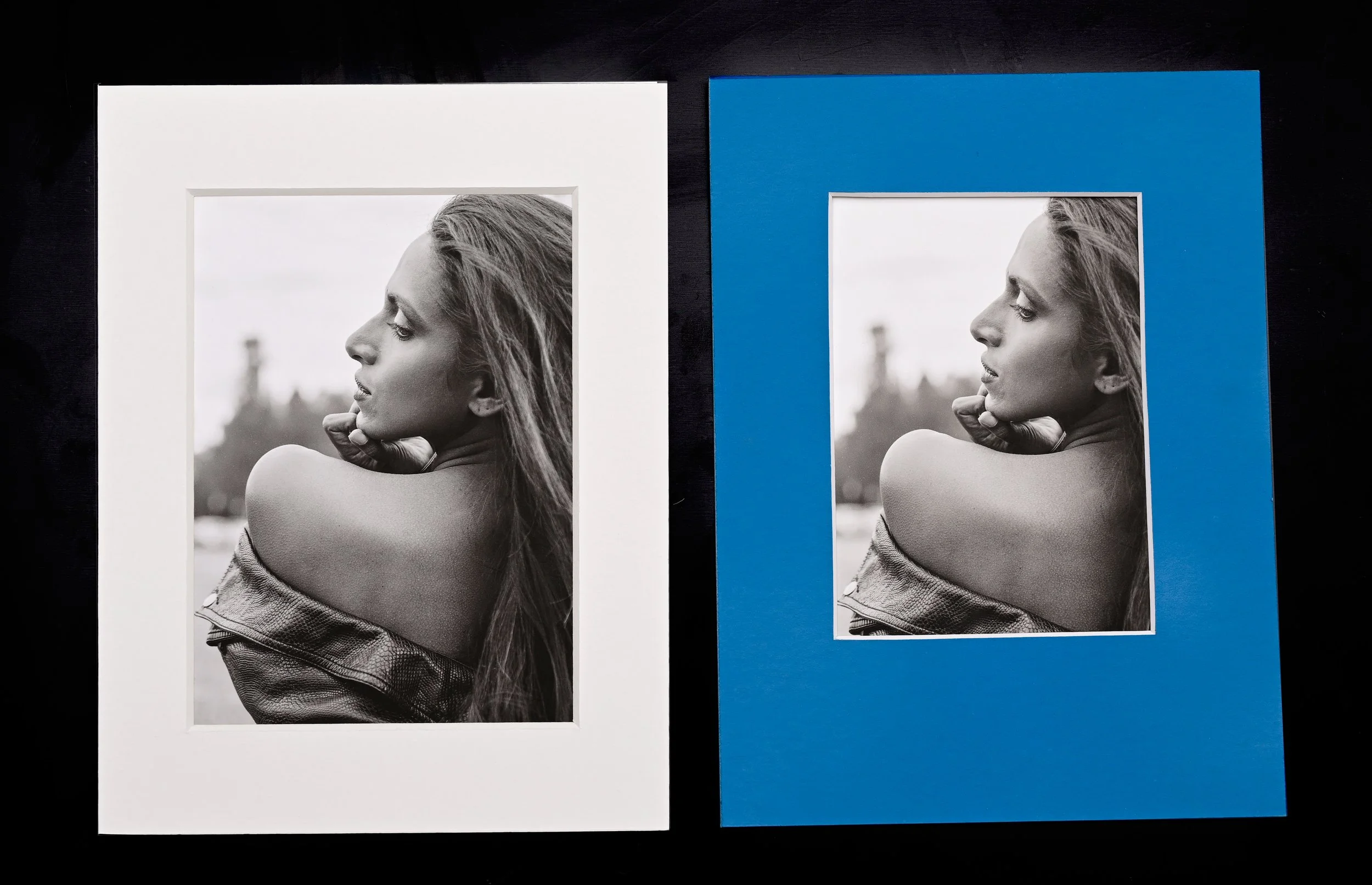
Passepartout color and framing can dramatically influence how we perceive an artwork.
Frames?
Most of our art is sold unframed, but mounted and ready for framing. Many collectors already have a preferred framing style, so it doesn’t make sense for us to offer every frame for every use case. Our goal is to make high-quality nude art more affordable. By removing frames, we lower costs and pass the savings on to you. This also gives you the freedom to choose a frame that fits your space—and often at a better price than we could offer. If you are new to framing, read our guide to framing and glazing for your new art. We also have a special article on Nielson and Halbe frames that we highly recommend.
5.Putting it all together.
If you haven’t already, make sure to read What Makes a Good Print and Edition Types Explained for a better understanding of what makes art worth collecting. Learn a bit about print paper. It is the medium of the art you will be collecting. We have a two-part series on paper (part 1 and part 2), along with a separate guide to paper weight and thickness and how they affect the print. Also, start imagining what your ideal collection could look like. What sizes do you actually like, can afford, and have space to display? What kinds of prints do you want to focus on in terms of quality, materials, and style?
Knowing these things ahead of time makes choosing much easier. Think of it like walking into a shoe store already knowing your size and what you need the shoes for—suddenly, most of what's on the shelf becomes irrelevant, and your options are clear. It might sound overly simple or a bit too practical, but it’s a helpful exercise. To get started, here are three tips that can help you in your thinking.
Start Small. We don’t recommend starting with the most expensive piece you can afford—it might not be what would make you happy. Just because something is premium and costly doesn’t mean you’ll fully appreciate it - you might need to grow into it. In our experience, the best way to start appreciating art prints is by acquiring smaller pieces first. Sometimes going for the highest quality small print is the smartest approach. This allows you to experience the quality of the paper and craftsmanship firsthand. If you love it, you can confidently go bigger with your next purchase selecting similar type of paper/quality level. Eventually, aim to own your largest artwork in the highest quality you can afford. Size matters, and the quality will shine and become a signature piece of your home. But do not overpay, unless you know exactly what you are getting.
To let you explore the levels and papers we offer sample print packs in 10×15cm size, featuring the same image printed on a variety of paper types. These sets are designed to show how the ink and image interact with different paper types, allowing you to see how each paper affects the final look and feel of the artwork. It’s a perfect introduction to the core of printing craftsmanship, helping you make more confident and informed choices as you build your art collection.
Have a goal for your collection. Have a plan for what you want to collect. Buying random pieces in various sizes and quality levels is rarely a good strategy. Do your research and think about the collection you want to build. Is it going to be around one specific model or photographer? Is it a special visual style that you want to focus on? Is it size, materials ore ranting technique that appeal to you? Remember—any plan is usually better than no plan at all. It’s very easy to spend a fortune on art and still end up with random pieces rather than a well thought collection. Value your time and money - take the time to plan how you want to spend them.
Accept that some of your initial purchases may not be your best. Most certainly, your tastes and budget sensitivity will evolve over time, and you might eventually sell or give away some of your earlier pieces. If your tastes don’t evolve, you probably didn’t buy art that truly resonates with you in the first place. The most important thing is that art should make you happy - it has no other purpose than this. But art buying is also a risk. If you find yourself constantly thinking about how much you paid for a piece, that’s usually a sign you overpaid - take it as a signal and learn from it. But if you look at it and feel like your home wouldn’t be the same without it, then you’ve probably found the right one. In that case, the feeling it gives you - the dopamine, the quiet rush every time you see it was worth every cent.In the end, art is about the journey and the personal connection it creates. It should reflect who you are, inspire you, and bring you joy.