

The Art of Framing or Why Bad Framing Kills Great Art.
Framing is what separates a poster from a true work of art. Today, we frame more things than ever - photos, paintings, certificates, and sports jerseys, but the fundamental principles of framing remain unchanged. Framing can be traced back to ancient Egypt, where it was used in religious and ceremonial contexts. It remained primarily a religious artifact (think iconography) up until around 1200. Fast forward just 200-300 years, and framing became primarily associated with paintings and drawings. However, there were no standardized sizes for artwork, meaning each piece required a custom-made frame. Framing was both an art form and a profession, as well as a practical necessity. Today, we have a much wider range of materials to create frames from, and frame sizes have become more standardized. Despite the industrialization of framing, it remains an art form, and the right frame can either elevate or diminish the impact of your artwork. Let’s take a closer look at what framing is and why it’s so important.
Framing enhances the visual impact of artwork while providing structural stability and protection. A well-chosen frame elevates the piece and helps it either blend seamlessly into its surroundings or stand out. The art of framing lies in finding the right balance between choosing a frame that protects and enhances the artwork while also complementing the space in which it’s displayed.
Framing allows us to personalize the art we bring into our homes. Some collectors prefer to use the same framing style for all their artwork, creating a uniform and formal presentation that doesn’t distract from the pieces themselves—think of gallery walls with consistent frames. Others embrace variety, allowing for a visual dialogue between each frame and its artwork—like in museums, where each piece often has a custom-made frame that reflects its character. There’s no single right way to frame art—but there are certainly many ways to do it poorly. As with many things in life an impulse purchase is great. A thoughtful approach or guiding strategy can go a long way toward making your framing choices feel intentional and cohesive.
Short Guide to Choosing the Best Frame
There is a staggering variety of frames available, ranging from inexpensive plastic models to luxurious options crafted by top jewelry brands. This isn't meant to be a comprehensive guide on all of them, but rather a starting point to help you make informed decisions. For more in-depth information, there are tutorials, magazines, books, and a wealth of infographics online that can further assist in choosing the right frame for your art. We also have a review and guide on two specific frame manufactures that we like: Halbe and Nielsen. What we've done here is put together the 8 key considerations for choosing the right frame. Let’s begin!
1.Frame Size
Frames come in all kind of sizes. Some sizes are standardised some are made to order. In most of Europe, the UK, Australia, and many other countries, frame sizes commonly follow the ISO A-series paper system, especially A4, A3, A2, and A1. In North America, the most common off-the-shelf frame sizes are typically 4×6", 5×7", 8×10", 11×14", 16×20", 18×24", and 24×36". There are also traditional photographic dimensions from the analog film era, canvas sizes, and many more.
If you’re buying unframed art, finding the right frame is usually quite simple. The main thing you need to know is the size of the artwork. At Nudicci, we typically work in the following formats:
15×21 cm
18×24 cm
20×25 cm
24×30 cm
28×36 cm
30×30 cm
30×40 cm
40×50 cm
50×70 cm
A3
A2
A1
Occasionally, we may release works in other sizes. When that happens, we update our Nudicci guide accordingly.
Summary: When the artwork is mounted in a passepartout (mat), the outer dimensions of the mat determine the frame size you’ll need. For example, an A4 print mounted in an A3 passepartout will require an A3 frame. You will see this listed as Frame size in our product description, which means you can start looking for a matching frame even before your print arrives. That’s really all there is to frame sizes—simple and easy process.
Once you’ve determined the frame size, the next step is choosing the color and material that best complement your artwork and space.
2. Frame Material
Frames are typically made from 3 main materials: wood, metal, and plastic. Each comes with its own strengths and weaknesses, and it is worth understanding the tradeoffs. Metal frames have usually the least character. They are not the kind of frames that carry carved detail or ornamental presence like an old painting frame, but they are practical, clean, and very good at protecting a print. They are functional. They are also easy to build a collection with over time. Many manufacturers make very similar frames, which makes mixing and matching much easier.
Wood gives you the most freedom. It can be shaped, finished, stained, painted, left raw, made decorative, or kept simple. In that sense, wood can do almost anything. The one thing it does not do especially well is becoming extremely thin. If you want a very slim frame, metal is a better route. Wood also has the advantage of aging well. A good wooden frame often looks even better after 20 years.
Plastic sits somewhere in the middle, a hybrid. It can be molded into almost any form and made in almost any color, which gives it a lot of flexibility. That is part of why plastic frames are so common. They can also be very affordable. The downside is that many of them tend to look trashy over time. They scratch, chip, or discolor more easily. That said, not all plastic frames are poor quality. Some are very durable. But once you get into better plastics, the price advantage starts to fade, and at that point they begin to compete with real wood and metal on more equal terms.
So while there are many options, the choice is not only about style. It is also about what kind of object you want the frame to be. It is less about finding the one correct answer and more about choosing the path that suits the artwork and the space around it. Le’s look closer.
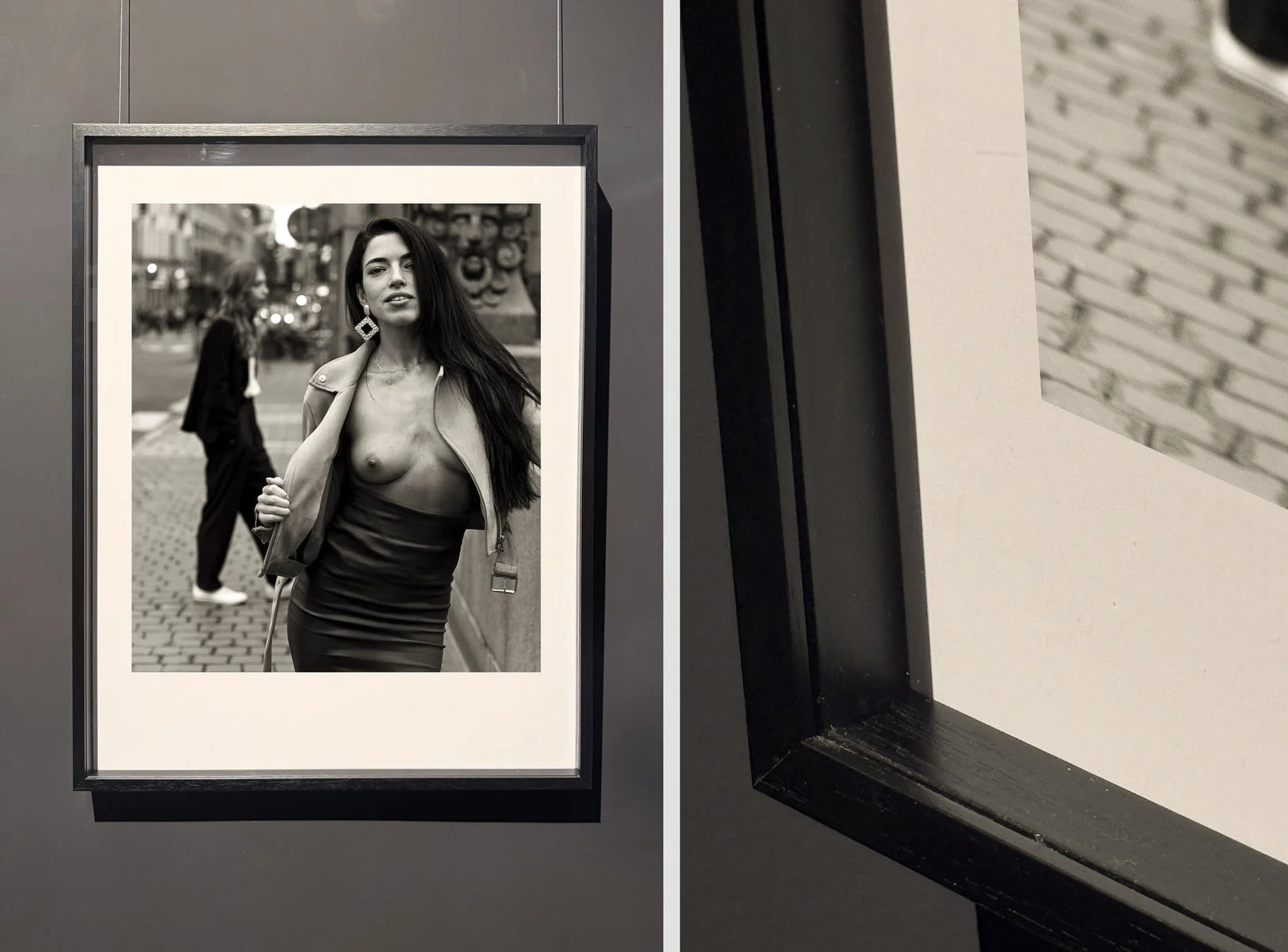
Wood frames are the royalty of the framing world. All frames used to made of wood. Wood add a timeless, natural warmth to artwork that no other material can replicate.The rich textures and grains of wood complement a wide range of art styles, from traditional to contemporary. Whether it’s a classic oak or a luxurious walnut, wood enhances the character of your piece, giving it a more organic, bespoke feel. Its tactile quality adds depth and warmth, making the artwork feel more intimate and connected to its surroundings. Wood frames tend to evoke associations with nature, which can make them work especially well with nude photography, since both have a natural, organic quality.
Wood frames are also often associated with luxury and craftsmanship, often used to elevate the perceived value of a piece. Wood is the choice for most custom made frames because of its versatility. Skilled framers can create fully custom wood frames tailored to your exact size and design preferences, offering endless creative potential.
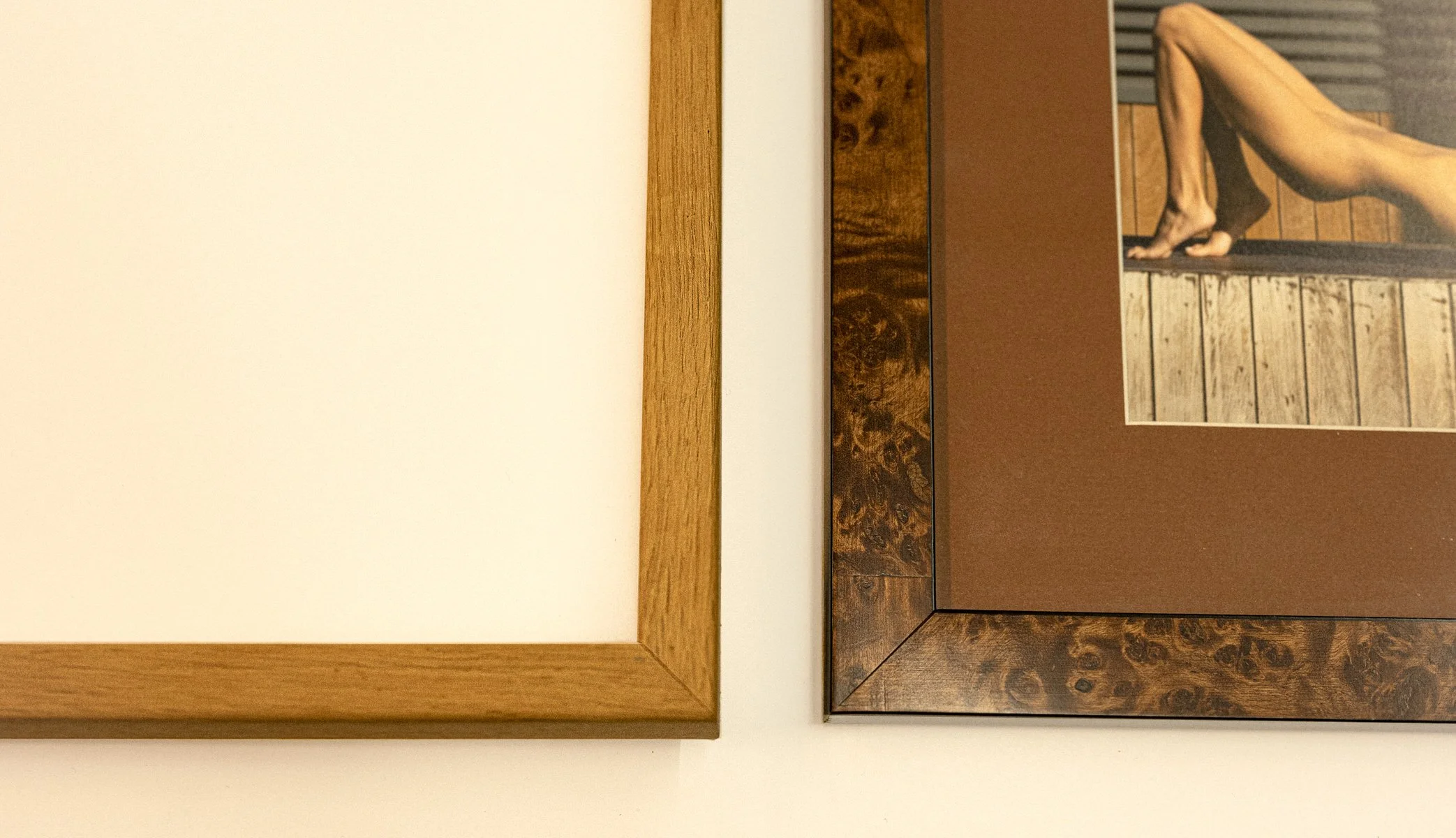
Two wood frame styles side by side: one light and understated with a clean oak finish, the other darker and more expressive with richly figured wood. The craftsmanship language feels different - the left one reads as precise and understated. The right one reads as tactile and luxurious, almost furniture-like.
In terms of durability, high-quality wood frames can last for decades when properly maintained. Certain hardwoods, such as oak and cherry, are particularly long-lasting and resistant to wear. Wood’s natural ability to "breathe" also helps regulate humidity and protect your print from moisture.
Beyond aesthetics, wood is also a renewable resource. Many manufacturers now offer frames made from reclaimed or responsibly harvested wood, which can make it a more sustainable and environmentally conscious choice. There are also smart ways of using premium wood without wasting it. A thin veneer of an expensive wood can be applied over a more affordable base, giving the customer a real wood frame with the look and character of a much rarer material. This makes it possible to produce more frames than would be feasible with solid premium wood alone. A good way to think about veneer is to compare it to gold leaf. The object is not solid gold, but it still has the visual presence of gold on the surface. Veneer is therefore not just a financial solution, but also a technical and environmental one. It allows manufacturers to create beautiful frames while using valuable materials more carefully.
However, wood does have its drawbacks—most notably, its weight. Unlike plastic or metal, wood cannot be made as thin and strong, so frames tend to be thicker and heavier. If not properly treated or finished, wood frames can also attract insects or become a food source for them.
Nowadays, a lot of frames that look like wood are actually made from MDF or other composite materials. They are technically wood-based, but they do not have the grain structure of solid wood and are often painted to disguise that. Many cheaper wood-look frames fall into this category. The main drawback is that they are not made from a single solid piece of material, so they do not have the same strength or stability as solid wood. They are generally more likely to warp or swell with moisture, delaminate, chip along the edges, or develop problems with the finish or joints. If you want a wood frame, get one made from real wood.
Metal frames offer a minimalist, modern aesthetic combined with a strong yet lightweight structure, making them a popular choice for contemporary and industrial-style interiors. Typically crafted from aluminum, metal frames feature a cool, clean-lined appearance that pairs beautifully with photography, graphic art, and modern prints. At the same time, they can create a bold contrast when used with more traditional or classic works, adding visual interest through juxtaposition. For nude photography, metal frames offer a more functional framing option, but they can also work well through contrast. The organic quality of the body is set against an industrial, man-made frame, and that tension can be visually powerful. Metal frames can feel colder and more distant than wood, but that can also suit nudes very well, especially when you want the image to feel sharper, cleaner, or more restrained.
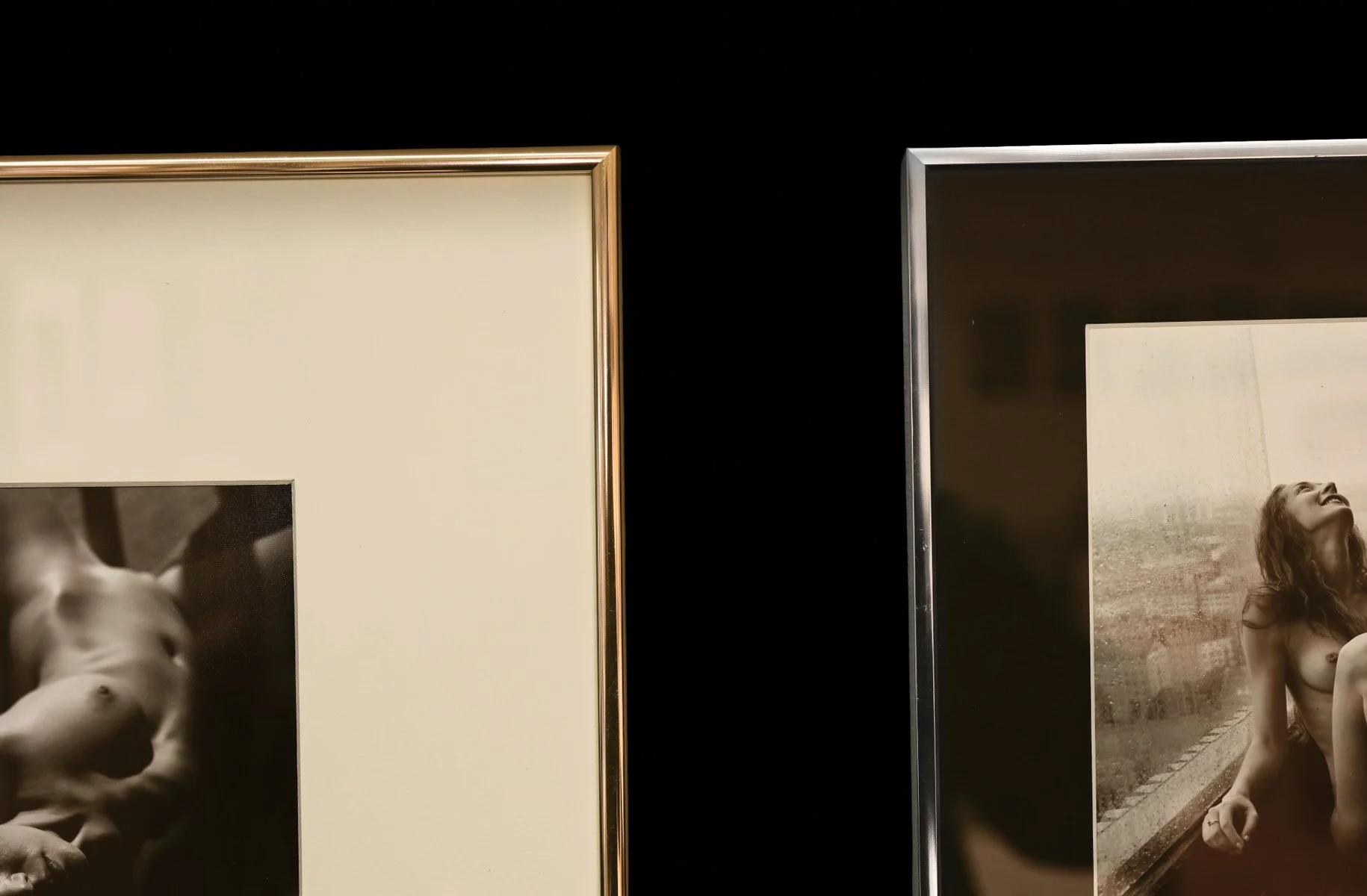
Two slim metal frame styles: one in a warm gold tone with rounded edges that create softer reflections, and one in a darker silver finish with a sharper, more angular profile that produces a cleaner, crisper reflection.
A key advantage of metal frames is their precision and uniformity. Because they are machine-manufactured, they provide a clean, exact finish—perfect for professional presentation. This makes them especially well-suited for gallery walls, commercial displays, or exhibition spaces where consistency and sleekness are important.
Another major strength is their exceptional strength-to-weight ratio. Metal frames are generally thinner and lighter than wood, yet offer excellent structural integrity. This makes them ideal for large artworks, reducing overall weight while maintaining stability. Metal is also highly resistant to environmental changes—it won't warp, expand, or contract due to humidity or temperature fluctuations. As a result, metal frames offer reliable, long-term protection for your artwork, especially in challenging environments.
Metal frames also offer a lot of flexibility in design. Back-locking mechanisms are more common in metal frames than in wooden ones, which makes it easier to swap images in and out. Even the traditional way of opening a frame from the back has been rethought by some manufacturers. Halbe, for example, developed a magnetic front-loading system that allows swiping images without taking a frame off the wall.
That said, metal frames do have their drawbacks. They can feel colder or less personal than wood. Many metal frames, especially shiny or chrome-finished ones, also scratch easily, collect dust quickly, and can lose some of their original appeal over time. If they fall, they are more likely to bend or become skewed, which happens less often with wooden frames. In short, metal frames can go from looking very presentable to looking quite worn rather quickly, at least visually. Functionally, though, they will often still do their job perfectly well, which is why they are popular in the first place.
Plastic frames are often the go-to choice for those seeking a budget-friendly and lightweight framing solution. They come in a variety of colors and finishes, offering versatility while replicating the appearance of more expensive materials like wood or metal. This makes them an attractive option for those looking for style at a lower cost. Plastic frames are particularly useful for larger prints or artworks where the weight of the frame might otherwise be a concern.
Additionally, plastic frames are resistant to certain environmental factors, meaning they won’t warp, swell, or crack due to humidity or temperature fluctuations. This durability makes them an excellent choice for areas with changing climates. Another exciting advantage of plastic frames is the potential for 3D printing—with advanced technology, frames can now be printed in creative and custom designs that are both durable and unique. There are many wood-looking plastic frames that are hard to differntiate unless you turn them around.
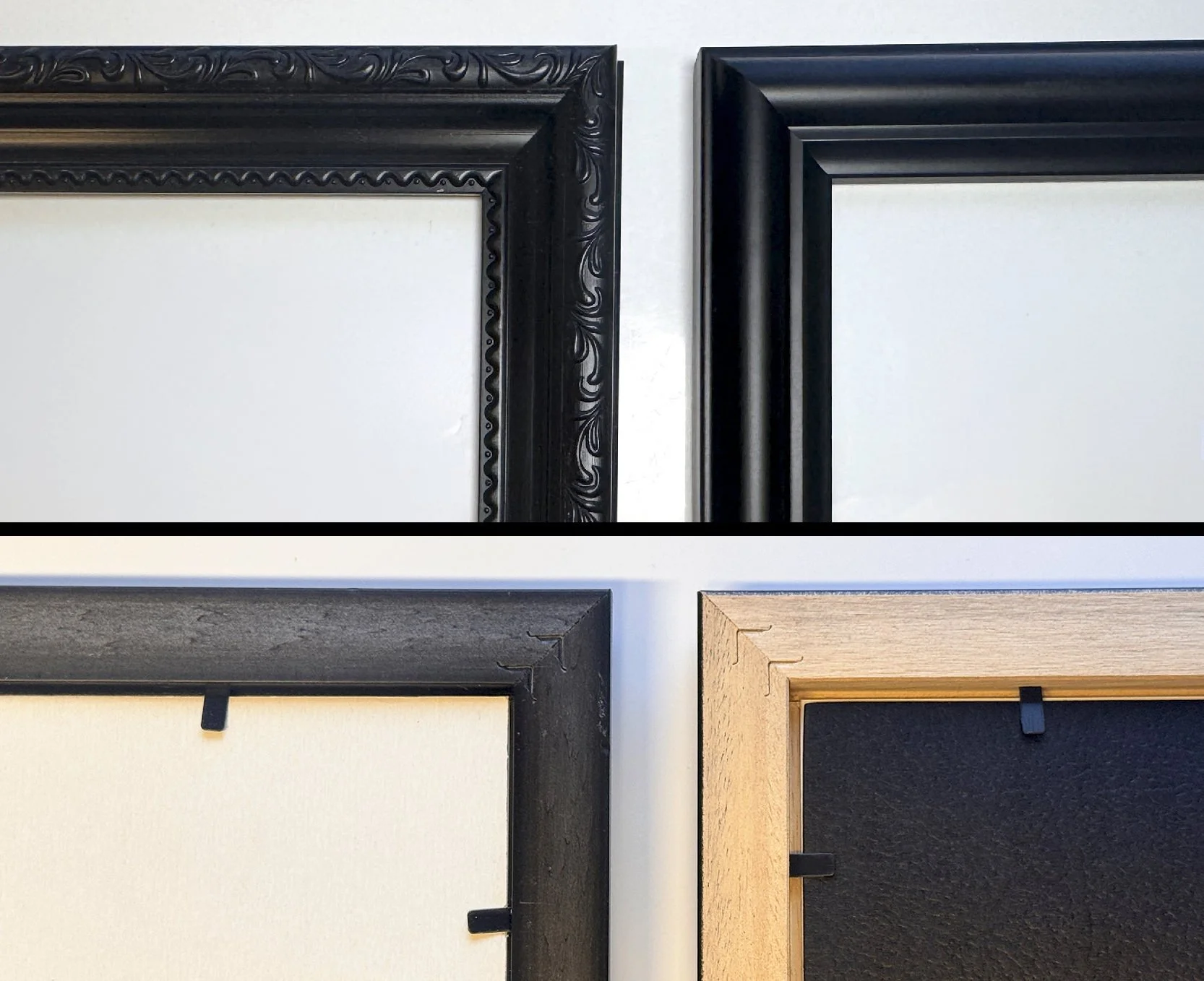
Plastic frame (left) with a wood look, while the one on the right is real wood. It is hard to tell them apart until you turn them around. The plastic frame is black all the way through and has a much smoother surface than the wood, it also weights a bit less.
On the downside, plastic is usually a budget material and is more likely to crack, scratch, or discolour over time. Better-quality plastic frames do exist, but they are harder to find than they should be. Most are flimsy and better suited to children’s drawings or very temporary use. Avoid them unless that is exactly what you need.
Other materials. There are also frames made from more unusual or luxurious materials—leather, glass, stone, carbon fiber, and even precious metals like silver or gold. These frames can be visually striking and often serve as statement pieces. However, they tend to be expensive and stylistically challenging to find artwork that truly harmonizes with them. They often overshadow the very artwork they are meant to present, drawing attention away from the image instead of enhancing it. These are statement frames, designed less for conservation and more for presentation. Their purpose is to enhance a single photograph rather than preserve artwork long term. They are also usually built to fit a single print, with little or no flexibility for anything thicker.
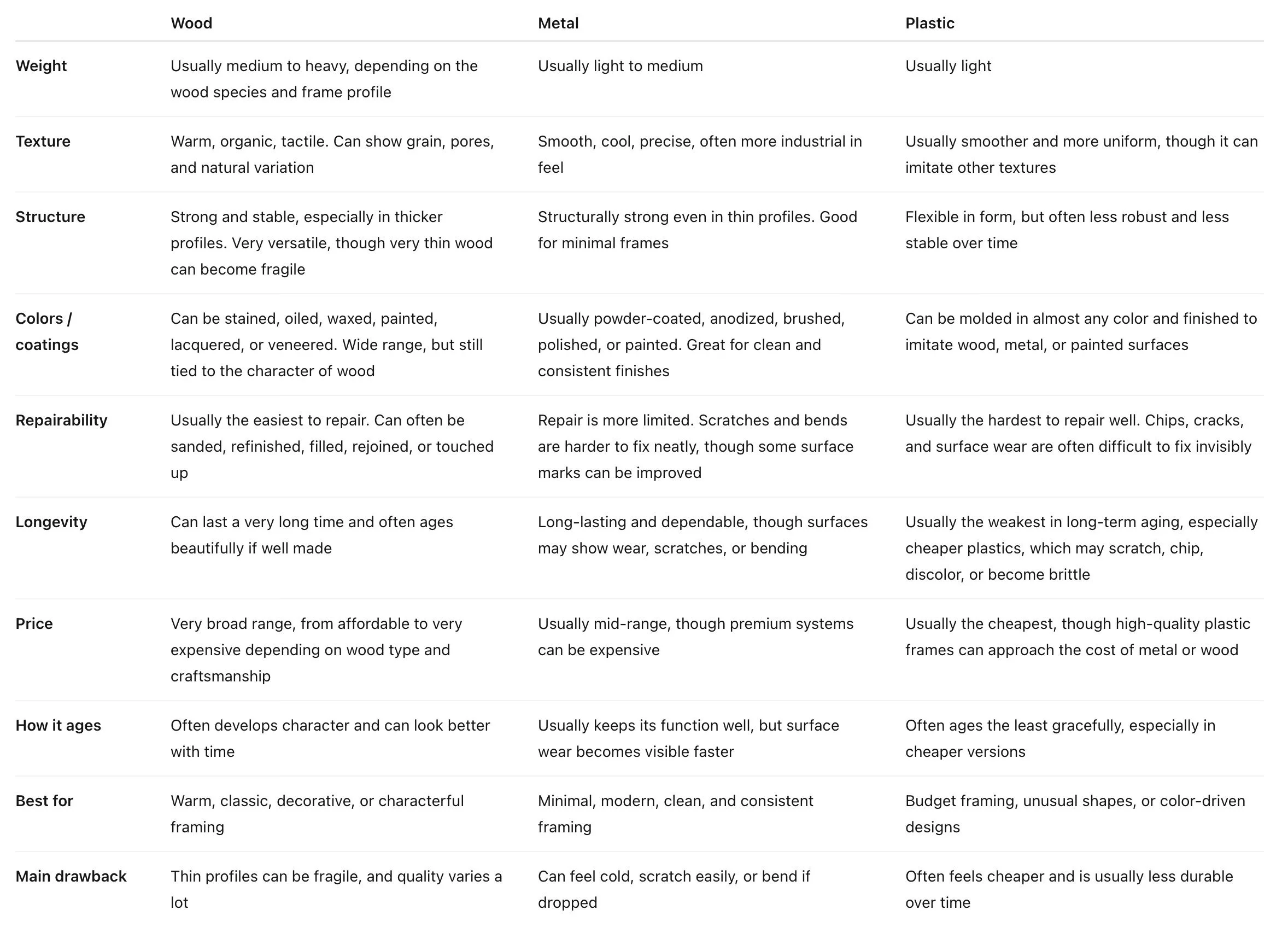
The material of a frame affects much more than just appearance. It shapes the frame’s weight, texture, structure, finish, durability, repairability, and price.
Summary: The choice of material shapes not only how a frame looks, but also how it feels and performs. Wood usually brings more warmth, texture, and visual depth. Metal tends to feel cleaner, lighter, and more precise. Plastic offers the greatest freedom in shape and finish, but often with less strength, texture, and long-term presence.
3. Frame Color
Frame material and frame color are two of the most important elements in the overall presentation of an artwork. While material affects weight, texture, and structure, color directly influences how the artwork is perceived. Choosing the right frame color is a creative decision—one that can subtly support the art or make a bold statement that changes how it's experienced.
The most commonly used frame colors are black, white, and silver/metallic.
Black frames provide a strong, defined edge that enhances contrast and draws attention to the artwork. They are particularly effective with photographs, graphic art, and pieces that benefit from visual separation from the wall.
White frames offer a softer, more neutral border, ideal for lighter-toned artwork or minimalist settings where the frame should quietly support without dominating.
Silver and metallic finishes bring a sleek, contemporary feel, often used with abstract or modern works to add a touch of sophistication and edge.
However, frame colors are by no means limited to these three. Frames can be found in virtually any shade or finish—from natural wood tones and warm earth hues to vibrant, saturated colors and weathered, distressed looks. A well-chosen frame color can enhance the artwork's palette, reflect the emotional tone of the piece, or tie into the room’s overall design.
The choice of frame color usually depends on three things: the image itself, the frame material, and the environment where the work will hang.
Many fine art prints are presented with a passepartout, which already acts as a visual separator from the wall. In that case, the frame color can either work as a contrast, such as a black frame around a white mat, or as a continuation, such as white on white. The frame color can also respond to what is happening inside the image. A blue frame might work beautifully with the sea, yellow with sand, or silver or chrome with a black-and-white photograph of a car.
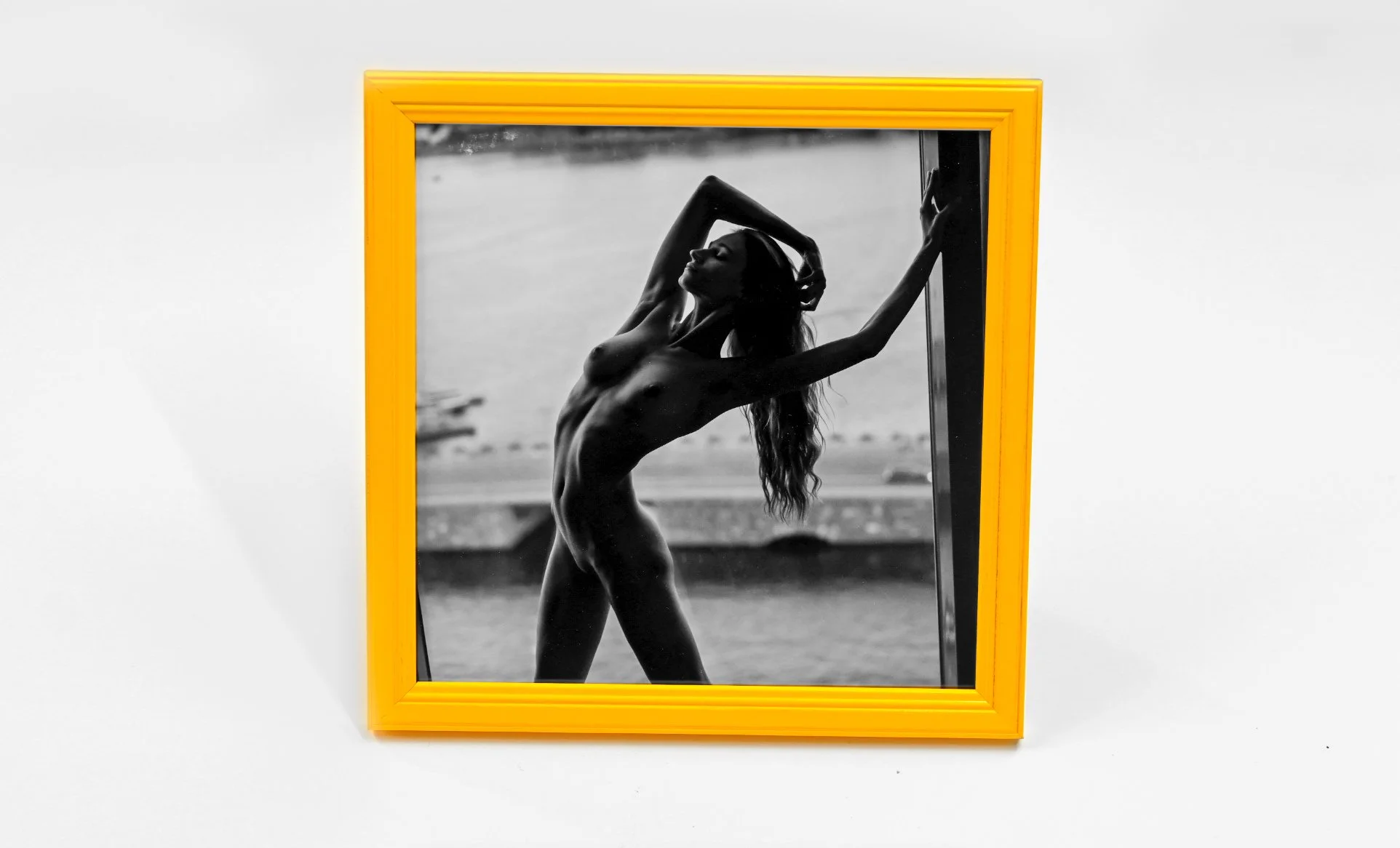
A small black-and-white print in a contrasting yellow frame stands out more than it would in a plain black frame.
Sometimes the choice can be more expressive. A yellow frame around a black-and-white nude, for example, might suggest confidence on the part of the owner, but also show that the frame is allowed to exist as an object in its own right, not just as a neutral support for the print.
Material will often influence color as well. There is little point in paying for a premium wood frame only to paint over it in bright red. With metal, trends tend to shift more quickly. Gold aluminium frames, for example, may fall out of fashion, while platinum or gunmetal finishes come to the front. Plastic is a slightly different case. Its main advantage is often its ability to imitate other materials, so it is less often used for bold colors like green, pink, or yellow, and more often to mimic current trends in wood or metal frames.
Finally, the environment matters. Some collectors and galleries work with standard frames, so there is no real choice to make. Others are more open to mixing styles, colors, and materials on the same wall. With nudes, though, the challenge is slightly different. It is not just about whether the frame fits the room, but whether it truly works for the print itself. Nudes are not decoration. They are statements, and they should not be treated like filler art used to occupy an empty part of the wall. Give nudes a frame that it deserves.
In summary, the color of the frame shapes how the artwork is seen and how it sits in the space around it.
4.Frame Thickness
Thickness refers to the front-facing width of the frame. It is the visible edge you see around the artwork when looking at it from the front. It is basically how wide the frame is. For example, a 50 × 70 cm print in a thin frame might only gain about 2 cm in total width, ending up around 52 × 72 cm. A thicker frame might add 4 cm or more, bringing the final size to around 54 × 74 cm.
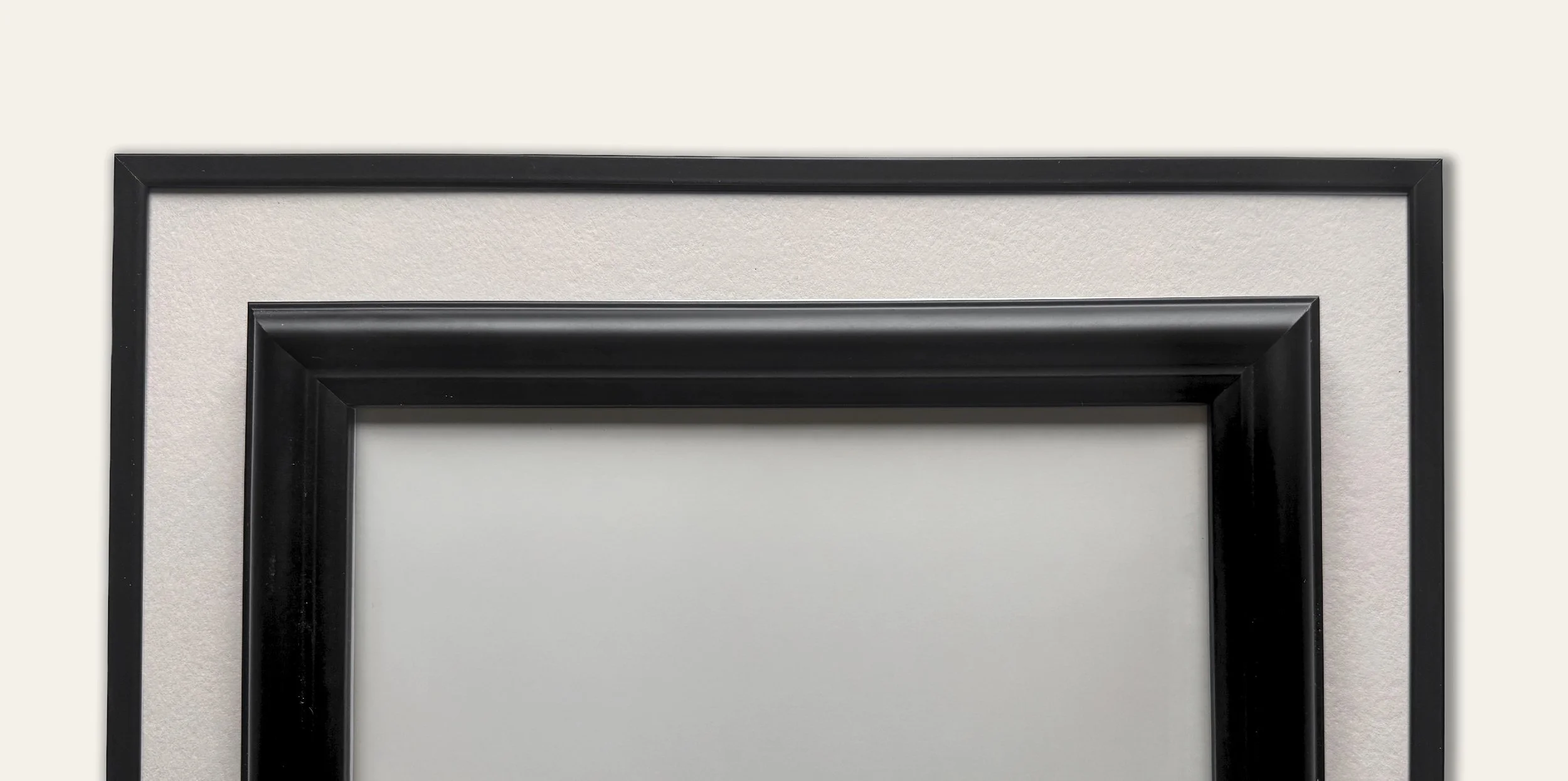
Two frames. A minimal matte black 8mm aluminium frame at the back, with a 24mm wooden frame at the front.
Thickness matters because it affects both the structural stability of the frame and the visual balance between the artwork and the frame. In general, the larger the artwork, the thicker the frame usually needs to be. A frame that is too thin can look a bit lost around a larger piece, while the right thickness gives the work more presence and proportion.
We can divide frames into two broad categories: thin and thick. Beyond aesthetic preference, the choice is often shaped by the material itself. Thin frames are often made of metal, because the material is strong enough to remain stable even in a narrow profile. At the same time, they usually cannot be made too thick, since that would make them too heavy. Thick frames, on the other hand, are more often made of wood. Wood generally cannot be made too thin or it will risk breaking, but it can be made much thicker while still remaining structurally sound. The widest frames are usually made of timber. Here is a simple overview:
Thin frames (6–12mm) offer a subtle, minimalist appearance. They draw minimal attention to themselves and are often chosen for modern interiors or artworks that benefit from a clean, almost invisible border. These are typically metal frames and are ideal for smaller prints or lightweight designs.
Thick frames (18–24mm or more) have a stronger visual presence and can become an integral part of the presentation. They add a sense of formality or importance to the piece and are often selected when the frame is intended to act as an extension of the artwork itself.
A wider frame leaves more room for decoration, which is why many wooden frames are more than just plain strips of wood. A wider frame also helps visually separate the artwork from the wall. The key is proportion. For example, an 10mm frame may work well for a 30×40 cm print, but it will likely look too thin and fragile for a larger 70×100 cm piece. Thin frames can appear overwhelmed by large-format artwork. A simple way to maintain visual balance across different artwork sizes is to scale the frame thickness proportionally. If a 10mm thick frame looks right on a 30×40 cm print, it’s likely because that frame width represents about 3–5% of the shorter side of the print. To preserve that same visual balance on a larger piece, you can scale the frame width by the same percentage.
Example: A 10mm frame on a 30×40 cm print means the frame width is roughly 3.3% (10mm/300mm) of its width. For a 70×100 cm print 3.3% is about 24mm. Hence, if you want the same visual effect on the 70×100 print as the 10mm frame on the 30×40, you’d likely want a frame in the 22-26mm range, depending on how bold or subtle you want the look. Many frame manufacturers offer the same frame design in multiple thickness options, allowing you to match style with proper scale. Always consider both the dimensions of the artwork and the overall aesthetic you're aiming for when choosing frame thickness.
Summary. Before deciding on frame thickness, think about the space where the print will hang and whether the print has a passepartout or not. A passepartout already creates a kind of frame around the image, and once you add an outer frame, you are essentially framing the frame. The question is how much of that outer border you want.
Should the frame stay minimal and let the print and passepartout take center stage, or should the frame play a stronger visual role as well? Many wooden frames benefit from a wider profile, since it gives the material more presence and allows the quality of the wood to show. There is reallyno single right approach here. The important thing is simply to consider the thickness of the frame in relation to the artwork.
5. Frame Depth
Unlike thickness, frame depth describes how far the frame sticks out from the wall. But depth refers to the internal space inside the frame — specifically, how much material it can hold between the front glazing and the back panel. It's a dimension most people tend to ignore until it is too late and a frame can’t be used. The rule is simple: the more layers your artwork has, the deeper the frame you need.
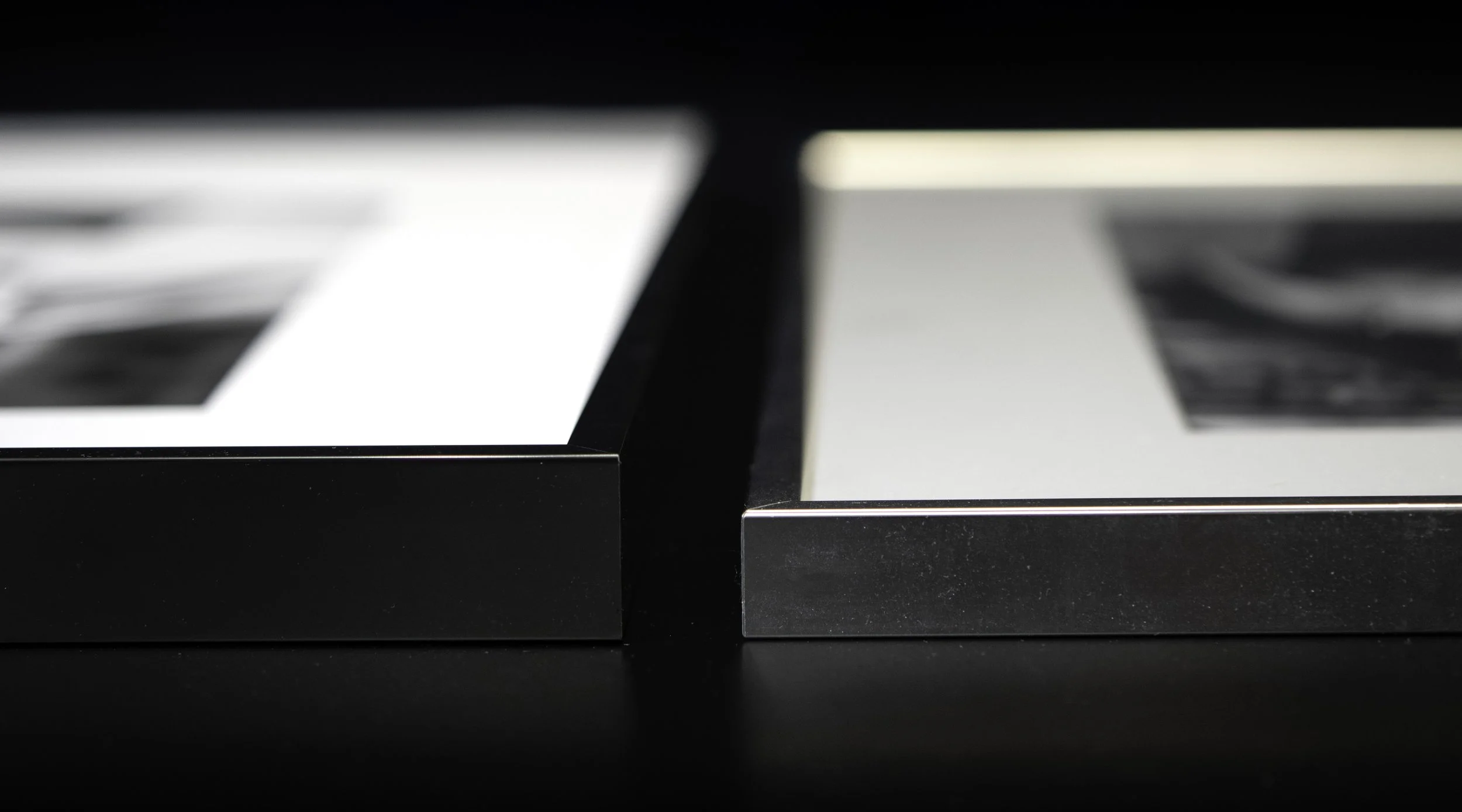
A deep frame (left) typically accommodates artwork with a deeper passepartout, often 4-5mm or more, to fit museum-quality matting. Thinner frames(right), on the other hand, are usually limited to single prints or artwork with a total depth of just 2mm.
Why depth matters? The best practice in print conservation is that a print should never touch the glazing. Glass and acrylic transfer temperature, and direct contact can cause the print to stick, warp, or degrade over time. The most common way to create that gap is a passepartout (mat board), which does two jobs at once: it frames the image visually and physically separates it from the glazing. A standard passepartout is around 1.8–2mm thick, which is enough clearance for most prints. If you prefer a borderless presentation, <u>spacers are the alternative</u> — <u>Halbe, for example, offers their own 5mm spacers</u> designed exactly for this. [→ link to Nielsen & Halbe article]. A good frame needs to work on two levels simultaneously: the depth has to fit your artwork's technical requirements, and the profile has to suit your wall. .
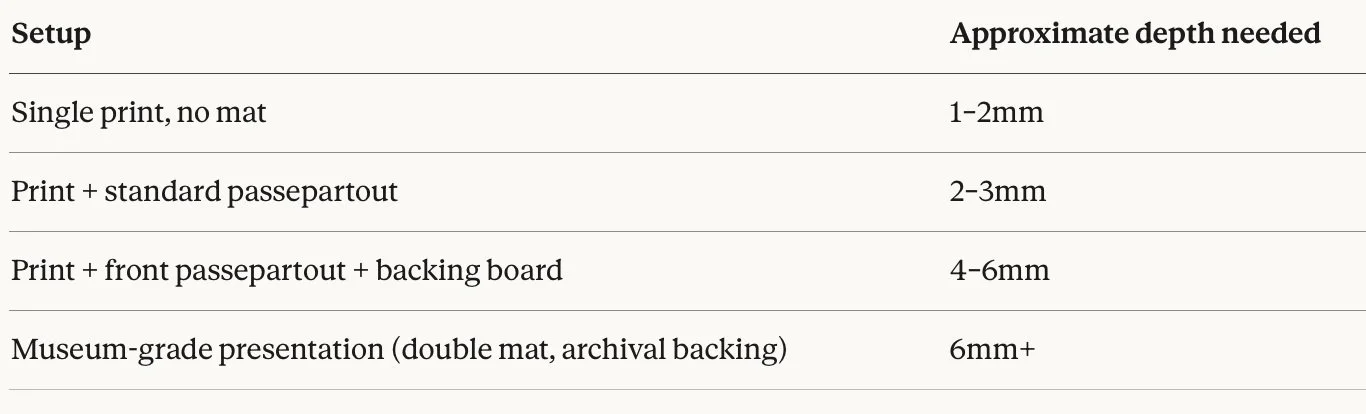
Most basic frames accommodate 1–2mm — fine for posters and everyday prints. For anything with a proper mat and archival backing, you'll need a frame with either a deeper rabbet (the internal recess that holds the art stack) or flexible inserts that adapt to thicker builds.
One more reason depth matters. If you ever intend to upgrade your glazing, like swapping standard 2mm glass for museum-quality anti-reflective glass or acrylic, your frame needs to accommodate that change. Premium glazing is often 4–6mm thick, meaning a frame that fits perfectly with basic glass may have no room for an upgrade.
This is one reason why basic frames are often shallow: they're built around standard glazing and nothing more. Wooden frames have some flexibility here — the pins holding the back panel can sometimes be adjusted to accept thicker glass, but if the frame's profile is too low, there simply won't be enough depth to make it work regardless of adjustments.
If longevity and upgradability matter to you, choose a frame with more depth than you currently need. Nielsen and Halbe both offer frames with generous rabbets precisely for this reason. It's the kind of decision that seems unnecessary at the time of purchase and obvious in hindsight.
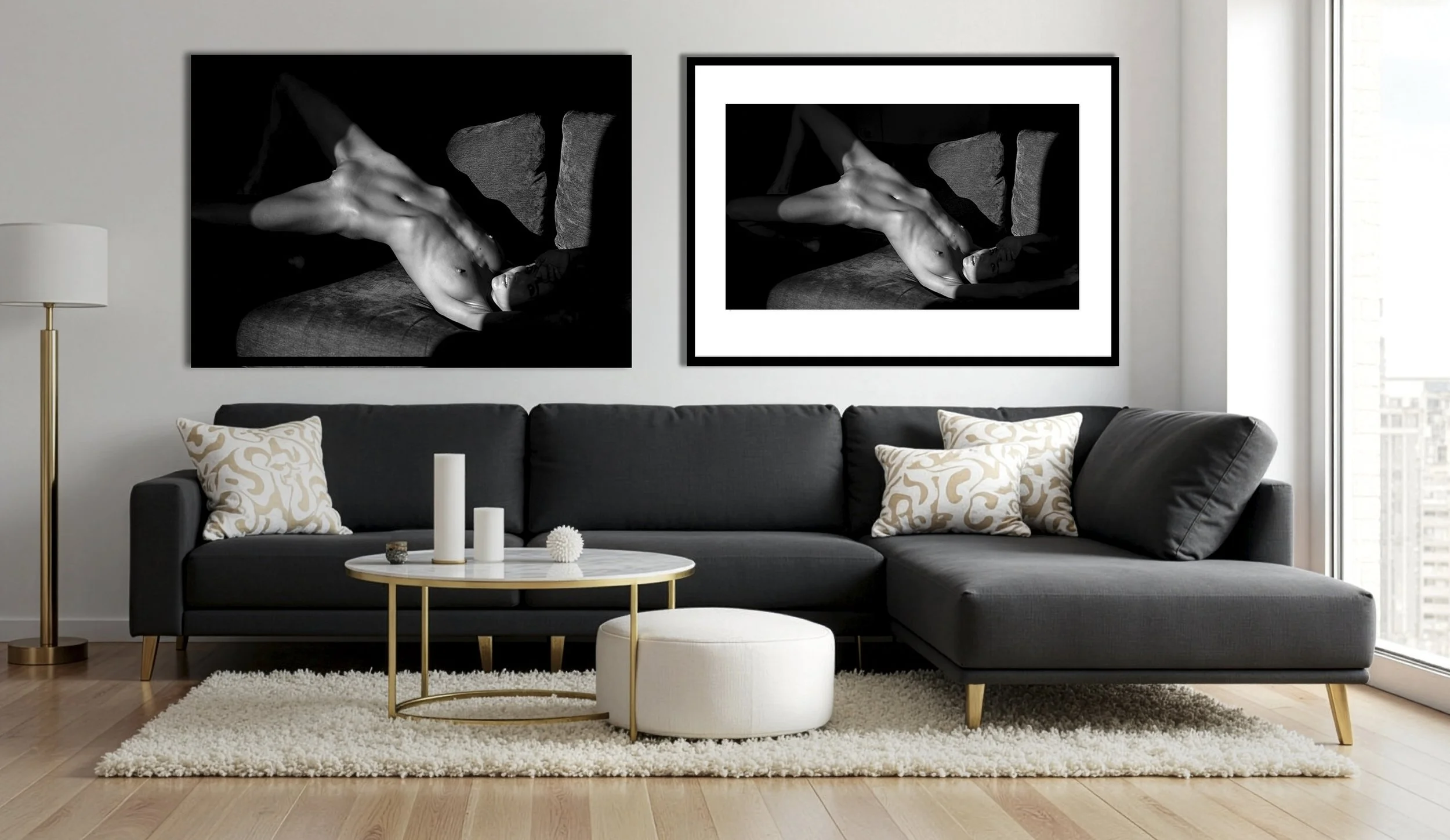
Two ways to frame the same print. Both approaches keep the print from touching the glazing — the borderless version(left) with spacers, the matted version with a passepartout. Different look, same principle.
A note on spacers. A print should never touch the glazing. If you're going borderless, spacers are what will create that gap. Halbe, for example, offers their own 5mm spacers designed exactly for this.
That said, spacers aren't a strict requirement. They're a best practice for prints that are valuable - irreplaceable or those you intend to sell later. If you're framing something you could easily reorder if it got damaged, you probably won’t need spacers. But if you've paid good money for a print, want to preserve it long-term, or might one day pass it on or sell it, spacers are a smart insurance. The risk without them isn't a certainty — it's a probability. Most prints will be fine. Some won't. Whether that gamble is worth it depends entirely on what's inside the frame.
This is an example of a 3cm spacer used to make the print stand out a little more. While it adds depth, it also creates stronger shadows because the image sits farther inside the frame. This is why frames with large spacers are often referred to as shadow box frames.
Summary: Before shopping for a frame, it helps to know your artwork and how you intend to frame it. How thick is the artwork? Do you plan to change the glazing? If so, how thick will it be? Once you know the answers, check the frame’s maximum insert depth in the specifications to see whether it will fit your needs. If you are buying online, some retailers let you choose the gap for the frame styles you want, as Halbe does. That is one reason their frames may be worth the premium over generic frame brands.
6. The locking mechanism

The top frame uses metal pins used to secure the backplate of a frame. These pins are not convenient to open repeatedly and can break after a few uses. In contrast, the bottom frame features a flexible locking mechanism - clips. Not only is it much easier to open, by simply press and turn it sideways, but it also accommodates thicker passepartouts, offering greater versatility.
Frames can also be categorised by the way the artwork is inserted and changed. That may sound like a small detail, but it affects both ease of use and the long-term care of the piece. Most frames open from the back. You remove the backing, place the artwork against the glazing, put the backing back in, and close the frame again. What really differs from one frame to another is the locking mechanism, and that is what this section looks at.
When I say that most frames open from the back, I am simplifying a bit. Some frames use a slot system, where the print is slid in and secured from below. These are often statement frames or tabletop frames made for a single photograph. Others, like Halbe’s front-opening system, take a completely different approach. And there you have it - 98% of all frames open from the back, some from the front, and others from the side. We will be talking only about the 98% segment.
I. Multi-Use Frames
These frames are designed for easy opening and frequent image changes. They typically feature clips, or snap-in backs that allow users to swap out artwork without damaging the frame or needing tools.
Ideal for collectors who like to rotate their displays seasonally or thematically
Common in galleries, retail spaces, and exhibitions where displays are updated regularly
Often used with prints that aren’t too fragile or need a conservational framing
Multi-use frames are all about accessibility and convenience, which makes them great for dynamic spaces or more casual displays. But many cheaper locking mechanisms are only meant to survive being opened and closed a handful of times before they start breaking. That is why it is worth paying attention to how the frame is actually built and hence we recommend taking a look at Nielsen and Halbe premium frames.
II. Permanent Frames
Permanent frames are meant for long-term or archival display. They usually need tools to be opened and closed, and in some cases may even be sealed for conservation. In that sense, they are less like temporary packaging and more like a permanent home for the artwork. Older painting frames are a good example. They were often treated as part of the work itself, and sometimes mattered almost as much as the painting inside.
Best for high-value, delicate, or archival-quality artwork
Often used in museums, private collections, and professional settings where artwork is not intended to be disturbed
Provide greater protection from environmental factors, dust, and handling
While it is still possible to replace the image in a permanent frame, the process is more involved and may require professional help to avoid damage.
If you're just starting out with framing, it's a good idea to begin with multi-use frames. These frames are more flexible—they can accommodate a wider range of artwork types and sizes. Once you've developed a more curated or permanent collection, you can always move on to archival or permanent framing solutions for your most valuable pieces.
Custom framing is almost always permanent. The back is often sealed to keep out dust, insects, and moisture, unlike reusable frames, which are designed to be opened again. Because of that, custom framing tends to create a more finished object, where the frame and the print feel like one unified piece.
So which sustem is better? It really depends on the kind of collector you are. I personally own more prints than I have frames or space to hang them, so I rotate them regularly. Because of that, I mostly use reusable frames, especially Nielsen and Halbe. There is also the issue of flexibility. With custom framing, you usually make all the decisions up front and then live with them. But what happens if you later want to change the passepartout, or upgrade to museum glass? Often, that is not really possible. For my needs, that is why reusable frames tend to be the better choice.
7. Glazing Options
The title of this article is “Bad Framing Kills Good Art,” and the same can equally be said about glazing. In fact, glazing is what makes or breaks a frame. There is nothing more satisfying than replacing the standard glass in a frame with museum glass and immediately seeing the difference. Personally, I think glazing is one thing that consistently blows people’s minds when they see a good one. Few things improve the presentation of an artwork as much as good glazing. But this is not what most people think about when buying a frame. The glass you get with most commercial frames is not what you need. Let me develop that thought.
Most paintings in private homes do not have glazing unless they are displayed in a place where extra protection matters. This is often what separates the framing of prints from the framing of paintings. While frames themselves have a much longer history, protective glazing became far more common later, especially with works on paper such as pastels, gouache, and watercolors. In that sense, a photograph is often closer to a watercolor or charcoal drawing than to an oil painting on canvas. And it is understandable: prints are made on paper, with chemicals and inks that are often far less stable than canvas, oil paint, and layers of varnish. Sadly, UV is the enemy of prints, and long exposure will change their colors. Prints therefore need protection from UV light, but also from moisture, gases, and everyday wear. The problem and the need for protection are real and clearly defined. The trouble is that the standard solution often does not solve it very well.
Somehow, frames with cheap glass have become the standard. Try finding a frame in a store without glass and you will see what I mean. It is almost impossible. Glass, and particularly cheap glass, has become part of the standard frame package, and it does very little to protect a print. It usually offers no meaningful UV protection, creates strong reflections, and if it breaks, it can shatter and damage the artwork. Acrylic is better in that respect: it will not break. Both standard glass and standard acrylic have strong reflections and little or no UV protection. So why do we need them? There is no good answer. In most cases, we do not.
Seriously, in most frames, glass is not there for protection but simply to hold the print in place. That is the one function it can perform very well. Without it, a print will just fall out, so we can say that glass is essential to the function of a frame. But if you have a print in a passepartout, the passepartout can hold the print without the glass. Try it and you’ll see what I mean. In that case, glass may not be needed, and leaving it out allows you and your guests to touch the print directly, which is often a deeply appreciated gesture. Many fine art papers have texture. There is a purpose to that texture. It gives the print a kind of fingerprint, but once it is covered behind glass, that tactile experience is gone.
My point is that, many times, glass is just an unnecessary element in a frame. But of course, that depends on the type of image, how valuable it is, and how it was made. Some images are irreplaceable, and some are hung in environments that are dirty, wet, or prone to insects. The Library of Congress specifically lists light, water, humidity, airborne pollutants, and dust among the things preservation framing tries to limit. These are all real problems, and glazing is needed.
So we know we need protection for our valuable prints, and it also has to be invisible. Standard glass can do neither, or very little. What is the solution? Reflex-free museum glass, or museum-grade acrylic with 70 to 99% UV protection. These are specially developed types of glass or acrylic with coatings that solve both problems. They are standard in museums and high-end framing. The problem is the price. These options can often cost more than the frame itself.
To sum up this introduction, the choice in glazing is usually this: cheap glazing that solves little, no glazing at all, or expensive glazing that finally does what glazing is supposed to do. Now let’s look at the details.
Glass is a traditional glazing option known for its exceptional clarity and sharpness. It provides a crystal-clear finish that allows the true essence of the piece to shine through.
The problem is that, with most commercial frames, you are typically getting standard green-tinted float glass (green), low-iron glass(white), or standard float glass (float), which does very little for your print in terms of UV protection. This is essentially window glass. It is often 2 to 3 mm thick, easy to break, and highly reflective.
What you actually want is UV-protective, anti-reflective glass. This is museum glass or art glass with special coatings that provide UV protection and reduce reflections. There are only a handful of manufacturers of this type of glass, with GroGlass and Tru Vue being the best known. Most framing stores offer one of the two, essentially the Pepsi and Coca-Cola of the framing world.
However, these special types of glass are often heavier, thicker, and still prone to breakage unless they are also tempered. They may not fit a standard frame unless there is enough space to replace a standard 2mm sheet with a thicker one that can be up to 6mm thick. That is one reason museum glass is mainly offered as a custom framing option. And of course, it is far more expensive. We are talking about five to 6 times the price of standard glass. But if you have something beautiful and valuable, would you rather use ordinary glass that does little to protect or enhance it, or spend more and get the real upgrade?
Glass can be made in very large sizes, but in practice its weight limits its use in larger frames. In those cases, acrylic, which typically weighs about half as much as glass, is often the better choice.
Acrylic, often referred to as Plexiglass, is a lightweight and shatter-resistant alternative to traditional glass, making it an ideal choice for larger frames or for environments where safety and durability matter. Acrylic can provide a clear, polished appearance similar to glass, but it is far more resistant to breakage, which makes it safer both for the artwork and for the people around it. Like glass, it can also be treated with a range of protective coatings, such as UV-blocking layers or anti-reflective finishes, which help preserve the artwork and reduce glare. However, uncoated acrylic is more susceptible to scratching, and scratch-resistant coatings can help reduce that problem.
Because it is much lighter than glass, acrylic is often chosen for larger works or whenever handling and transport are a concern. Tru Vue specifically recommends acrylic for oversized works, shipping, high-traffic areas, children’s rooms, and places where safety matters. If you are buying a frame online, acrylic is usually the safer option. Glass is more likely to break in transit, and even if you receive a replacement, the delay and hassle can be frustrating.
Acrylic also comes in different thicknesses depending on the quality and price of the frame. Budget frames often use a thin acrylic sheet, which may be more prone to warping or scratching and in general should only be used temporarily. Higher-end frames often use thicker acrylic, usually 2-3mm. Both GroGlass and Tru Vue offer museum-grade acrylic, but it is usually even more expensive than the glass version. Tru Vue markets Optium Museum Acrylic as a premium product with anti-reflective, abrasion-resistant, anti-static, shatter-resistant, and 99% UV-protective properties, which helps explain the higher cost.
Protective Coatings & Features
Whether you choose glass or acrylic, the following features can greatly improve both protection and visual quality, and they are worth understanding before you buy.
UV Protection
Reduces fading and deterioration caused by ultraviolet light. This is especially important for archival-quality artworks, photographs, and anything displayed in bright rooms or near windows. High-end conservation glazing often offers 97%- 99% UV protection, with 99% being common in museum-grade products. Many premium glass products come in 70% UV-protection versions, which are cheaper than the 99% versions and still far better than standard glass. This is often the sweet spot between protection and cost.
Anti-Reflective Coating
Reduces glare and surface reflections, making the artwork easier to see and giving the glazing a more invisible appearance. This is one of the most noticeable upgrades in everyday viewing, especially in bright interiors or rooms with many light sources. Tru Vue’s Museum Glass is specifically designed to “virtually eliminate reflections.”
Scratch-Resistant Coating (Acrylic)
Improves the surface durability of acrylic, making it more suitable for situations where the glazing may be cleaned or handled more often. This matters because standard acrylic is softer than glass and scratches more easily. Abrasion-resistant acrylic is a useful upgrade for high-use settings.
Tempered Glass
Improves resistance to impact and changes the way the glass breaks. Instead of breaking into dangerous sharp shards, tempered glass is designed to break into smaller, less hazardous pieces. It is safer than ordinary glass, although it is still glass and can still fail under impact.
Fire-Resistant Acrylic
A specialty acrylic designed to perform better under fire-safety requirements. This is usually relevant in commercial, institutional, or public settings rather than normal home framing. It is not the same thing as scratch-resistant acrylic, and it is usually chosen for compliance or safety reasons rather than viewing quality. (You may want to mention that this is a niche feature and not something most private collectors need.)
Non-Glare / Reflection-Control Surface
Different from true anti-reflective coating. Non-glare glazing usually uses an etched or matte surface to scatter reflections, but it can slightly soften the image, especially if the print is not directly against the glazing. The farther the image sits behind it, the softer it looks. That means it does not work well with deep frames, spacers, or other setups where the artwork sits back from the glazing. Anti-reflective museum glass is generally the better option when image clarity matters most. Tru Vue distinguishes between reflection-control products and true anti-reflective museum products for exactly this reason.
8. Style and Aesthetics
The final consideration is the style and overall aesthetic of the frame—this is where all the practical decisions come together to support the visual impact. At this stage, you know the size of the frame, the material, and the color. You also know that thickness, depth, locking mechanism, and glazing all matter. What you may still not know, however, is what style of frame you want. Now it’s about choosing a style that suits both your artwork and your space. The right choice will depend on both the character of your artwork and the style of your interior. Matching the artwork with the frame—and the frame with your interior—is where the true art of framing lies. Nevertheless, there are some guiding principles you can follow to make the process easier and more intentional.
For modern, industrial, or Scandinavian interiors, where clean lines and simplicity are key, smooth metalor thin black wood frames are a natural fit.
Villas, bohemian, or organic spaces pair beautifully with natural wood frames that showcase organic grain and texture.
Classic, maximalist, or vintage-inspired interiors often call for gold-leaf frames or heavily carved baroque-style designs that add richness and historical character.
And in glamorous, luxurious, or colorful settings, glossy, mirrored, or metallic frames can introduce an elegant, eye-catching finish.

A warm gold classic frame with a broad profile and delicate inner beading. Style-wise, it sits somewhere between traditional, vintage, and gallery-classic. Elegant, timeless, and ideal for adding presence and character to portraits, fashion images, and statement prints. In interiors, it works especially well in classic, expressive, or Parisian spaces.
A note on picture hanging. An important point that many people miss is how the prints will actually hang. The way a frame hangs really matters, and hardware choice affects both compatibility and stability. Do you already have, or are you planning to install, a gallery rail? Will you use adhesive strips(powerstrips), screws, or nails? What kind of attachments does the frame need to support the way you want to hang it? This is a very overlooked detail, and it often creates frustration when you think you have everything ready, only to discover that the frame cannot be hung the way you intended.
Frame suppliers and hanging guides commonly discuss different hardware setups such as D-rings, wire, sawtooth hangers, rails, and corner or wall-protection bumpers a nd they also sell picture-hanging kits. It is worth having a kit like that at home so you can adjust frames when needed. Wooden frames, unless custom-made, often need a bit of modification before they can be hung safely. That might mean adding a wire or placing silicone bumpers on the back. Silicone bumpers are a good habit in general, since they help protect the wall and keep the frame steady. They are placed on the two lower corners and come in all kinds of forms, round or square, black or transparent.
Buying tips
When choosing a manufacturer, start by exploring local producers—they often provide the best variety and pricing options. A visit to your local framing store will typically showcase the ready-to-hang frames they offer. On an international level, specialized framing brands like Nielsen, Halbe, Larson-Juhl, DEHA offer a wide range of frames, from small to oversized, combining premium materials with expert craftsmanship. High-end designer frames, often from fashion and jewelry houses like Ralph Lauren, Tiffany & Co., and Versace, are more exclusive, usually focused on tabletop sizes and not found in traditional framing stores. Consumer brands such as IKEA, H&M Home, and ZARA Home offer mid-range frames in various sizes, designed to complement their unique interior aesthetics, and these too are typically unavailable in local framing shops. Also check Etsy. Many independent makers there offer excellent craftsmanship, custom sizes, and frame styles that are hard to find from larger brands.
Lastly, because the right frame provides aesthetics, functionality, and protection for your art, it’s a smart idea to take your art to a professional framer for advice. While you’re not obliged to follow their recommendations, you might find that their expertise leads you to a frame better suited to your artwork than one you might choose yourself. There are also specialized framing solutions designed for all-weather protection, as well as frames that are fire-resistant or theft-proof - that you will not find in traditional stores. As we covered in our review of Nielsen and Halbe frames, both offer excellent ready-to-hang framing solutions for a range of needs.
In addition, here are some general guidelines to keep in mind:
• 30% rule. A good rule of thumb is to spend about 30% of the price of the print on the frame. For example, a $100 print pairs well with a $30 frame, while a $300 print would suit a $100 frame. This can of course vary depending on the price of the artwork. Higher-priced works may fall closer to 20% or even 10%, while less expensive ones may end up closer to 50%. Custom-framing might also significantly bump up this number.
• Glass is optional. Glass is often a bonus that you might no need. If you’re on a tight budget and an identical frame is available with either glass or acrylic glazing, consider choosing the acrylic option. Acrylic is lighter, more affordable, and still offers similar protection as glass. Plus, you can always upgrade to premium glass later if needed, making it a practical choice for budget-conscious framing - taking it one step at a time.
• Consider used frames. A used frame can add a lot of character to a print and sometimes make it look far better than a new commercial frame. Check your local thrift stores from time to time. It is also worth looking at art listings on sites like eBay, where a piece may come with a high-quality or unique frame that you can reuse for your own work and then sell the original art separately. Frames made from rare woods are especially interesting finds, since you are unlikely to see them new in an ordinary frame shop.
• Buy in pairs. Consider purchasing two identical frames. A matching pair creates visual coherence, adding to a harmonious and polished look in your space. This is why galleries and museums often use identical frames—it establishes a consistent and professional style. Even if you don’t have an immediate use for the second frame, you’ll likely find something to display in it soon enough. The alternative can be worse. Commercial frames are often like car models—regularly replaced by new designs and discontinued after a short time. If you wait too long to purchase a matching frame, it might no longer be available, leaving you with mismatched pieces that disrupt the overall aesthetic.
To sum up, the frame you choose not only protects your artwork but enhances its presence and impact in your space. Framing is an investment in the long-term enjoyment and preservation of your collection, so choose wisely and let your artwork shine in the best possible light.
Conclusion and next steps
Now that you know more about framing, I hope you’ll never pass by a frame without noticing it. And it doesn’t need to be at museums. Frames are everywhere—in hotels, in bars, in coffee houses, in offices, and even at friends' houses. Everywhere you go, there’s an opportunity to observe how different frames can influence the overall aesthetic of a space. This gives you ample opportunities to study and appreciate them, refining your eye for the small but important details that can make or break the presentation of a piece. Does it fit the artwork? What color and material is it made of? How prominent is it? How unique is it? Does it fit the current setting? Why was it chosen? What would you have chosen? All of these questions are important because they train your eye to be more discerning, ultimately helping you refine your own collections.
This exercise might also reveal to you just how much value a frame can add—or take away. A poorly framed artwork, a lazy framing decision, can detract from an otherwise great piece. Learn from it, and don’t treat a frame as just a simple decoration. It is, in fact, an integral part of the artwork.
If you want to keep exploring frames, check out our review of Halbe and Nielsen frames. We also recommend reading What makes a Good Print? and, of course, the must-read Guide to Quality and Size Options at NUDICCI.
If you’re keen to explore what to frame, we’d recommend starting your collection at a lower price point. It’s a good way to ease in and see whether collecting feels like your thing. Take a look at our Prints Under €100 and Silver Tier Printscollections. And when you’re ready to explore limited editions or really large prints, we’ve got those too.
Want to learn more? conservation-wiki.com is great source to learn what is considered the best practices in framing, and they also have a great list of resources for photographic prints.
Hanging and arranging artworks is another topic we will cover in the next article. For now, check out this video for some inspiration.
A short video about making your own gallery wall.