

The Latest


The Art of Framing Art
Bad framing kills great art. Framing is a powerful tool that shapes how we see and feel about a piece. It’s the difference between simply hanging something on a wall and turning it into a bold statement. The right frame can transform a simple print into true art.
Framing is what separates a poster from a true work of art. Today, we frame more things than ever - photos, paintings, certificates, and sports jerseys, but the fundamental principles of framing remain unchanged. Framing can be traced back to ancient Egypt, where it was used in religious and ceremonial contexts. It remained primarily a religious artifact (think iconography) up until around 1200. Fast forward just 200-300 years, and framing became primarily associated with paintings and drawings. However, there were no standardized sizes for artwork, meaning each piece required a custom-made frame. Framing was both an art form and a profession, as well as a practical necessity. Today, we have a much wider range of materials to create frames from, and frame sizes have become more standardized. Despite the industrialization of framing, it remains an art form, and the right frame can either elevate or diminish the impact of your artwork. Let’s take a closer look at what framing is and why it’s so important.
Framing enhances the visual impact of artwork while providing structural stability and protection. A well-chosen frame elevates the piece and helps it either blend seamlessly into its surroundings or stand out. The art of framing lies in finding the right balance between choosing a frame that protects and enhances the artwork while also complementing the space in which it’s displayed. In this way, framing allows us to personalize the art we bring into our homes. Some collectors prefer to use the same framing style for all their artwork, creating a uniform and formal presentation that doesn’t distract from the pieces themselves—think of gallery walls with consistent frames. Others embrace variety, allowing for a visual dialogue between each frame and its artwork—like in museums, where each piece often has a custom-made frame that reflects its character. There’s no single right way to frame art—but there are certainly many ways to do it poorly. As with many things in life, randomness and impulse rarely lead to the best results. A thoughtful approach or guiding strategy can go a long way toward making your framing choices feel intentional and cohesive.
Short Guide to Choosing the Best Frame
There is a staggering variety of frames available, ranging from inexpensive plastic models to luxurious options crafted by top jewelry brands. This isn't meant to be a comprehensive guide on all of them, but rather a starting point to help you make informed decisions. For more in-depth information, there are tutorials, magazines, books, and a wealth of infographics online that can further assist in choosing the right frame for your art. What we've done is put together the 8 key considerations for choosing the right frame. Let’s begin!
1.Frame Size
Frames come in many sizes, but most follow standardized formats—either ISO sizes (like A4 or A3), traditional photographic dimensions from the analog film era, or your country’s local standards (like ANSI). Custom-sized frames are also an option for uniquely sized artwork, though these are typically made to order.
If you’re buying unframed art, finding the right frame is usually straightforward. When the artwork is mounted in a passepartout (mat), the outer dimensions of the mat determine the frame size you’ll need. For example, an A4 print mounted in an A3 passepartout will require an A3 frame. That’s really all there is to frame sizes—simple and easy process. Once you’ve determined the frame size, the next step is choosing the color and material that best complement your artwork and space.
2. Frame Material
Frames are commonly made from three basic materials: plastic, wood, and metal. Each has its own pros and cons and it is worth understand the choice here.
Plastic frames are often the go-to choice for those seeking a budget-friendly and lightweight framing solution. They come in a variety of colors and finishes, offering versatility while replicating the appearance of more expensive materials like wood or metal. This makes them an attractive option for those looking for style at a lower cost. Plastic frames are particularly useful for larger prints or artworks where the weight of the frame might otherwise be a concern.
Additionally, plastic frames are resistant to certain environmental factors, meaning they won’t warp, swell, or crack due to humidity or temperature fluctuations. This durability makes them an excellent choice for areas with changing climates. Another exciting advantage of plastic frames is the potential for 3D printing—with advanced technology, frames can now be printed in creative and custom designs that are both durable and unique.
On the downside, cheaper plastic frames are more prone to cracking, scratching, and discoloration over time, which can detract from their overall aesthetic. To avoid this, it’s essential to opt for higher-quality, premium plastic frames that offer better durability and a more refined look. Avoid flimsy, low-quality frames that may compromise the visual impact of your artwork.
Wood frames add a timeless, natural warmth to artwork that no other material can replicate. The rich textures and grains of wood complement a wide range of art styles, from traditional to contemporary. Whether it’s a classic oak or a luxurious walnut, wood enhances the character of your piece, giving it a more organic, bespoke feel. Its tactile quality adds depth and warmth, making the artwork feel more intimate and connected to its surroundings.
Beyond aesthetics, wood is a renewable resource. Many manufacturers now offer frames made from reclaimed or responsibly harvested wood, making it a more sustainable and environmentally conscious choice. Wood frames are also commonly associated with luxury and craftsmanship, often used to elevate the perceived value of a piece—ideal for framing valuable works or creating a refined, upscale presentation.
One of wood’s greatest strengths is its versatility. It can be stained, painted, or left in its natural state to match almost any interior. A wide variety of finishes and styles are available, from rustic to modern. Skilled framers can also create fully custom wood frames tailored to your exact size and design preferences, offering endless creative potential.
In terms of durability, high-quality wood frames can last for decades when properly maintained. Certain hardwoods, such as oak and cherry, are particularly long-lasting and resistant to wear. Wood’s natural ability to "breathe" also helps regulate humidity, which can benefit the longevity of your artwork in environments with fluctuating climates.
However, wood does have its drawbacks—most notably, its weight. Unlike plastic or metal, wood cannot be made as thin and strong, so frames tend to be thicker and heavier. While this isn’t an issue for smaller pieces, larger artworks may require more robust wall mounting or support to ensure they remain safely in place.
Metal frames offer a minimalist, modern aesthetic combined with a strong yet lightweight structure, making them a popular choice for contemporary and industrial-style interiors. Typically crafted from aluminum, metal frames feature a cool, clean-lined appearance that pairs beautifully with photography, graphic art, and modern prints. At the same time, they can create a bold contrast when used with more traditional or classic works, adding visual interest through juxtaposition.
A key advantage of metal frames is their precision and uniformity. Because they are machine-manufactured, they provide a clean, exact finish—perfect for those seeking a polished, professional presentation. This makes them especially well-suited for gallery walls, commercial displays, or exhibition spaces where consistency and sleekness are important.
Another major strength is their exceptional strength-to-weight ratio. Metal frames are generally thinner and lighter than wood, yet offer excellent structural integrity. This makes them ideal for large artworks, reducing overall weight while maintaining stability. Metal is also highly resistant to environmental changes—it won't warp, expand, or contract due to humidity or temperature fluctuations. As a result, metal frames offer reliable, long-term protection for your artwork, especially in challenging environments.
However, metal frames do have their drawbacks. They can feel colder or less personal than wood, and may not blend as naturally with interiors that emphasize warmth, texture, or traditional design. Additionally, although metal is durable, very thin or oversized metal frames can be more susceptible to dents if not handled carefully.
Other materials. There are also frames made from more unusual or luxurious materials—leather, glass, stone, carbon fiber, and even precious metals like silver or gold. These frames can be visually striking and often serve as statement pieces. However, they tend to be expensive and stylistically challenging to find artwork that truly harmonizes with them. They often overshadow the very artwork they are meant to present, drawing attention away from the image instead of enhancing it.
3. Frame Color
Frame material and frame color are two of the most important elements in the overall presentation of an artwork. While material affects weight, texture, and structure, color directly influences how the artwork is perceived. Choosing the right frame color is a creative decision—one that can subtly support the art or make a bold statement that changes how it's experienced.
The most commonly used frame colors are black, white, and silver/metallic.
Black frames provide a strong, defined edge that enhances contrast and draws attention to the artwork. They are particularly effective with photographs, graphic art, and pieces that benefit from visual separation from the wall.
White frames offer a softer, more neutral border, ideal for lighter-toned artwork or minimalist settings where the frame should quietly support without dominating.
Silver and metallic finishes bring a sleek, contemporary feel, often used with abstract or modern works to add a touch of sophistication and edge.
However, frame colors are by no means limited to these three. Frames can be found in virtually any shade or finish—from natural wood tones and warm earth hues to vibrant, saturated colors and weathered, distressed looks. A well-chosen frame color can enhance the artwork's palette, reflect the emotional tone of the piece, or tie into the room’s overall design.
A carefully selected color helps define the mood, focus, and relationship between the artwork and its environment, making it a key element in the storytelling power of presentation.
4.Frame Thickness
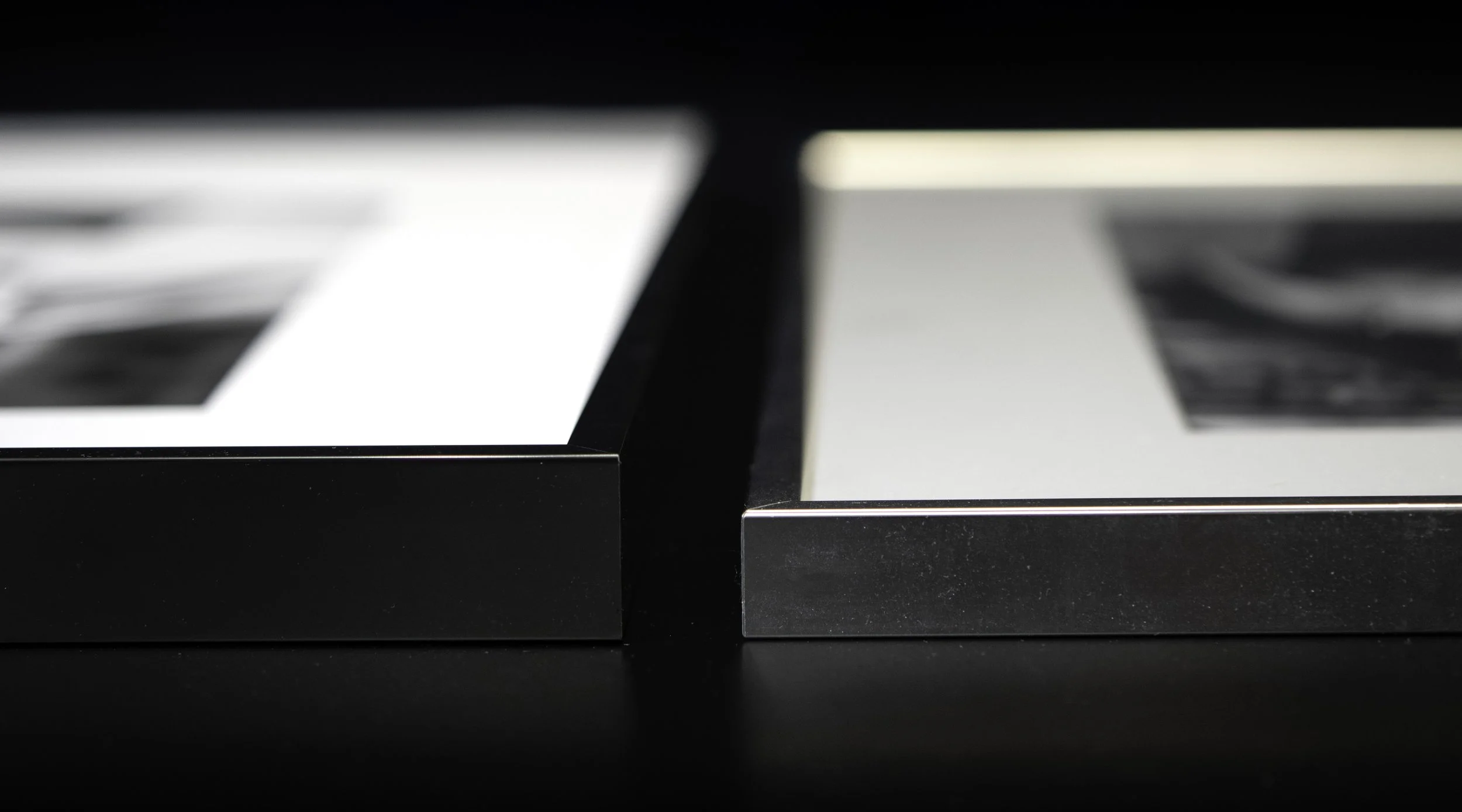
A thick frame (left) typically accommodates artwork with a deeper passepartout, often 3mm or more, to fit museum-quality matting. Thinner frames, on the other hand, are usually limited to single prints or artwork with a total depth of just 1–2mm.
Thickness refers to the front-facing width of the frame—the visible edge that borders the artwork—not how deep the frame extends from the wall.
Frame thickness plays a significant role in the visual balance between the artwork and its frame:
Thin frames (6–10mm) offer a subtle, minimalist appearance. They draw minimal attention to themselves and are often chosen for modern interiors or artworks that benefit from a clean, almost invisible border. These are typically metal frames and are ideal for smaller prints or lightweight designs.
Thick frames (18–24mm or more) have a stronger visual presence and can become an integral part of the presentation. They add a sense of formality or importance to the piece and are often selected when the frame is intended to act as an extension of the artwork itself.
A wider frame also helps visually separate the artwork from the wall, which is especially useful when the wall color closely matches tones in the artwork.
The key is proportion. For example, an 8mm frame may work well for a 30×40 cm print, but it will likely look too thin and fragile for a larger 70×100 cm piece. Thin frames can appear overwhelmed by large-format artwork, making the entire presentation feel unbalanced.
Many frame manufacturers offer the same frame design in multiple thickness options, allowing you to match style with proper scale. Always consider both the dimensions of the artwork and the overall aesthetic you're aiming for when choosing frame thickness.
A simple way to maintain visual balance across different artwork sizes is to scale the frame thickness proportionally. If a 10mm thick frame looks right on a 30×40 cm print, it’s likely because that frame width represents about 3–5% of the shorter side of the print. To preserve that same visual balance on a larger piece, you can scale the frame width by the same percentage.
Example:
A 10mm frame on a 30×40 cm print means the frame width is roughly:
10mm ÷ 300mm = ~3.3% of the short side (30 cm)
For a 70×100 cm print:
3.3% of 700mm = ~24mm
So yes, if you want the same visual effect on the 70×100 print as the 10mm frame on the 30×40, you’d likely want a frame in the 22-26mm range, depending on how bold or subtle you want the look.
5. Frame Depth
Depth refers to the internal space inside the frame—specifically, how much material it can hold between the front glazing (glass or acrylic) and the back panel. This dimension is essential when framing artworks that require more than just a flat display.
Deeper frames are necessary for fine art prints with a passepartout (mat board).
These frames allow for greater depth, such as fine art prints with both a museum quality mat and archival backing. A deeper profile also adds a sense of dimensionality and sophistication, giving the piece a more gallery-like or museum-grade appearance.
In contrast, shallow frames are designed for flat, single-layer items such as: posters, single photo prints and Certificates or documents. These frames are typically more affordable and minimalist. While perfect for simpler presentations, they may be limiting if you’re working with premium or conservation-grade artwork.
Most basic frames can accommodate artwork 1–2mm thick, which is suitable for everyday prints and basic passepartout. However, higher-quality or professionally mounted art—especially museum quality pieces—often includes both a front and backing passepartout, resulting in a total thickness of 4–6mm or more. In such cases, you’ll need frames with either:
A deeper rabbet (the internal recess that holds the art stack), or
Flexible inserts or spacers that can adapt to thicker presentations.
When in doubt, check the frame’s maximum insert depth before purchasing—especially if you plan to include matting or protective layers.
When choosing a frame, ensure both the thickness matches your aesthetic goals, and the depth matches the technical needs of what you're framing. A beautifully thick frame with insufficient depth won't accommodate a mat properly, while a deep frame with an overly thin profile might look visually off-balance.
6. Insert Type

The top frame uses metal pins used to secure the backplate of a frame. These pins are not convenient to open repeatedly and can break after a few uses. In contrast, the bottom frame features a flexible locking mechanism. Not only is it much easier to open, by simply press and turn it sideways, but it also accommodates thicker passepartouts, offering greater versatility.
Frames can be categorized by how the artwork is inserted and replaced. This distinction affects not only convenience but also the long-term care and purpose of the frame.
I. Multi-Use Frames
These frames are designed for easy opening and frequent image changes. They typically feature flexible tabs, clips, or snap-in backs that allow users to swap out artwork without damaging the frame or needing tools.
Ideal for collectors who like to rotate their displays seasonally or thematically
Common in galleries, retail spaces, and exhibitions where displays are updated regularly
Often used with posters, prints, or photography that isn’t fragile or archival
Multi-use frames prioritize accessibility and convenience—perfect for dynamic spaces or casual displays.
II. Permanent Frames
Permanent frames are designed for long-term or archival display. They usually require tools to open and close, and may even be sealed for conservation purposes.
Best for high-value, delicate, or archival-quality artwork
Often used in museums, private collections, and professional settings where artwork is not intended to be disturbed
Provide greater protection from environmental factors, dust, and handling
While it is still possible to replace the image in a permanent frame, the process is more involved and may require professional help to avoid damage.
If you're just starting out with framing, it's a good idea to begin with multi-use frames. These frames are more flexible—they can accommodate a wider range of artwork types and sizes.
Once you've developed a more curated or permanent collection, you can always move on to archival or permanent framing solutions for your most valuable pieces.
7. Glazing Options
The choice between glass and acrylic as glazing materials directly impacts both the presentation and long-term preservation of your artwork. Each material offers distinct advantages and comes with various protective coating options that enhance durability, visibility, and protection from environmental damage.
Glass is a traditional and premium glazing option known for its exceptional clarity, which enhances the sharpness and vibrancy of colors in artwork. It provides a crystal-clear finish that allows the true essence of the piece to shine through, making it a popular choice for high-quality frames, especially in fine art or photography. Glass also offers excellent protection against dust, dirt, and environmental factors while adding a refined, premium feel to the overall presentation. Available in various types, (green, white, and floating glass), UV-protective glass, and anti-reflective options, it caters to both aesthetic and preservation needs. However, its heavier weight and susceptibility to breakage yet tempered glass offers a more durable alternative. It’s heat-treated to increase its strength and is less likely to break upon impact compared to regular glass.
Glass - Summary:
Clarity & Appearance: Offers superior visual clarity and a premium, high-end appearance. It enhances the artwork's sharpness and color fidelity.
Protection: Available in various types including standard, UV-protective, and anti-reflective glass (Artglass).
Limitations: Heavier and more fragile than acrylic, making it less ideal for large frames or environments where safety and durability are priorities.
Best for:
Smaller frames
Permanent or luxury installations
Low-traffic areas
In many premium frames, the glass is the primary factor that drives up the cost. Premium options, such as museum-grade or UV-protective glass, are often used to enhance both the artwork’s presentation and its long-term preservation. Often, a similar frame can be purchased much more affordably with standard glass or no glass at all.
Acrylic, often referred to as Plexiglass, is a lightweight and shatter-resistant alternative to traditional glass, making it an ideal choice for larger frames or environments where safety and durability are important. Acrylic provides a clear, polished appearance similar to glass but is virtually unbreakable, making it safe for both artwork and people around it. Similar to glass, it can also be treated with a range of protective coatings, such as UV-blocking layers or anti-reflective finishes, which help preserve the artwork and reduce glare. However, acrylic can be more susceptible to scratching, though scratch-resistant coatings can mitigate this issue. Due to its lower weight, acrylic is often chosen for larger pieces or when the ease of handling and transportation is a concern. Acrylic comes in varying depths depending on the quality and price of the frame. Budget frames often feature a thin acrylic sheet, which may be prone to warping or scratching. In contrast, higher-end frames typically use acrylic that ranges from 1mm to 3mm in thickness, offering increased durability, rigidity, and better overall protection for your artwork.
Lightweight & Durable: Much lighter than glass and highly resistant to shattering, making it a practical choice for larger frames or public/high-traffic areas.
Scratch Sensitivity: More prone to scratching than glass, though scratch-resistant coatings are available on higher-end options.
Cost-Effective: Standard acrylic is typically less expensive and easier to handle during shipping or installation.
Best for:
Large artworks
Children’s rooms or busy spaces
Framing that needs to be lightweight or transportable
Acrylic is a far better choice for shipping. If you're purchasing a frame online, acrylic is the safer option. Frames with glass are more prone to damage during transit, and even if you receive a replacement, the delay can be frustrating.
Protective Coatings & Features
Whether you choose glass or acrylic, the following features can greatly enhance both protection and visual quality:
UV Protection: Prevents fading and deterioration caused by ultraviolet rays. Essential for archival-quality art or pieces displayed in sunlight-prone areas.
Anti-Reflective Coating: Minimizes glare and reflections, improving visibility in bright spaces and enhancing the artwork’s presence. Often referred to as museum glass or museum acrylic.
• Scratch-Resistant Coating (Acrylic): Increases the surface durability of acrylic, making it more suitable for environments where the glazing might be cleaned or handled frequently.
8. Style and Aesthetics
The final consideration is the style and overall aesthetic of the frame—this is where all the practical decisions come together to support the visual impact. At this stage, it’s about choosing a style that suits both your artwork and your space. The right choice will depend on both the character of your artwork and the style of your interior. Matching the artwork with the frame—and the frame with your interior—is where the true art of framing lies. Nevertheless, there are some guiding principles you can follow to make the process easier and more intentional.
For modern, industrial, or Scandinavian interiors, where clean lines and simplicity are key, smooth metal or thin black wood frames are a natural fit.
Villas, bohemian, or organic spaces pair beautifully with natural wood frames that showcase organic grain and texture.
Classic, maximalist, or vintage-inspired interiors often call for gold-leaf frames or heavily carved baroque-style designs that add richness and historical character.
And in glamorous, luxurious, or eclectic settings, glossy, mirrored, or metallic frames can introduce an elegant, eye-catching finish.
When choosing a manufacturer, start by exploring local producers—they often provide the best variety and pricing options. A visit to your local framing store will typically showcase the ready-to-hang frames they offer. On an international level, specialized framing brands like Nielsen, Larson-Juhl, DEHA, and Halbe offer a wide range of frames, from small to oversized, combining premium materials with expert craftsmanship. High-end designer frames, often from fashion and jewelry houses like Ralph Lauren, Versace, or Tiffany & Co., are more exclusive, usually focused on tabletop sizes and not found in traditional framing stores. Consumer brands such as IKEA, H&M Home, and ZARA Home offer mid-range frames in various sizes, designed to complement their unique interior aesthetics, and these too are typically unavailable in local framing shops.
Buying tips
Lastly, because the right frame provides aesthetics, functionality, and protection for your art, it’s a smart idea to take your art to a professional framer for advice. While you’re not obliged to follow their recommendations, you might find that their expertise leads you to a frame better suited to your artwork than one you might choose yourself. There are also specialized framing solutions designed for all-weather protection, as well as frames that are fire-resistant or theft-proof - that you will not find in traditional stores.
In addition, here are some general guidelines to keep in mind:
• 30-50% Rule. Plan to spend about 30–50% of the price you paid for the print on the frame. For instance, a $100 print pairs well with a $30–50 frame, while a $300 print would suit a $100–150 frame. Higher-quality frames not only provide superior protection but also elevate the presentation of the artwork, making it worth investing more when framing true art prints. A well-chosen frame complements the value and importance of the piece, ensuring it is preserved and displayed beautifully.
• Skip the Glass. Glass is often the most expensive component of a frame. If you’re on a tight budget and an identical frame is available with either glass or acrylic glazing, consider choosing the acrylic option. Acrylic is lighter, more affordable, and still offers decent protection. Plus, you can always upgrade to premium glass later if needed, making it a practical choice for budget-conscious framing.
• Buy in Pairs. Consider purchasing two identical frames. A matching pair creates visual coherence, adding to a harmonious and polished look in your space. This is why galleries and museums often use identical frames—it establishes a consistent and professional style. Even if you don’t have an immediate use for the second frame, you’ll likely find something to display in it soon enough. The alternative can be worse. Commercial frames are often like car models—regularly replaced by new designs and discontinued after a short time. If you wait too long to purchase a matching frame, it might no longer be available, leaving you with mismatched pieces that disrupt the overall aesthetic.
To sum up, the frame you choose not only protects your artwork but enhances its presence and impact in your space. By carefully considering factors like size, material, thickness, glazing, and framing guidelines, you can make informed decisions that will elevate both the aesthetic and value of your art for years to come.
Remember, framing is an investment in the long-term enjoyment and preservation of your collection, so choose wisely and let your artwork shine in the best possible light.
Conclusion
Now that you know more about framing, I hope you’ll never pass by a frame without noticing it. And it doesn’t need to be at museums. Frames are everywhere—in hotels, in bars, in coffee houses, in offices, and even at friends' houses. Everywhere you go, there’s an opportunity to observe how different frames can influence the overall aesthetic of a space. This gives you ample opportunities to study and appreciate them, refining your eye for the small but important details that can make or break the presentation of a piece. Does it fit the artwork? What color and material is it made of? How prominent is it? How unique is it? Does it fit the current setting? Why was it chosen? What would you have chosen? All of these questions are important because they train your eye to be more discerning, ultimately helping you refine your own collections.
This exercise might also reveal to you just how much value a frame can add—or take away. A poorly framed artwork, a lazy framing decision, can detract from an otherwise great piece. Learn from it, and don’t treat a frame as just a simple decoration. It is, in fact, an integral part of the artwork.

Paper, Part II: Printers And Inkjet Paper Coatings.
In Part I, we followed the 2,000-year journey of papermaking, from its origins in ancient China to today’s advanced inkjet papers. Now, in Part II, we explore how modern technology is reviving old innovations and giving them new life: inkjet coatings.
In Part I, we explored the 2,000-year journey of papermaking, from its origins in ancient China to the advanced inkjet papers of today. The history of paper is remarkable because it is the history of human invention, often shaped by the arts. It’s centuries of humans searching for a way to express themselves, for a way to send a message through time. It’s important to remember this, especially when we often hear that art is just entertainment, or worse - meaningless and unnecessary.
This series is called “When Print Becomes Art” and paper coatings play a major role in that equation. I want to set the expectations for this article upfront. I’m not here to rewrite Wikipedia, but this won’t be a short read and I’m sorry for this, there is no other way. My aim is to show you what’s driving printing and photo art today and why it matters. If you’re new to printing, whether you’re a collector or a photographer, I want to expand your horizon - to get you seeing and thinking in new ways. Because once that happens, the world around you gets richer. The way you look at a print, at an image, at the very idea of art, will change. Permanently. You’ll learn what sets a good print apart from a great one, but that kind of shift doesn’t happen in a single paragraph. It takes a more systematic approach to set the scene.
The story of print paper starts with the story of paper itself — and that’s where we begin. Inkjet printers might be cutting-edge today, but in the bigger picture, they’re just tools — tools for human creativity, for expression, for storytelling. The technology may be new, but the purpose is as old as art itself. Every innovation in printing — from the darkroom pioneers of the 1900s to today’s nano-precision printheads — is built on centuries of craftsmanship, trial, and reinvention. The inkjet papers we use today carry the vision of fine art masters from the 1500s, and the craftsmanship of papermakers stretching back two thousand years. The past isn’t just an influence — it’s the foundation of art.
Since the beginning, artists have used paper for calligraphy, drawing, and painting, experimenting with its composition to suit their needs - altering ink absorption, texture, and longevity. Then, with the rise of industrialization, these papers evolved into its own category—art papers. They were designed with specific arts in mind - for watercolor, oil painting, drawing, calligraphy, and printmaking, each driving its own development forward.
Then came a new art form — photography. Early photographers needed a surface that could stay stable under the chemical coatings used to expose and develop an image. After starting with glass as the first chemically resistant medium, they turned to art papers as an alternative. By coating high quality art papers with special emulsions and adjusting the development processes, they produced the first photographic prints. Photo emulsion coating became a critical layer - controlling how the paper behaved during the chemical development. This gave rise to an entirely new industry: photographic paper coating. It’s a science where chemical layers on paper determine how an image comes to life. For over 100 years, photographers and artists have depended on variety of darkroom coatings to turn light and shadow into lasting images we can still see today.
And now, with the arrival of inkjet printers, the demand for new coatings set off new wave of innovations. The new technology required innovative nano coatings that could properly receive and absorb inkjet inks on paper. Coatings control how ink is absorbed, how colors pop, how blacks stay deep, and how details remain crisp and vibrant for decades.
Paper coatings are engineered to work seamlessly with the other advanced technologies of the digital era — printers and inks. Without synergy between these three — printers, inks, and papers, modern printing wouldn’t exist, and artists wouldn’t have embraced the digital workflow. That’s why, we are taking a closer look at paper coatings—their critical role in the print industry, how they work, why they matter, and how they define the final print.
1.THE ROAD TO MODEN INKJET PAPER, OR WHAT’S SO SPECIAL ABOUT COATING?
Because, coating is what separates a good print from a great one, and the perceived quality of a print—its colors, sharpness, contrast, and longevity, depends on it. Without coating, even the best printer, paper and ink in the world would produce dull, lifeless results. But to get there, paper manufacturers, print and ink makers, and coating technologists must work together, aligning their innovations to create the perfect fit.
Let’s first define what we mean. When we talk about “photo paper” for inkjet printing, we’re really talking about paper that has been specially coated to receive dye or pigment inks. There’s no such thing as photo paper without a coating. Raw, uncoated office paper or artist paper straight from a block won’t work with inkjets — try it, and the result will be dull and lifeless. A specialized coating layer is applied to the base paper to control how ink droplets spread and absorb. This precision boosts color vibrancy and sharpness, improves archival longevity, and elevates overall print quality. The challenge is developing coatings and application techniques that don’t alter the character of the paper. If a paper is matte and textured, it has to remain that way even after coating. Before we get into coatings, a quick recap on paper.
For many centuries, rag-and linen based paper was ”the paper”, and was characterized by its strength, archival quality, and texture. The invention of the printing press in 15th-century Europe sparked a surge in demand for paper, leading to the rise of the first paper mills and laid the foundation for the modern paper industry in Europe. But by the mid-1800s, the growing demand for paper made cotton rag supplies unsustainable, forcing the exploration of alternative sources. The development of a process to manufacture paper from wood pulp transformed papermaking into an industrial process, making paper cheaper and more accessible. However, this cheaper wood-based paper came at the expense of longevity and quality compared to traditional cotton-based papers. This shift divided paper industry into two categories: wood-based paper for everyday use, such as newspapers, packaging, and books, and cotton-based paper for fine art, premium publications, certificates and money.
When we link the history of paper to photography, two distinct paths emerge: traditional darkroom printing and inkjet printing. Within the darkroom paper category, there’s a further distinction between fiber-based papers and resin-coated (RC) papers. Fiber-based papers, rooted in the legacy of cotton art papers, absorb more chemistry and water. They require longer processing and washing times but deliver superior print quality. Many coatings were developed to enhance print quality, including Baryta, known for its deep blacks and bright whites. With its rich tonal range and distinctive surface, Baryta became the gold standard in printing, favored by printers, collectors, galleries and museums.
Resin-coated (RC) darkroom papers emerged more than a century after the first cotton-based photo papers, revolutionizing traditional darkroom printing by making it faster and more affordable. A polyethylene layer on both sides of a wood pulp base prevented liquids from soaking into the fibers, allowing the paper to dry quickly and resist curling or damage. Since the paper itself was encased between plastic layers, manufacturers could use lower-cost wood based paper, further driving down production costs.
Baryta and RC coatings clearly influenced the development of inkjet paper by showing how surface treatments can fundamentally change the properties of paper. The interplay between paper types, surface coatings, and inks defines the very character of printed art. Each paper offers its own texture, brightness, contrast, and longevity, all of which interact uniquely with specific inks and printers, shaping the final print. To understand this fully, we need to start by looking at the three key variables that coating companies must consider: the type of inkjet printhead, the ink type and formulation, and the paper itself, which serves as the foundation for these coatings.
Let’s start with printers—because without them, there would be no industry. The way a printer delivers ink onto paper determines everything else. It influences the type of inks that can be used, the coatings needed to control absorption, and ultimately, the quality and longevity of the final print. Understanding printers is the first step to understanding how paper, coatings, and inks come together to create a perfect print.
THE TALE OF TWO KINGS: EPSON AND CANON
The world of professional photo printing is a duopoly—Epson or Canon. Their dominance wasn’t handed to them - it was built through fair and relentless innovation. Both companies have spent decades perfecting their printheads, ink formulations, and paper compatibility. Customers voted with their wallets, forcing competitors with inferior products out of the market, proving that when given the choice, consumers will favor superior technology.
Inkjet printing technology was invented as early as the 1950s, but it wasn’t until the mid-1980s that HP and Canon successfully turned it into a commercial product. However, before the mid-1990s, there was little demand for high-quality inkjet printing. Photography was still dominated by film. There simply wasn’t much to print. Offices relied on laser and dot matrix printers, and inkjet photo printing was more of a novelty than a necessity, giving manufacturers little reason to push innovation. Inkjet printheads were developed in labs, but they were rarely seen by consumers due to low high cost and how demand. But as digital cameras advanced, so did the desire to print photos at home, setting the stage for an entirely new industry - professional home photo printing.
As digital cameras advanced, traditional photo labs handled the printing. Instead of sending in a roll of film, you could now print directly from files. For printer manufactures, the key to success in photo printing was always clear: make high-quality home printing affordable and remove the need for photo labs. Achieve that, and it would drive printer sales while creating a steady demand for replacement inks, fueling long-term revenue. That revenue, in turn, could be reinvested into more R&D, pushing the technology even further. But to match lab-quality prints and make printers a truly appealing product, manufacturers had to develop new ink formulations and advanced printheads capable of delivering precise colors and razor-sharp details. And all of this had to fit into an affordable, desktop-sized printer—a challenge that required completely rethinking traditional printing technology used in labs. So the game was on. But who would be the first to succeed in building a professional small-business photo printing industry?
Epson was the first to enter the professional photo printing market in the mid-1990s. Instead of starting with consumer-grade printers, Epson made a strategic decision to begin at the top, targeting the most lucrative premium segment—photographers, artists, and professionals who demanded the highest print quality, regardless of cost.
Epson took a significant risk by developing its MicroPiezo printhead technology and committing to more expensive pigment inks at a time when dye-based inks dominated the industry. While pigment inks offered clear advantages—better longevity, superior fade resistance, and a wider color gamut—they were also more costly and, at the time, no commercial printheads were optimized to handle them.
Despite these challenges, Epson’s bet paid off. By delivering a product that combined exceptional print quality with long-term durability, Epson set a new standard in professional photo printing, securing its position as the industry leader.
Meanwhile, Canon and HP, both of whom dominated the office printer market, were slower to enter the professional photo printing space. By the time Canon began focusing on high-end photo printing in the early 2000s, Epson was already the industry leader for several years. Additionally, Epson’s extensive patents on piezoelectric printhead technology created significant barriers, making it challenging for Canon and HP to catch up quickly in the professional photo market. The truth was, the initial photo printing market was too small for Canon to bother with. Until it wasn’t. By the time Canon realized its potential, the industry had grown too big to ignore, and they had almost missed the train.
Because Canon arrived late, the premium “uncompromised quality” position was already claimed by Epson. That left Canon searching for another angle, leading them to focus on entry-level printers. This choice shaped their early strategy, making photo printing more accessible to a wider audience. Canon leveraged its existing thermal inkjet technology (which it co-developed with HP) to refine its printers for use with cheaper dye-based inks. This helped Canon secure a strong second place in the market, becoming a formidable competitor to Epson.
However, in the long run, this early focus on accessibility rather than high-end product proved limiting. As the industry evolved, the professional market—where print quality and longevity mattered most—became the real battleground. Epson, having already committed to pigment-based inks and high-end printheads, maintained a dominant position. Canon had to play catch-up, eventually developing its own professional-grade printers and pigment ink systems to compete head-on with Epson in the high-end market. Other manufacturers like HP tried to compete, releasing the occasional product, but none could keep up. Eventually, they threw in the towel.
Today, both Epson and Canon remain at the forefront of professional photo printing, continually pushing the boundaries of print quality, color accuracy, and longevity, each with its own technological approach and loyal user base. While Epson is still the leader, its previously undisputed position is now challenged by Canon’s LUCIA PRO pigment inks, which offer excellent color accuracy, deep blacks, and archival quality.
A few other brands worth mentioning are the so-called lab machines—high-output, high-quality systems designed for large-scale production. Fujifilm, Roland, Mimaki and HP offer high-quality photo printers used by top labs around the world. However, they are not aimed at individual photographers or small studios and have little influence in this space, so we won’t consider them here.
TWO TYPES OF INKS
Now let’s turn to the inks, so we can understand the risk Epson took — and why it worked. There are two main types of inkjet inks: pigment and dye inks. Both types of producing colors have existed long before modern printing, finding their roots in the arts and textile industries. Their differences in composition and behavior affect everything from color vibrancy to longevity and even the type of paper on which each excels. So why two types, you might ask? The existence of both pigment and dye inks comes down to balancing quality and cost.
Dye-based inks have been around for centuries. These are traditional dyes, derived from natural sources like plants and minerals, and were used for coloring fabrics, paper, and other materials. When inkjet printing technology emerged, dye inks became the natural choice for manufacturers because they were easy to produce, inexpensive, dissolved well in liquid carriers, and created vibrant, rich colors when absorbed into paper.
Dye inks are made from color molecules fully dissolved in liquid, much like sugar in water. This allows them to soak into the paper’s fibers, similar to dyeing a T-shirt, where the dye becomes part of the fabric itself rather than just sitting on top. In printing, dye inks produce rich, vibrant colors with smooth gradients—meaning you won’t see where one color ends and another begins. The benefits of dye inks lie in their affordability and their ability to create vivid prints, especially on glossy surfaces.
However, because of their chemical composition, dye inks are inherently more sensitive to environmental factors such as UV light damage, ozone, humidity, and pollutants. When exposed to these elements, the chemical bonds in dye inks break down, causing colors to fade over time. Additionally, dye inks don’t perform as well on matte papers, struggle with producing deep blacks in black-and-white prints, and lack the stability required for archival purposes or museum-quality prints. Essentially, dye inks were well-suited for consumer-grade printers but failed to meet the demands of professional photographers who required long-lasting, high-quality prints that would last for decades.
This unmet need for professional prints created a demand for more durable inks—ones that could deliver stunning prints while ensuring long-term stability for professional photographers, for whom quality mattered more than price.
Pigment inks were introduced to address the limitations of dye inks, particularly their tendency to fade quickly. Inspired by the long history of pigments used in fine art, such as those found in oil paints and pastels, pigment inks offered superior durability and longevity, making them ideal for archival purposes. However, they required more sophisticated technology to handle the solid particles and apply them consistently to paper surfaces.
Pigment inks use tiny solid particles of color suspended in liquid. Unlike dye inks that soak into the paper’s fibers, these particles sit on the surface, forming a durable layer of color that is far more resistant to fading. Think of it like painting a wall versus dyeing a fabric: pigment inks create a stable, protective layer on top, while dye inks are absorbed into the material itself. Because pigment particles remain on the paper’s surface, they are more resistant to environmental factors like light, moisture, and pollutants. Their chemical stability makes pigment inks the preferred choice for archival-quality prints where longevity is essential, offering photographers and artists confidence that their work will endure over time.
So both ink types have their strengths: dye inks offer vivid colors and smooth blends, while pigment inks provide durability and longevity. Yet, each has its limitations too. Dye inks are prone to fading over time, while pigment inks have historically struggled to match the vibrancy and seamless color transitions of dye-based prints.
Epson prioritized pigment inks early on, focusing on longevity, color accuracy, and expanding the color gamut through additional channels. They understood that this is what professional photographers would value most.
Canon, by contrast, initially leaned on dye inks, favoring affordability and vibrancy, and focused on the consumer market first. But in recent years, Canon has made significant strides in pigment technology with its LUCIA series, now competing directly with Epson in the professional photo market.
Today, the advances in both dye and pigment technologies have significantly narrowed the gap between the two types. Some premium dye ink formulations are now offering improved longevity and UV resistance. Meanwhile, new pigment ink formulas are achieving similar vibrancy to dye inks. But choosing the type of ink is just one part of the equation. The real challenge is how to deliver that ink onto paper. That’s where printheads come in.
TWO TYPE OF PRINTHEADS
All inkjet printing operates by precisely ejecting ink droplets through electronic control, but the technique used to accomplish this differs. Canon and Epson, took different approaches to solve this problem, each developing their own printhead technology with distinct advantages: thermal inkjet technology by Canon and HP’s and piezoelectric inkjet technology by Epson. But what is a printhead?
Printhead is the heart of any inkjet printer. It responsible for accurately placing tiny droplets of ink onto paper. The printhead does not mix colors or process the image. It is purely a mechanical component that ejects tiny droplets of ink onto the paper in a controlled pattern. Think of the printhead as the brush in a digital painting—it doesn’t decide which colors to use or how they are mixed, but it applies them onto the paper with high accuracy.
How does it work? Printhead contains thousands of nozzles, each assigned to a specific ink color. These nozzles fire droplets as small as 1-4 picoliters which is about 10 times smaller than the diameter of a human hair. Each printhead is designed for a fixed number of inks, meaning if a printer has 10 inks, the printhead will have 10 separate ink channels and nozzles. For example a printer might have 180 nozzles for each of it’s 10 inks, making it 1,800 nozzles in total.
Beyond simply placing ink, the printhead controls droplet size and placement. Piezoelectric printheads, used by Epson, can adjust droplet size (variable droplet technology) on the fly because they use an electrically controlled deformation of piezo crystals to control how much ink is ejected. Think of it like choosing the size of a brush — a small brush for fine details, a broad brush for large, solid areas. Larger droplets efficiently fill broad color areas, while smaller droplets enhance fine details and smooth gradients, leading to smoother gradients and better tonal transitions.
A 10-12 ink system can theoretically produce billions of colors. Yet inkjet printers do not mix inks inside the printhead like traditional paint mixing. So if the printhead itself doesn’t mix colors, how are colors created? It all happens in the printer’s software. The RIP (Raster Image Processor) and printer drivers use halftoning algorithms to determine how inks are layered and combined to produce a vast color range from just a dozen of inks. Color mixing happens on the paper, where microscopic droplets of different ink colors are placed next to or on top of each other. The human eye then blends these dots visually, creating the illusion of smooth gradients and continuous tones.
It’s actually an incredibly impressive feat of calculation—the ability to produce any color simply by placing microscopic dots on paper. What we perceive as solid colors, smooth gradients, and fine details is, in reality, mostly white space, with tiny ink droplets carefully arranged in patterns. The human eye blends these dots visually, creating the illusion of continuous tones and a full spectrum of color. It’s a mind trick of precision and engineering, turning basic ink placement into stunning, lifelike prints.
The accuracy of droplet placement is measured in dots per inch (DPI)—the higher the dpi, the finer the detail and the smoother the gradients in the final print. This is what is called “printer resolution”. However, DPI alone does not determine print quality, much like megapixels in a camera don’t guarantee better image quality. A well-optimized 24-megapixel camera can outperform a poorly engineered 40-megapixel sensor, and the same principle applies to printers. A 2400 DPI professional photo printer with precise droplet control will often produce superior prints compared to a 5600 DPI consumer-grade printer. While higher DPI means more dots per inch, fixed droplet printheads (like Canon’s thermal inkjet) always eject the same-sized droplets, which can lead to harsher tonal transitions and visible dot patterns. In contrast, Epson’s 2400 DPI piezoelectric printheads with variable droplet technology can dynamically adjust droplet sizes, using smaller droplets for fine details and larger ones for solid areas, resulting in smoother gradients, better tonal transitions, and more natural-looking prints—especially in black & white photography.
But while most color mixing happens visually on the paper, some degree of unwanted physical blending occurs when wet ink droplets overlap. This is why paper coating matters—some papers allow more ink spreading, while others keep droplets distinct for sharper detail. Paper coatings act like guides for the ink, making sure each droplet stays exactly where it was placed. Additionally, high-end papers are often supplied with their own ICC profiles—a set of instructions that guide the printer on how to accurately reproduce colors on this paper type. These profiles ensure that the printer adjusts color data correctly, optimizing ink application for the specific characteristics of the paper, such as its brightness, texture, and coating.
It’s worth mentioning that advancements in cameras and monitors have played a major role in pushing printing technology forward. As cameras captured more detail and monitors displayed more accurate colors, printers had to evolve to keep up. A 5-megapixel image from the early 2000s didn’t require the same level of precision in inks and printheads as today’s 64-megapixel files. At the same time, as speed improves everywhere—from internet connections to processors and SSDs—expectations for print times have risen. People no longer tolerate waiting 10 minutes for a single print. To meet that demand, today’s printheads are designed to deliver both speed and quality — working together with faster-drying paper coatings. Modern printheads achieve this by increasing nozzle density, improving droplet precision, and boosting firing efficiency. The result: professional-quality prints, produced fast, without sacrificing detail or depth.
Now that we understand what printheads are and how they work, let’s take a closer look at the two distinct designs used by Epson and Canon.
EPSON’S PIEZOELECTRIC TECHNOLOGY: SUPERIOR TONAL TRANSITIONS & LONGEVITY
Epson was the first to introduce an elegant and technically advanced solution: piezoelectric printhead technology. The printhead reliese tiny crystals that change shape when an electrical charge is applied, mechanically pushing ink droplets out of the nozzles. This method allows for incredibly precise droplet control, resulting in finer details, smoother gradients, and better color accuracy.
The beauty of this approach is that it emerged from a completely different industry—watches. Epson, originally part of Seiko, had engineers who recognized the potential of the piezoelectric effect used in Seiko’s quartz watches and adapted the same principle for inkjet printing. But what is the piezoelectric effect? It is a phenomenon where certain materials, like quartz or ceramics, generate an electric charge when subjected to mechanical pressure. This effect also works in reverse—when an electric charge is applied, the material changes shape or deforms in a highly controlled and repeatable way.
Epson’s Micro Piezo printhead technology is built on this principle. Instead of using heat as Canon’s thermal printheads, Epson’s printheads use tiny piezoelectric elements that flex when an electric charge is applied. This controlled movement creates pressure, pushing precise amounts of ink through the nozzles without the need to boil the ink. This breakthrough led to the creation of Micro Piezo printheads, which became the foundation of Epson’s inkjet superiority, setting it apart from competitors. The advantage of piezoelectric printheads is that they allow for variable droplet sizes, more consistent ink placement, and greater durability, since they don’t experience the wear and tear caused by heating and cooling cycles.
Epson’s Micro Piezo technology became the gold standard for archival-quality photo printing. The superior longevity and precisionof piezoelectric printheads made Epson printers the go-to choice for photographers who demand consistent, high-quality results over time. However, piezoelectric printheads are more expensive to manufacture, contributing to the higher cost of Epson printers. While the initial investment is higher, the printhead lasts the life of the printer. And because no heat is involved, the printheads experience less wear over time, making them long-lasting and highly reliable. Built upon Seiko’s breakthrough in quartz watch technology, Epson transformed inkjet printing with its piezoelectric innovation, redefining professional photo and fine art printing and securing its position as a dominant force in the industry.
CANON’S THERMAL INKJET TECHNOLOGY: CHEAPER, FASTER SPEEDS & VIVID COLORS
Now, because Canon, entered the professional photo market later than Epson it forced to take a different approach. Epson’s piezoelectric printhead technology was patented. Before Canon adapted inkjet for photo printing, thermal inkjet technology was primarily used for office and home document printing as well as label printing for markings or shipping.
Thermal inkjet technology was pioneered in 1977 by Canon engineer Ichiro Endo and later commercialized by both Canon and HP. It works by using a resistive heating element inside a tiny ink chamber. When an electric current is applied, the ink is heated to over 300°C in a fraction of a microsecond, causing it to vaporize and form a bubble. This sudden expansion forces a droplet of ink through the nozzle onto the paper. As the bubble collapses, a vacuum effect draws fresh ink into the chamber, ready for the next cycle.
Canon’s solution was to refine and optimize existing thermal inkjet technology for professional photo printing. Canon focused on increasing nozzle density and enhancing precision, allowing their printers to achieve high resolutions, smooth gradients, and vibrant colors. Their FINE (Full-Photolithography Inkjet Nozzle Engineering) printhead technology improved droplet placement, making Canon’s professional photo printers competitive in both detail and color accuracy.
One of the main advantages of Canon’s approach is cost-efficiency. Thermal printheads are cheaper to manufacture, making Canon’s professional photo printers more accessible for photographers needing high-quality A3 and A2 prints at home. However, despite its strengths, thermal inkjet comes with inherent limitations. The ink must be designed to withstand extreme heat, meaning not all ink formulations work well with this technology. The heating and cooling cycles also cause wear over time, making thermal printheads a consumable part that must be replaced periodically, adding a long-term maintenance cost.
CANON VS EPSON TODAY
The core difference between Canon and Epson inkjet technology lies in how their printheads deliver ink — and this difference is protected by decades of patents. Epson holds key patents for its piezoelectric printheads, while Canon’s thermal inkjet technology is also proprietary. Neither company can use the other’s method without licensing agreements. Still, over time, the performance gap has narrowed. Today, the difference between the two is subtle and often only noticeable to the most demanding professionals.
In the early days of professional photo printing, the divide was clearer — mainly due to the type of inks used. Before 2006, Epson was the only major manufacturer offering pigment-based inks for high-end photo printing. This gave it a strong lead among archival printmakers and fine art photographers, who needed long-lasting, stable prints. Canon, by contrast, focused on dye inks, which offered more vibrant colors on glossy paper but lacked longevity.
The real issue with dye inks isn't just how they’re absorbed by paper — it's their chemical makeup. They fade faster over time. To compete, Canon developed LUCIA pigment inks for its imagePROGRAF series in 2006. These were paired with refined thermal printheads capable of handling pigment particles reliably. From that point forward, the competition shifted: no longer dye vs. pigment, but rather how each brand optimized pigment ink within its printhead system.
A major technical difference remains in how ink is delivered. Canon’s thermal printheads eject ink using heat, producing a fixed droplet size. This design favors speed and sharpness. Epson’s piezoelectric printheads use mechanical movement and can vary droplet size on the fly. This allows for smoother tonal transitions, richer shadow detail, and finer gradients — especially noticeable in BW prints using dedicated gray inks.
Since Canon’s thermal heads can’t change droplet size, they rely on higher nozzle counts and denser droplet firing (higher DPI) to achieve smooth results. It works well, but lacks the nuanced tonal control of Epson’s approach. Canon tends to be faster and sharper; Epson slower but better at subtle transitions and grayscale depth.
To summarize: Canon’s thermal technology is efficient and fast, but puts more strain on the printhead. Epson’s piezo method is slower but offers greater precision and durability. Each has evolved to meet the needs of professional photographers in different ways. Canon moved from dye to pigment to stay competitive in the archival space, while Epson expanded into dye-based consumer printers to reach a broader market.
In the end, the choice between them comes down to priorities — speed and vibrancy vs. tonal depth and fine control.
Finally, we can group the last 30 years in print quality innovation in these 5 areas:
Higher-resolution printheads with more nozzles (increased from 12 to more than 50,000), enabling faster, sharper prints.
Variable droplet technology, allowing precise control of ink volume in each tiny area for smoother gradients and finer details.
Expanded ink sets, moving from basic CMYK to 6, 8, 10, or even 12-color systems, improving color accuracy, tonal depth, and black & white performance.
Improved ink formulations that resist fading, provide richer colors, and enhance print longevity.
Better paper coatings that optimize how ink sits on the surface, preventing bleeding, smudging, and bronzing.
And the last point naturally lead us to the topic of coating. As inkjet technology has evolved, so too have paper coatings, adapting to the demands of higher-resolution printheads, wider ink gamuts, and the need for long-lasting, museum-quality prints. So, let’s dive into the world of paper coatings.
2. WHAT IS COATING?
Now, finally, we arrive at the main topic - coating. That long introduction was necessary to set the stage for our main character. By the mid-2000s, professional inkjet printers could produce color gradients and black-and-white tones that rivaled traditional photo labs—thanks in no small part to advancements in paper coatings. To reach that level of quality, printer manufacturers set to develop new ink formulations and printheads. But they also recognized that their hardware performance relied on paper that could consistently produce perfect prints. This led to the need for specialized paper coatings designed to work seamlessly with their specific inks. As a result, both Epson and Canon began investing in their own branded papers optimized for top performance with their printers. Thus, the photo paper industry essentially became a “coating industry”, and the competition for papers and coating has begun.
Famous artisan paper companies like Canson, Hahnemühle, Arches, and Fabriano had spent centuries making premium cotton-based papers for artists. They now saw a new market in inkjet printing and began investing in advanced inkjet coatings for their renowned papers, blending old-world craftsmanship with new-world chemistry for the photo industry. Meanwhile, some established darkroom paper giants struggled to adapt to the digital era. Brands like Agfa, Kodak, Fujifilm, Polaroid, and Vivitar didn’t survive the digital revolution. However, new tech companies seized the opportunity, focusing entirely on research and development of inkjet paper coatings, becoming true specialists in the world of coating.
All photo papers have coatings. If you have an art paper at home, like watercolor paper, and try to print on it, the image will likely come out blurry. Why? Because the ink is absorbed too deeply into the paper, much like watercolors. Even if it’s high-quality cotton paper, without an inkjet coating, the ink will spread too far from where it was originally placed - colors will mix, lines will blend. The structure of the paper itself, with its various fiber properties, affects how the ink is absorbed. The solution is to prepare the paper to hold the ink in its exact place. This is where coating comes in. It’s a layer—or multiple layers—applied to the surface of the paper, designed to control how printer ink behaves on that specific paper type.
Coating catches the ink droplets and guides them exactly where they need to be. The base paper still matters – type of paper used, its composition and thickness influence durability and feel, but the coating is where color vibrancy, sharpness, ink absorption, and longevity are truly decided. In short, coatings are what make the difference between a traditional art paper for drawing and a high-performance photo paper capable of reproducing vibrant colors, sharp details, and long-lasting prints.
But it’s not as simple as just applying a primer or gesso layer to paper. Coatings are made up of various materials - binders (polymers, starches), fillers (often silica or clay/ceramic), and other additives for gloss control, UV resistance, and drying properties. If the coating is too absorbent, the ink droplets spread, making images look blurry. If it’s not absorbent enough, the droplets can pool or smudge. And if the chemical composition doesn’t match the ink, colors may shift or fade. But coating does more than just control how inks behave. It can solve a variety of issues—providing UV protection, making paper water-resistant, and enhancing color range. As a result, coating is complex and highly innovative.
To address multiple challenges, a multi-layer coating approach can be used, where each layer solves a specific issue: producing high D-max (rich blacks), achieving a wide color gamut, ensuring fast drying, and providing resistance to fading or bronzing. Alternatively, a single advanced coating can be engineered to serve multiple functions at once, such as controlling ink spread, enhancing color, and providing protection, all within one advanced coating. Both approaches are valuable, and many top manufacturers use a mix of both depending on their product line and target market.
So coatings are the most critical factor for inkjet paper because they:
Control ink absorption (preventing bleeding or spreading).
Enhance color vibrancy, sharpness, and tonal range.
Support longevity (e.g., fade resistance, UV protection, archival properties).
With so much emphasis on coating, it’s no surprise that patents and trade secrets abound. In this space, proprietary coatings are the real magic sauce. Each brand has its own secret formula, often protected by patents or trade secrets. And patents can complicate things—if a manufacturer doesn’t have access to a specific patented technology, they must either license it, or find a workaround to achieve similar results. This explains why some brands may excel in certain coating characteristics, such as color vibrancy, while others may focus on archival longevity or gloss uniformity. Some brands handle everything in-house, while others buy third-party coatings to complement their own.
This intense competition over coatings shapes the industry’s structure and drives its unique value propositions. The need for specialized expertise in coatings has led to distinct categories of manufacturers, each contributing in a different way to the creation of high-quality photo paper.
Branded Papers - by Epson and Canon
Heritage Paper Mills - Legacy mills like Canson and Hahnemühle that are also doing their own coating,
New Tech Companies - new technologically advanced dedicated coating companies such has MediaJet, FotoSpeed, or Moab and also older traditional darkroom companies like Ilford.
It is also possible to add a fourth category—Specialized Coating Companies. These manufacturers don’t produce the paper itself but instead develop advanced coatings that they supply to paper mills and printer brands. However, since consumers will never interact with these brands directly, we will not cover them here.
BRANDED PAPERS
Canon and Epson play a vital role in the print ecosystem. They hold a unique advantage in the photo printing industry as the creators of both printer technology and proprietary ink systems. Without their printers, there is no industry, and no need for print papers. Everyone in the industry depends on them. But they depend on others to make papers as they don’t manufacture their own papers or coatings. They typically partner with mills that can supply the base stock and with coating specialists who can formulate surfaces tuned to their specific inks. They determine essential properties like ink absorption, color vibrancy, smudge resistance, and drying speed.
Epson and Canon have deep scientific expertise in how ink interacts with different media, particularly for their own proprietary ink formulations. They hold key patents in ink chemistry and coating technologies, giving them tight control over print quality. When working with paper suppliers they provide specific requirements for chemical formulations, surface texture, and coating durability, ensuring that the paper meets their exacting standards.
Before approving a paper for their lineup, they conduct rigorous testing to guarantee color accuracy, longevity, and performance across different printing conditions. Once the paper meets their expectations, the rest is simply packaging, branding, and distribution, making it appear for consumers under their own name. The final product is sold as “Canon Photo Paper Pro” or “Epson Legacy” even if a separate mill or coater is behind the scenes.
For example, it’s plausible that a paper sold as Epson Signature Worthy was produced in collaboration with Hahnemühle, with subtle tweaks to ensure compatibility with Epson’s pigment inks. Consumers know that these papers are tested with their respective printer models, providing a sense of safety and reassurance, ensuring reliable results. These are great benefits for an entry-level customer, offering reliability, ease of use, and peace of mind when choosing the right paper.
However, while these branded papers are excellent for their printers, they aren’t necessarily the absolute best on the market. Independent companies like Canson or Ilford might offer competing papers with better performance. Why? Because, Canon and Epson prioritize printer and ink development, which are their most profitable products. Photo paper is an important part of their ecosystem, but not their primary business. By outsourcing production to established paper manufacturers, they avoid the associated costs while still offering papers that are good enough for most users. This might sound like a less-than-ideal approach for a brand with a premium reputation, but there is a clear logic behind it.
Both Epson and Canon sell a wide range of printers, from entry-level models to high-end professional machines. And all of these printers need paper. But not all paper needs to be premium—most of what they sell consists of basic, everyday photo papers that are not good enough for artists and professionals. For these customers, they offer in high-quality, reliable papers, but they often lag behind in adopting the latest coating technologies. Instead of leading innovation, they rely on third-party manufacturers to bring cutting-edge coatings to the market. This creates a market opportunity for specialized paper manufacturers who can offer rare papers or innovative coatings that push print quality beyond what Canon and Epson provide.
Epson and Canon base their strategy on a simple real-world assumption: professional photographers are unlikely to stay loyal to a brand’s limited paper selection. And is this really a problem for them? Of course not. No matter which paper photographers and artists choose, they still need ink—and that’s where the real money is. Whether a print is made on their branded paper or a third-party specialty paper, the printer still runs on Canon or Epson inks, keeping their business thriving.
In fact, the more high-quality papers available, the more consumers feel the need to experiment—and that search burns through ink. Every test print, every comparison, every adjustment means more ink consumption, which only benefits Canon and Epson. The more serious a photographer or artist becomes about finding the perfect paper, the more ink they end up buying along the way.
HERITAGE PAPER MILLS
Historically, many of the big names in the art paper industry built their reputations on centuries-old papermaking expertise: Fabriano (funded 1264), Arches (1492), Canson (1557), Hahnemühle (1584), and St Cuthberts Mill (1700s). They continued their tradition of producing high-quality artist papers, using techniques like mould-made manufacturing and 100% cotton rag processing. But with the rise of digital printing, a new opportunity emerged—inkjet printing. Recognizing this shift, they set out to develop innovative inkjet-receptive coatings, adapting their premium papers for the demands of modern printing technology. And they often produce unique textures and mould-made surfaces that modern mass-production factories simply cannot replicate.
Heritage brands have an enormous marketing advantage - their deep-rooted connection to the arts. Their legacy isn’t just about centuries of papermaking expertise; it’s about their place in art history. Their papers have been used by iconic artists, showcased in top museums and galleries, and tested in real-world archival conditions. This lineage is their appeal.
You might be holding a fresh print in 2025, but the paper you’re using carries the same tradition that fueled artistic pursuits in the 1500s. It reflects the same obsession with quality, the same relentless drive for perfect self-expression that has defined artists for centuries. Great artists have always needed tools to express their vision, and heritage mills earned their place by matching the artist’s dedication to craft. Paper is never just paper—it is a masterpiece in the making. You’re not just holding a modern inkjet print—you’re part of an unbroken artistic lineage, applying the latest technology to the same timeless pursuit of beauty, meaning, and self-expression.
For example, a brand like Hahnemühle protects its paper recipes, blending centuries of internal knowledge about cotton rag formation with advanced polymer chemistry for the top layers. This fusion of tradition and innovation is what sets them apart. Their brand story resonates deeply with artists and fine art photographers who appreciate the weight of history behind their materials.
Another example is Japanese paper maker Awagami, that stand out because they combine their centuries-old washi traditions with modern coating technologies. Their base papers are entirely their own, often handmade or produced on traditional equipment, but they apply proprietary coatings to make them suitable for inkjet printing. These papers tend to be more textured and tactile, offering a unique look and feel that appeals to niche markets and command very high prices.
But it’s not just about smart marketing. Marketing can sell inferior products, and legacy alone doesn’t guarantee quality. Just because a brand traces its roots back to 1584 doesn’t mean it makes the best product today. Relevance and performance in the present are what truly matter. And that’s where these papers stand apart. They aren’t just built on tradition—they set the modern standard. Their heritage lies in uncompromising service to artists—not just preserving tradition, but continually pushing the boundaries of quality to meet the demands of those who rely on their materials to create. Their superiority is proven by countless awards and independent industry tests. Time and again, they outperform competitors in archival longevity, color accuracy, and print quality, making them the gold standard for fine art printing.
These papers are standard for museum and gallery exhibitions, guaranteeing archival-quality prints that withstand the test of time. They are also the preferred choice for weddings and limited edition prints, where artists and photographers seek not just exceptional print quality, but also the depth and prestige that comes from working with heritage brands known for their craftsmanship and history. It’s something special when the paper itself has a story.
NEW TECH COMPANIES
It’s reasonable to expect that where heritage brands exist, new, innovative companies will rise to challenge them. Companies like MediaJet, PermaJet, Tecco, Innova, FotoSpeed, and Moab may lack centuries of prestige, but they focus on pushing innovation in coatings and responding quickly to market trends.
Their goal isn’t to preserve the past—it’s to solve the problems of today. They aren’t bound by tradition but driven by innovation, constantly refining materials and coatings to meet the evolving demands of modern digital printing. Unlike traditional mills, these brands typically source base papers from established manufacturers and invest heavily in advanced R&D for coatings. Because they aren’t tied to any heritage, they have the flexibility to experiment with new materials and technologies, bringing products to market faster. Many compete on speed, cutting-edge coatings, and cost-effectiveness, with some offering equal or even better performance than legacy brands.
Make no mistake - these companies are deeply passionate about photography and printing, perhaps even more so than some legacy brands. They represent a new breed in the industry. Unlike heritage brands, they have no connection to traditional art papers and, in many cases, no ties to darkroom papers either. Their entire focus is on digital printing—not as an extension of the past, but as the only thing that matters.
This dynamic creates a diverse market, with each brand claiming unique advantages in texture, gloss, longevity, or ink compatibility. While heritage brands focus almost exclusively on the premium “best” segment, modern coating companies serve a broader range of customers—offering good, better, and best options to meet different needs.
Another key advantage of specialized coating companies is their commitment to innovation. Heritage brands can sustain themselves on reputation and their connection to fine art, but for coating companies, performance is everything. If their products aren’t good enough, they don’t survive.
Another point worth mentioning is that the price of photo paper is often linked to the base stock. High-end inkjet papers made from cotton rag or bamboo tend to cost more because of the raw materials and their superior archival qualities. These fibers are longer, stronger, and less likely to yellow over time. Other fibers like hemp, agave, and sugarcane are also used in specialized papers, each offering unique textures and tonal qualities — often at a premium. But no matter the base material, it’s the coating that ultimately turns them into true inkjet photo papers.
To summarize. Today’s photo paper industry is complex. Coating specialists might produce slightly different formulas for various clients. Canon or Epson might commission a line of “Premium Photo Paper” from a well-known mill, customizing it with certain top layers to match their inks. Meanwhile, the same mill could produce an uncoated or differently coated variant for a smaller brand. Some big mills supply base stock to multiple brands.
3. HOW COATINGS WORK
As we’ve already discusses, paper coating controls how inks interact with the surface, and there are papers specifically designed for each printhead technology. The type of ink used (pigment vs. dye) and the method by which it is applied (thermal vs. piezoelectric) affect how the paper absorbs, holds, and displays the ink.
A typical inkjet coating starts with a base layer that may contain fillers and binders to smooth the paper surface. This is followed by one or more layers of either microporous or swellable polymers — each designed to handle ink differently.
MICROPOROUS COATING
One of the most advanced coating technologies is the microporous coating. It’s called microporous because it contains millions of tiny pores that act like a sponge, instantly absorbing ink while keeping the surface dry to the touch. This fast absorption prevents smudging and allows for deep, rich blacks and vivid colors. Microporous coatings are widely used on professional glossy, satin, and fine-art papers because they produce sharp images with excellent detail. Microporous coatings are more compatible with pigment inks and piezoelectric printheads like Epson’s, which rely on precise ink placement and variable droplet sizes. The paper coating is designed to hold the pigment particles on the surface rather than letting them soak into the fibers.
There are microporous and nanoporous coatings, with nano being the latest innovation.
Microporous
Standard for quality pigment printing, fast drying, good archival quality.
Contains tiny pores in the range of a few microns (1 micron = 1,000 nanometers).
Ink is absorbed quickly into these pores.
Designed mainly for pigment inks, which stay near the surface while the liquid vehicle is drawn into the pores.
Offers fast drying, sharp detail, and good water resistance.
Very common in high-end photo and fine art papers, especially those using pigment inks and piezo printheads.
Nanoporous
An evolution of microporous, with smaller pores for finer control and smoother finishes.
Contains even smaller pores, typically in the tens to hundreds of nanometers range.
Functions similarly to microporous coatings but with a more refined pore structure.
May offer finer control of ink spread, higher density of pigment capture, and slightly better gloss uniformity.
Often used in premium inkjet papers where extremely fine detail, smoother gradients, or more uniform finishes are desired.
Piezoelectric printers, like those from Epson, often benefit from papers with highly advanced microporous coatings that allow for the precise placement of variable droplet sizes. This preserves the fine tonal gradation and detail that piezo heads are known for. Nanoporous coatings, offer even finer pore structures that enable more controlled ink absorption, leading to smoother gloss, improved image uniformity, and even sharper detail. They are especially effective with high-resolution pigment printing, where precise pigment placement is critical.
Canon’s thermal printheads also work well with microporous-coated papers, though their fixed droplet size can make them more sensitive to overly absorbent coatings. Papers that slightly regulate ink absorption help maintain consistency and prevent issues like dot gain or banding. Canon printers using dye inks may also pair well with swellable-coated papers for improved gloss and color vibrancy.
SWELLABLE COATING
Dye inks require papers with a swellable coating. In this approach, the polymer layer absorbs and expands around the ink, locking the color molecules into the top layers of the paper. This encapsulation helps protect dye inks from environmental pollutants like ozone and light, which can cause fading over time. Swellable coatings often produce smoother gloss and more uniform surface appearance but take longer to dry. They can deliver rich, vibrant colors, especially on glossy papers, but are generally less resistant to humidity and UV light compared to microporous coatings used with pigment inks. Swellable-coated papers are typically better suited for thermal printheads, like those used by Canon, which rely on dye-based inks and fixed-size droplets fired at high speeds.
To summarize:
Microporous/Nanoporous = better for pigment inks and piezo heads (e.g., Epson)
Swellable = better for dye inks and thermal heads (e.g., Canon)
COATING BY SURFACE TYPE
Now when we know how the coatings works, we can split all papers into two categories: glossy papers and matte papers. Glossy papers are typically RC-coated (Resin-Coated), while matte papers are what is often called fine-art papers. There are exceptions and hybrid papers that blur the lines, but keep these binary divisions in mind for now.
Coatings determine gloss levels. Glossy RC-papers have a polyethylene layer that seals the surface and prevents ink from soaking into the paper fibers. This results in higher contrast, deeper blacks, and more vibrant colors, making them ideal for high-impact photographic prints. Within glossy papers, we find variations like high-gloss, semi-gloss, pearl, satin, and luster finishes—all sharing the core characteristic of a smooth or lightly textured surface with strong reflectivity. Luster, or semi-gloss, strikes a balance — offering strong contrast while reducing glare.
Matte papers are, by definition, non-reflective. They use a different kind of coating — a textured surface that can range from smooth to heavily textured, much like watercolor paper. Matte papers can be either standard or premium fine-art grade, but what they all have in common is the absence of a plastic RC layer. They can’t be coated in the same way as glossy or luster papers, because doing so would flatten or mask their texture and make them glossy.
There are some exceptions. Baryta-coated fine art papers sit between glossy and matte, offering a semi-gloss surface without an RC layer — combining deep blacks and sharpness with the depth and feel of a textured paper. The baryta layer, widely used in darkroom printing, refers to a coating of barium sulfate (barite) in a gelatin binder applied to fiber-based photographic paper. It behaves more like a mineral-based, clay-like layer than plastic. Modern inkjet "baryta papers" often mimic the look and feel of traditional baryta, though they may use different minerals and coating formulas to achieve similar optical and tactile qualities. There are also RC-coated matte papers, which retain the durability of resin coatings while offering a non-reflective finish.
STANDARD VS. PREMIUM COATINGS
Let’s talk pricing — why are some papers cheap while others can cost ten times more? It mostly comes down to two things: the base material and the quality of the coating, especially how well that coating works with the ink. Premium papers use better bases like 100% cotton or alpha cellulose, which are more stable, durable, and archival. They’re paired with advanced coatings that hold ink at the surface, producing vibrant, crisp prints that resist fading over time. Cheaper papers, on the other hand, cut corners. They often use wood pulp bases and lower-grade coatings that may absorb ink inconsistently. Sometimes they work fine — but they can also fade, shift colors, or degrade within months. Gloss differential — where dark areas appear duller than lighter ones under certain lighting — is a more common issue with budget papers. This happens because lower-quality coatings can’t hold ink evenly across tonal ranges, leading to inconsistent surface reflectivity, especially in high-gloss or semi-gloss prints. Premium papers minimize this with more uniform, multi-layer coatings that maintain consistent gloss across the entire image. That might be acceptable for casual vacation prints, but it’s not reliable for professional use — especially not for commercial work.
Standard inkjet papers typically use swellable coatings or basic microporous coatings. Swellable coatings are common in lower-cost papers because they are cheaper and simpler to produce than microporous or nanoporous coatings. They use water-soluble polymers, which are less expensive than the materials required for more advanced coatings, and the result is well-suited for dye-based inks, which are widely used in many consumer and office printers.
Premium papers, by contrast, almost always use microporous or nanoporous coatings. High-end brands like Canson, Hahnemühle, and Moab often apply multi-layer microporous coatings that improve ink holdout, reduce gloss differential, and deliver deeper blacks (better Dmax) — especially with pigment inks. These advanced coatings are typically paired with superior base materials, such as 100% cotton or alpha cellulose, which enhance print stability and archival lifespan. Tuned for fine art and exhibition-quality output, premium coatings allow for highly precise pigment placement, faster drying times, and minimal risk of bleeding or dot gain. Basic microporous coatings, on the other hand, use larger or less-uniform pores and may show slight inconsistencies in ink absorption, leading to minor issues like gloss differential, uneven saturation, or less smooth tonal transitions. Cheaper papers also often include optical brightening agents (OBAs) for brighter whites, which can cause prints to discolor over time, which is why some ultra-premium fine art papers avoid them altogether.
Brands like Canson and Hahnemühle can offer paper that works exceptionally well with both Canon and Epson printers because their papers are designed with versatile, high-quality coatings that accommodate the differences in both printing technologies. The key lies in the advanced science behind their paper coatings and the adaptability of modern pigment inks used in both thermal and piezoelectric printheads. This type of coating is not tied to how the ink is delivered—whether through Canon’s thermal heat-based method or Epson’s piezoelectric mechanical method—but rather to the ink itself, particularly pigment inks. This versatility means photographers don’t have to worry about whether a certain paper will produce better results on a Canon or Epson printer; top-tier papers are built to deliver exceptional quality across the board. Advancements in coating technologies have also led to the development of papers with unique textures, providing artists and photographers with creative options such as unique surface finishes, from ultra-matte to metallic and even handmade textures.
Now let’s talk details — longevity. Two major factors that affect the lifespan of a print are acidity and the use of optical brightening agents (OBAs). Papers made from 100% cotton or alpha-cellulose are naturally acid-free and built for long-term stability. In contrast, papers made from wood pulp typically contain acid unless they’ve been specially treated — making them less suitable for archival use. Glossy papers are typically less archival than matte papers.
Glossy RC-based papers often rely on optical brightening agents (OBAs) and chemically active coatings to achieve a bright white base and reflective finish. These components can degrade over time, particularly under exposure to light, heat, or humidity, leading to yellowing, fading, or surface cracking. Even when labeled acid-free and OBA-free, the polyethylene resin layers itself remain vulnerable to oxidation and brittleness as they age. Under ideal storage conditions, modern RC papers can last several decades, but they still don’t match the long-term stability of high-quality cotton or alpha-cellulose papers.
Matte papers, especially those made from 100% cotton or alpha-cellulose, are typically free from OBAs and plastic resins, making them more chemically stable. Their porous, natural surfaces bond well with pigment inks, supporting fade-resistant, archival-quality prints that can last for generations.
That said, some premium RC papers are engineered with enhanced coatings that improve ink absorption, color stability, and surface durability. A few even include baryta-like layers that boost contrast and image depth. While these papers still don’t meet the full archival standards of fine art cotton papers, they can offer a respectable lifespan of 40 to 60 years when stored under proper conditions.
Furthermore, there are also functional coatings - to protect the print and improve handling, longevity, and display potential. Coatings are chemical solutions to problems that can’t be addressed by the base paper alone. These properties may be built into a single coating layer (think smoothie) or applied as additional layers on top of each other (multi-coated). Many premium papers include UV-blocking agents in the coating to reduce fading from sunlight or indoor lighting. This is especially critical for dye inks, which are more sensitive to UV degradation. Water resistance is built into microporous and nanoporous coatings, especially when paired with pigment inks, which are already water-insoluble. Some papers include a hard topcoat or a gloss optimizer-compatible surface that improves resistance to scratches and minor abrasions. Some coatings can reduce fingerprint smudges. Finally, there are anti-scanning coatings with embedded pattern that are applied to a paper surface that disrupts attempts to scan, photocopy, or photograph the printed content. Coatings turn an ordinary sheet into something with entirely different properties.
4. CLOSING THOUGHTS
This has been a long article, and I’m glad you’ve made it to the end. What I want to leave you with are a few final thoughts — not conclusions, not answers, just things to sit with. Questions without right or wrong. Just food for thought for your own reflection.
We’ve lost the meaning of print. Historically, a print meant an imprint — something pressed into or onto a surface. Stone, metal, or wood onto paper, textile, or another material. It was a physical trace of contact, a transfer of presence. Relief, intaglio, lithography, screenprinting — all involved physical interaction between matrix and substrate. That embodied process gave the print both material presence and authorship.
Today, when we say “print,” we usually mean something rendered line by line by a machine onto a surface — paper, vinyl, metal — with no trace of where it came from. What’s often lost is the simple, essential question: what is being printed, and on what? The type of ink and the type of paper rarely enter the conversation. Most people don’t think about what ink is being used, what paper it’s printed on, or how these choices shape the final image. That awareness mostly exists among photographers, printmakers, and collectors — not the general public.
The word “poster” has been hollowed out too. Historically, poster referred to silkscreen or offset printed works made for public display: promotion, propaganda, concerts, etc. Over time, the term has come to mean any cheap wall art. When you hear the word, you’re not meant to ask how it was made or with what materials — you just assume it’s cheap and disposable.
And by flooding the world with cheap, lifeless reproductions, we’ve devalued real printed art. A carefully made print now seems “too expensive” or “too much” next to a ten-dollar poster. Why pay more for something that looks similar at a glance? Mass-produced posters have lowered expectations of what art “should” cost. If a 50×70 cm poster is $10 at IKEA, then a hand-printed, pigment-based, archival photo print for $300 suddenly seems “expensive” — even though it's a different object entirely. This distorts public understanding of value in art and craft.
Posters have become the fast food of the art world — convenient, mass-produced, stripped of origin and meaning. Posters deliver instant visual gratification, mass-distributed, with no nutritional (or artistic) depth. They don’t nourish anyone except the businesses selling them.
The point is this: turning a print into art is a complex project. It involves a number of variables — the printer, the inks, the paper, the coatings, the framing — each with its own role in shaping the final piece. At one time, a photograph was by definition a print. But today, digital images have overtaken that meaning. The art print has become something of an exotic object — rare, unfamiliar, even misunderstood. We used to discuss art, to debate its meaning, its beauty, its place in the world. Today, we buy posters designed to blend effortlessly into our interiors. They match the furniture, fill the space, and they are silent, mute. They are cheap and safe. They’re there, but no one remembers them. Hollow. Shallow. Disposable. Empty calories that doesn’t do the job art is meant to do.
Prints aren’t old-fashioned, and they’re not a nostalgic cry for the past. In many ways, they’re more relevant than ever. They are a critical reflection on how language, production, and perception have shifted in the digital age. Prints are physical, and so are we. We live in a physical world. A print has weight, texture, presence — things a screen can’t offer. While screens flicker and vanish, a print stays and lives with you. It asks you to pause. It anchors the image in reality, in time. It’s not only a technical shift — it’s a shift in how we feel, connect, remember, and understand ourselves.

The Paper, Part 1: The Medium Of Art
Without paper, a digital photograph is just another content—something to swipe past. Paper turns it into art, into a physical object that shares space with us, demands attention, and holds its own weight in the world. But what is paper, really? Just a surface or a medium, a message or the messenger?
This article will explore the origins of paper and its evolution through history. This section aims to provide a broad overview of papermaking processes, laying both the technical and philosophical groundwork for Part II. In the second part, we will dive into photo paper coatings and how they drive value in today’s inkjet paper market.
Paper seems so ordinary that we rarely stop to think about it. But for photographers, artists, and art collectors, it’s more than just a surface. It’s a medium that makes the art itself. Understanding the history of papermaking and how it led to the photographic papers we use today is essential.
When we pick up a new hobby or passion, we eagerly dive into the details that deepen our understanding: nutrition and supplements for fitness, audio quality for music, optics and lenses for photography. Yet, paper rarely makes the list. It’s so common and basic, that we assume there’s nothing more to know.
Yet the journey from pulped plant fibers to a finely coated photo paper is an extraordinary tale of innovation and adaptation. By weaving together the historical evolution of papermaking with the specific demands of photography, we can better understand why certain processes and materials were developed, how they influence quality and price, and why coatings have become such a crucial battleground in modern inkjet photo paper manufacturing.
Without that knowledge, photographers and artists can’t make intentional choices in their craft.
Without that knowledge, collectors can’t fully connect with the medium that brings their favorite images to life.
Without that knowledge, we limit our development as artists or collectors, failing to recognize the creative expression and artistic legacy of papers. As a result, mediocre art gets produced and sold at a premium to unaware collectors. While really exceptional pieces go unnoticed, and true mastery remain undervalued. With more knowledge, this equation can change for the greater good, and raise the standard of art as a whole.
1.BEFORE PAPER: THE FIRST SURFACES FOR WRITING
People have been recording words and images on a variety of surfaces long before the invention of paper. If we exclude clay tablets, since they differ significantly from what we consider paper, then two of the earliest and most significant writing materials were papyrus, used in ancient Egypt as early as 3000 BCE, and parchment (or vellum), which emerged in the Middle East and Mediterranean around 2000 BCE.
Parchment is a general term for writing material made from animal skins, typically from sheep, goats, or calves. Vellum is a type of parchment, but it is considered higher quality and is made from the skins of animals like sheep, goats, or calves, was particularly well-suited for scrolls. It could withstand repeated rolling, unrolling, and handling, making it ideal for religious texts and other significant writings that required durability. In short: All vellum is parchment, but not all parchment is vellum. Vellum is simply the premium version of parchment.
Papyrus, on the other hand, was made by slicing the stalks of the papyrus plant into thin strips, laying them crosswise, dampening them, and pressing them together. The plant’s natural sap acted as an adhesive, fusing the strips into a durable sheet. Once dried, these sheets provided a reliable writing surface that has survived for millennia in Egypt’s arid climate.
While often referred to as paper, papyrus is not “true paper” by modern definitions. True paper involves breaking plant fibers down into a pulp—a wet, soupy mixture of fibers and water—before reforming them into a sheet. In contrast, papyrus uses relatively unaltered strips of plant material. To illustrate the difference, think of papyrus as being made by pressing intact strips together (like potato fries or chips that retain their shape), while paper involves mashing the fibers into a pulp (more like mashed potatoes) before creating a sheet. Though not a perfect analogy, it highlights the fundamental difference: papyrus relies on unaltered plant strips, while paper depends on thoroughly broken-down fibers.
While both animal skin and leaves can be used for writing with minimal alteration, paper is a fully manufactured creation. You won’t find paper in a tree or a cotton plant—it doesn’t exist in nature. Unlike papyrus or vellum, paper demands a transformative process. It is the result of human ingenuity—breaking down raw fibers, refining them, and reshaping them into a surface designed to carry ideas, images, and expression.
At the core if it, paper making process involves breaking plant fibers down into their most basic components - cellulose. These fibers are separated and dispersed in water to create a pulp, a slurry of fine fibers floating in suspension. A screen is then dipped into this pulp, lifting out a thin, even layer of fibers. As the water drains away, the fibers settle and interlace naturally. When dried, this forms a unified and durable sheet of interwoven fibers, which we recognize as paper.
The key to this process lies in cellulose, the structural component of plant fibers. Cellulose’s ability to bond and interlock when dispersed in water is what gives paper its strength and flexibility, distinguishing it from earlier materials like papyrus. This durability makes cellulose an excellent choice for papermaking, as paper can essentially be produced from any plant.
Now, before we continue, here’s a glossary of essential terms that will be important in the next section. This brief guide will help you understand the concepts and technical details ahead.
KEY TERMS
Pulp. Pulp is a soft, moist, and fibrous material made by mechanically or chemically breaking down raw materials such as wood, cotton, or recycled paper. It is the primary substance used in papermaking, serving as the base from which paper fibers bond together when pressed and dried.In papermaking, there are two main types of pulp: Mechanical pulp: made by grinding wood logs into fibers. It is cheaper but produces lower-quality, less durable paper. Chemical pulp: made by breaking down wood chips using chemicals (e.g., in the kraft or sulfite process), resulting in stronger, higher-quality paper fibers.
Cellulose is the main building block in the cell walls of practically all plants and trees. It’s a strong, fibrous carbohydrate that gives structure to leaves, stems, and wood. The purest form of cellulose are cottonballs. Yes, raw cottonballs that are forever linked with slavery and industrialization are the purest form of cellulose. In practice, papermakers often use cotton linters (the shorter fibers left on seeds after ginning) or recycled cotton textile scraps, but the cellulose in cotton bolls is perfectly suitable for papermaking once seeds and other impurities are removed. The difference between a cotton boll and, say, a tree trunk comes down to how that cellulose is arranged and combined with other substances. Cotton bolls have fibers that are almost pure cellulose, which is why they’re soft and easily spun into threads. In a tree trunk, the cellulose fibers are much more rigid because they’re interwoven with lignin and other compounds that give wood its strength. Thus, both tree trunks and cotton rely on the same cellulose “building blocks,” but their forms and properties differ depending on what other materials—like lignin—are present and how the fibers themselves develop.
Lignin is a complex organic polymer found in the cell walls of many plants that essentially acts as a glue, binding cellulose fibers together and giving woody plants their strength and rigidity, but also giving the trees unique properties like flexibility, strength, or elasticity. On average, the wood (excluding bark) of most trees is roughly 40–50% cellulose and 20–30% lignin by dry weight, with the remainder made up of hemicellulose and other compounds. Hemicellulose is a group of complex carbohydrates found in plant cell walls alongside cellulose and lignin. They are made from a variety of sugar monomers and help fill in the spaces between cellulose fibers, providing structural support and flexibility in the plant. Some hemicelluloses are removed during chemical pulping and bleaching (especially when aiming for very pure cellulose), but not all. In many papermaking processes, a portion of hemicellulose remains in the pulp, helping with bond strength and other sheet properties. For specialty or archival-grade pulps, more rigorous chemical treatments can further reduce hemicellulose content, but it’s rarely completely eliminated. While it’s not always 100% eliminated, alpha-cellulose generally contains only minimal residual hemicellulose compared to ordinary pulp.
Fibers. In plant biology and papermaking, “cellulose” refers to the actual polymer—long chains of glucose molecules that form the structural backbone of plant cell walls—whereas “fibers” are the physical, elongated cells (often containing cellulose, lignin, and hemicellulose) that make up the tangible structure of wood, cotton, or other plant materials. Essentially, cellulose is the chemical substance that gives fibers their strength, while “fiber” is the broader term for the plant cells themselves. Think cells in human body as cellulose, and bones are fibers.
Rag paper. The terms rag paper, cotton paper, fiber paper, and rag cotton paper are often used interchangeably, but they emphasize slightly different aspects of the material. Rag paper specifically refers to paper made from recycled cotton or linen rags (textile scraps), which was the traditional source of fibers for centuries. Cotton or Fiber Paper is a broader category that includes any paper made from cotton fibers, whether those fibers come from rags, cotton linters (the short fibers left after ginning cotton), or virgin cotton sources. This term is common in contemporary contexts, especially in fine art or archival-grade paper. So while rag paper is a type of cotton paper, not all cotton paper originates from rags. Modern cotton papers are often made from linters (a byproduct of the cotton industry) rather than recycled textiles.
Alpha-cellulose is the high-purity, high-molecular-weight fraction of cellulose that remains undissolved when treated with certain alkaline solutions in the paper making process. Because it’s more chemically stable and contains longer, stronger chains than other cellulose fractions, alpha-cellulose is prized for uses like archival-quality papermaking and specialty products where durability and purity are critical. If alpha-cellulose is properly purified (meaning it’s free of lignin and acid) and the paper is buffered to maintain a neutral or slightly alkaline pH, it can match the archival quality of cotton-based “rag”-papers. Many archival-grade papers labeled “alpha-cellulose” have been processed to remove harmful impurities, so their longevity is effectively on par with cotton in most conditions. Cost wise they are on the same level as cotton papers, making them a premium segment.
2. COTTON: THE FIRST 2,000 YEARS OF PAPER
The earliest records of true paper production trace back to China around 2000 years ago, where paper was initially used for administrative purposes, wrapping, and even padding for fragile items. No one knows exactly when paper was invented—we only know based on what has survived, and that it was in China. One of the oldest surviving examples of paper is a hemp paper fragment, dated to around 179–41 BCE, discovered in a tomb near Xi’an. This artifact predates the “official” invention of paper attributed to Cai Lun in 105 AD, which is still debatable.
Sometime around that time, Chinese craftmakers discovered that fibers from mulberry bark and hemp rags could be shredded, soaked, boiled, and beaten into a mushy pulp. This pulp, rich in cellulose, was the key to the process. When a fine mesh screen or sieve was dipped into the watery slurry, a thin layer of fibers would catch on the surface, bonding as the water drained. After pressing and drying, the resulting sheet was strong, flexible, and remarkably versatile. The innovation hinged on cellulose’s unique property of retaining strength even when wet, enabling the fibers to interlace and form a cohesive sheet. This paper was absorbent and worked well for the delicate brush techniques in Chinese art.
Over time, Chinese artisans refined the process, experimenting with fiber blends, optimizing the beating of the pulp, and incorporating additives like sizing agents or fillers to improve the paper’s texture and performance. These advancements laid the foundation for the papermaking techniques that would spread across the world in the centuries to follow.
After nearly 700 years of Chinese dominance in papermaking, a new hub emerged in Samarkand (in present-day Uzbekistan), a key crossroads on the Silk Road. This led to the development of high-quality paper in Samarkand, made from linen and hemp, which became highly prized. By around 800 CE, Baghdad had adopted and refined these techniques even further, establishing itself as a major center of paper production in the Middle East and advancing the craft to new levels of sophistication. These advancements spread rapidly through the Islamic world, which played a pivotal role in preserving and advancing the craft. Islamic scholars and artisans not only embraced the Chinese methods but introduced significant innovations, such as starch-based sizing to strengthen and smooth the paper surface, making it more suitable for writing. As Islam expanded, so too did the knowledge of papermaking, reaching North Africa and eventually Europe.
Papermaking arrived in Christian Europe through Spain and Italy in the 12th century, following the routes of Islamic influence. Europeans, who had long relied on parchment—made from animal skins—for important documents, found it both costly and labor-intensive to produce. Cotton paper, by contrast, offered an affordable and scalable alternative, renowned for its durability and archival stability. Beyond religious texts, the Islamic world used paper to produce scientific, medical, philosophical, and literary manuscripts, which later found their way to Europe and contributed to the Renaissance.
The invention of the Gutenberg printing press in the 1450s was a transformative moment for paper. It created an unprecedented demand for affordable writing surfaces and revolutionized Bible production, making paper indispensable for spreading Christianity and increasing literacy. To meet the soaring demand, paper mills quickly sprang up across Spain, Italy, France, and Germany, relying on cotton and linen rags as their primary fiber sources.

Cotton-based paper can be made either from cotton linters (the fine fibers around the cotton seed) or by recycling old cotton textiles—hence the name “Cotton rag”.
When it comes to art, cotton papers were often used for sketches, drawings, and later for more finished works using watercolors. However, cotton paper wasn’t immediately compatible with oil painting, as oils would seep into the fibers and degrade the material. Instead, artists working with oils relied on wood panels or canvas, materials that could handle the heavier medium.
For roughly 400 years, there was little innovation in papermaking. Cotton and linen rags were the primary source of fibers for papers. Sheets were produced one at a time, and a skilled worker could produce 1,000 to 1,500 sheets per day. This labor-intensive method limited production scale and kept the paper pricing relatively high. Significant advancements came with the Industrial Revolution, which transformed papermaking into a faster, more efficient, and large-scale process.
In 1804, the Fourdrinier machine was invented. This revolutionary device introduced a continuous mesh belt that moved at high speed. Pulp was poured onto the belt, where water drained out, and the damp paper traveled through rollers that pressed and dried it, producing a near-endless roll of paper. The Fourdrinier machine increased papermaking speed by a factor of 100 times compared to previously manual methods and drastically reduced labor costs. This breakthrough made paper far more affordable.
3. FROM RAGS TO PULP: THE SHIFT TO WOOD-BASED PAPER

Handmade paper in the making: a vat of cotton pulp mixed with water, with wooden moulds and deckles ready to shape the fibers into sheets. This is essentially how all paper was made before the Industrial Revolution.
Though cotton rag paper was highly prized, it had one clear limitation: the supply of cotton. As literacy rates climbed, newspapers and books multiplied, and expanding bureaucracies demanded more written records, paper mills struggled to source enough rags to keep up with demand. Machines brought speed and efficiency, but scalability hit a wall—production was still limited by the availability of raw materials. The need for paper was growing, but the supply chain couldn’t keep pace.
This scarcity prompted scientists and industrialists to seek more abundant sources of cellulose, with wood emerging as the clear candidate. However, extracting cellulose from wood proved far more complex than simply tossing cotton scraps into a beater. The bark had to be removed, and non-cellulose components like lignin had to be addressed to produce a usable pulp. The early transition to wood-based paper required significant technological and chemical advancements within its first 100 years (1840–1940). The story of modern paper is the story of the Industrial Revolution and human inventiveness. It is a story of problem-solving—of overcoming material shortages, improving production methods, and pushing technology forward to meet the world’s growing demand for knowledge and expression.
Overcoming problem 1: using wood for paper making. Although wood is abundant, it is difficult to process into fibers suitable for papermaking without mechanical or chemical methods. Early techniques couldn’t efficiently break down wood fibers into a smooth pulp without causing brittleness. Yet it all changed in 1844, when Friedrich Gottlob Keller in Germany developed the first practical method for producing wood pulp through a mechanical grinding process, laying the groundwork for the mass production of wood-based paper. This breakthrough was soon followed by the development of chemical pulping methods, advanced bleaching techniques, and mechanized production systems. Together, these innovations transformed wood from a problematic and inconsistent raw material into the cornerstone of modern papermaking.
Overcoming problem 2: fragility of paper. Wood contains lignin, a natural binder that holds a tree’s cells together. While lignin gives trees their strength and flexibility, it becomes a major drawback in paper production. When exposed to light and air, lignin breaks down, causing paper to yellow and become brittle over time. This was a new problem that didn’t exist with cotton papers, which were naturally more stable and long-lasting. With the shift to wood pulp during the Industrial Revolution, the challenge was clear: how to remove or manage lignin to create durable, archival-quality paper.
Early attempts to make wood pulp involved mechanically grinding logs into a slurry, known as groundwood pulp, which retained much of the lignin. This process produced a cheap, brownish paper suitable for newspapers or packaging, where longevity was not a concern. Since newspapers didn’t need to last forever, mechanical pulping was perfectly acceptable for these applications.
However, for books, stationery, fine art, and other high-quality uses, a purer cellulose pulp was essential. This is where chemical processes came into play. Methods like the sulfite process (developed in the 1860s) and the sulfate (Kraft) process (1879) used chemical solutions to dissolve most of the lignin while preserving the cellulose fibers. While rhe development of these methods took about three decades, the resulting pulp was not only stronger but also easier to bleach, enabling the production of brighter, more durable paper suitable for archival, artistic, and literary purposes. These innovations laid the foundation for modern, high-quality papermaking, ensuring that prints and books could stand the test of time. By 1880, chemically purified wood pulp overtook rag-based paper in volume. This marked a monumental shift in the industry.
Overcoming problem 3: Paper color and brightness. Once wood pulp became the standard for papermaking, mills faced another challenge: color. Natural wood pulp, even without lignin, often remained off-white or grayish, so producing a bright white sheet required bleaching.
By the 1920s, chlorine-based bleaches were widely adopted to whiten paper. While effective at brightening, chlorine treatments eventually raised environmental concerns, prompting mills to explore less harmful methods, such as chlorine dioxide (ECF) or oxygen-based bleaching (TCF).
Bleaching served a dual purpose: it not only brightened the paper but also helped remove residual lignin, significantly improving paper longevity by preventing yellowing over time.
From the 1840s to the 1920s—a span of less than 80 years—continuous advancements in pulping, chemical processing, and machine technology transformed wood pulp into a scalable industrial material. Mills produced massive rolls of paper on large, mechanized machines, revolutionizing paper availability and affordability for everyday use, newspapers, books, and office paper.
Overcoming problem 4: optimizing papers for graphics. By the 1950s, another need emerged - paper coating. As halftone and color printing grew, coated papers offered sharper images and more vivid colors. Manufacturers began to apply coatings made of clay, calcium carbonate, titanium dioxide, and binders that help the coating adhere to the base. This process would become critical in photography, since photographic prints depend on a well-prepared surface—either for hosting a photosensitive emulsion (darkroom papers) or for receiving microscopic ink droplets (inkjet papers).
Overcoming problem 5: environmental impact. The sheer scale of modern papermaking has a big environmental impact. Packaging, printing, writing, and sanitary products all compete for raw pulp. The rise of e-commerce has created a surge in demand for packaging paper and cardboard. With every order comes a box, filler paper, labels, and inserts. Most of which are used once and discarded.
About 40% of the world’s harvested wood goes into paper production, half of this is used for packaging materials. A single ton of dry paper might require evaporating around two tons of water, requiring high-temperature steam or forced hot air.
Many paper mills today have adopted efficient water reuse systems, allowing mills to filter and recycle water multiple times, minimizing the strain on local water sources and protecting surrounding ecosystems. Additionally, many mills operate on a sustainable forestry model, ensuring that for every tree harvested, one or more are planted. Many also source their wood from FSC-certified forests, which are managed to promote biodiversity and long-term sustainability.
Recycling can help reduce the strain, and many countries have established robust wastepaper collection systems. When used paper is sorted, de-inked, and cleaned, it can be turned back into pulp and reused. Each cycle shortens fiber length slightly, so eventually it needs mixing with virgin fiber to keep up strength. Still, higher recycling rates mean fewer new trees are cut, which can help preserve forests.
Using old clothes to create new rag paper seems like a natural solution, especially since cotton and linen rags were once the primary materials for high-quality paper before wood pulp became standard. In ancient times, people used old clothes, sails, and even wound bandages to produce paper—a true example of resourcefulness and reuse.
But today, rag paper production is a small market, held back by challenges in cost, labor, and fiber quality. Modern clothes are often made from blended fabrics (cotton mixed with synthetics), making them unsuitable for papermaking. Dyes need to be stripped, buttons and zippers removed, and fibers sorted by quality. Compared to wood pulp, recycling textiles into paper is labor-intensive and expensive.As a result, it’s simply cheaper and easier to dump old clothes into landfills than to recycle them into paper.
However, with growing demand for sustainability, some manufacturers are exploring upcycled textile papers, especially for art prints, luxury stationery, and eco-friendly packaging. If the push for closed-loop recycling continues, we may see more of these innovative papers in the future—turning textile waste into something both useful and beautiful.
Genuine photographic paper represents only 3-5% of total global paper production. Yet, environmental awareness influences photographic paper as well. Alternative fibers like bamboo, hemp, and bagasse (from sugarcane) also see growing interest. Bamboo can yield more cellulose per acre than many tree species, making it relatively efficient. Hemp also grows quickly and has strong, long fibers. Esparto grass was historically used in Great Britain for printing papers, providing good opacity and smoothness. Each of these materials can help diversify the fiber supply. But none has displaced wood on a large scale, mainly because wood-based papermaking infrastructure is so entrenched, and supply chains for trees have been built up for over a century. The choices keep expanding, as paper mills develop new ways to reduce water use, recover chemicals, and minimize pollution.
Unlike the other 4 major challenges in papermaking, the environmental impact of papermaking remains an unsolved problem. While there has been progress, the scale of waste, deforestation, and pollution from paper production is still significant, especially as packaging demand surges with e-commerce. This is the hardest problem to solve because it requires systemic change—from manufacturers to consumers, from forest management to waste management. Unlike the technical breakthroughs of the past, this challenge is about behavior, policy, and sustainable practices.
4. PAPER IN THE DARK: THE ERA OF PHOTOGRAPHIC PRINTING
Darkroom photo paper, a cornerstone of photographic printing, has its origins intertwined with art papers and printing techniques. While darkroom paper is distinct from traditional art paper in its chemical makeup, the two share a lineage rooted in the desire to preserve and present images with clarity and longevity. Papers remains the essential foundation upon which artists and photographers bring their visions to life.
Gradual improvements in papermaking during the 15th and 16th centuries opened the door to new artistic possibilities: printmaking. Cotton-based paper became the favorite choice for artists and printers. It was valued for its strength and even ink absorption.
Improvements in papermaking made paper smoother, stronger, and cheaper than ever before. Techniques like woodcut, engraving, and etching emerged. These methods required strong, durable paper that could hold fine detail and withstand the pressure of the press, even when wet. Cotton papers had these qualities. They ensured sharp, detailed reproductions, making them essential for artists and printers alike. In the late 18th century, lithography expanded artistic expression. It created new demand for smooth, high-quality papers. These papers were essential for capturing subtle tonal variations.
By the 19th century, early photographic prints, such as salt prints or albumen prints, were made by treating cotton papers with light-sensitive solutions. These darkroom papers had to be chemically stable, able to withstand prolonged immersion in developing baths, and capable of holding fine detail and tonal gradations. As photography evolved, gelatin-based emulsions replaced albumen. Silver halide crystals dispersed in a gelatin layer introduced the classic silver gelatin process still known among film photographers. This new process involved several chemical steps: developer, stop bath, and fixer, followed by a thorough rinse. The paper needed to withstand repeated soaking without falling apart. A lot of coating layers and ability to withstand chemical exposure put another demand on photographic prints – heavy weight papers. Printmakers and watercolors artists had these papers, which photography industry gladly used too.
The search for better coating and improved image quality led to the development of baryta papers. The baryta layer, made from barium sulfate, was added between the paper base and the light-sensitive emulsion. This innovation offered several key benefits. It brightened the paper by creating a smooth, reflective white surface, enhancing highlights and overall image clarity. It also expanded the tonal range, producing deeper blacks (D-max) and richer contrast. Additionally, the baryta layer acted as a barrier, preventing the emulsion from soaking into the paper fibers. This not only improved sharpness but also preserved fine details in the image.
By the early 20th century, baryta-coated papers became the gold standard for darkroom prints. They laid the groundwork for modern fiber-based baryta papers, which are still used today in archival inkjet printing. These papers are prized for their lustrous tonal range and archival stability, making them a top choice for high-quality prints.
As photography evolved, so did the demands for new types of paper. Although fiber-based photo paper produced beautiful results, it had a significant downside: processing took a long time. The paper absorbed chemicals and water, requiring extended washing to prevent residual fixer from causing fading. Drying was slow, and prints could curl or warp if not dried carefully. Labs handling large volumes of prints sought a faster, more efficient solution. This need led to the development of resin-coated (RC) paper in the mid-20th century.
RC papers became commercially significant in the mid-1970s. The innovation involved sealing the paper fibers between thin polyethylene layers on both the front and back. This design allowed the light-sensitive emulsion to rest on a plastic surface rather than directly on raw paper. As a result, chemicals couldn’t penetrate the paper base deeply during processing. Washing and drying times were dramatically reduced, and prints emerged with a consistent gloss. Labs could now handle larger print volumes without waiting hours for fiber-based paper to dry.
Finished prints could be produced in minutes, and the paper’s variety of surfaces—glossy, satin, or pearl finishes—made it ideal for everyday photography. RC papers were also cheaper to produce because they didn’t require expensive cotton fibers, unlike traditional fiber-based baryta papers. The polyethylene layers on both sides sealed the base, making it water-resistant and durable, even without the superior fiber strength of cotton. This lower production cost allowed RC papers to dominate the consumer market, especially for everyday photo prints and high-volume lab processing. By the 1980s, RC papers dominated both the consumer and commercial markets.
However, RC prints sometimes lacked the nuanced tonal range and subtle sheen of fiber-based baryta papers. As a result, collectors and galleries continued to favor fiber-based papers, a preference that persists to this day.
During these decades, darkroom papers diversified. Some were designed specifically for color printing, with multiple emulsion layers for cyan, magenta, and yellow dyes. Others specialized in black-and-white printing, offering varied surface finishes and tonal characteristics. Major manufacturers like Ilford, Kodak, Agfa, and Fuji competed by refining emulsion formulations, surface textures, and resin layers. Ilford, for instance, introduced variable contrast (VC) papers that allow photographers to change contrast using colored filters without swapping paper grades. This was a big convenience leap.
At the same time, smaller specialist brands emerged, catering to artists seeking unique looks such as warm-tone or cool-tone black-and-white papers. Even today, one can find fiber-based photo papers that are newly formulated for better blacks, or that incorporate less harmful chemistry. RC papers also continued to evolve, with improved polyethylene coatings that reduce color shifts and dryness issues.
Yet the fundamental difference remains: fiber-based tends to be the choice for archival, exhibit-quality black-and-white prints that some collectors pay high prices to own. RC is widely used in labs, schools, or quick-turnaround contexts. Many photographers appreciate that RC prints can look very good while costing less time and money. But for a purist who wants the hallmark “depth” and tangibility, fiber-based still stands supreme, bridging 19th-century tradition and 20th-century refinements.
Despite their differences, RC papers laid the groundwork for the development of modern inkjet printing papers. Their polyethylene coatings, surface textures, and focus on consistent, quick processing became the template for the archival, fine-art, and photographic inkjet papers used by photographers and artists today.
5. FROM LIGHT TO INK: THE RISE OF INKJET PAPER
As home computers and digital cameras proliferated, printing technology raced to keep up. By the early 2000s, inkjet technology had advanced to the point where home printers could produce semi-professional photo prints, leading to the development of the modern inkjet printing industry. Printer manufacturers raced to innovate in areas such as ink composition, ink types, printing heads, papers, paper coatings, and the software that controlled the printers.
The rise of inkjet printing created new demands for paper. Unlike darkroom prints, inkjet prints relied on tiny droplets of ink—either dye-based or pigment-based—fired through nozzles onto the paper. This introduced an entirely new challenge: controlling how those droplets spread. Without a specialized coating, ink would feather or bleed, producing fuzzy lines and dull colors.
The solution came from advancements in paper coatings, building on technologies pioneered in RC (resin-coated) papers. Just as RC papers sealed the paper fibers with polyethylene layers to prevent chemical absorption during darkroom printing, modern inkjet papers adopted specialized surface coatings to control ink behavior, maintain sharp detail, and enhance color vibrancy.
Two primary coating technologies emerged. Microporous coatings that contain minute pores that rapidly absorb the ink’s liquid, locking the pigments near the surface for sharper detail and faster drying. And swellable coatings that expand when they encounter ink, encapsulating the dyes or pigments within a polymer layer, which can enhance color vibrancy but dries more slowly.
Both approaches to inkjet paper coatings offered different advantages depending on the type of ink. Microporous coatings performed best with pigment-based inks, known for their longevity and fade resistance, while swellable coatings were more compatible with dye-based inks, offering deeper color saturation and a glossy finish.
Further innovations continued to improve the quality and durability of inkjet art papers. Some coatings included ceramic or silica particles, which enhanced color density and sharpness. To protect against fading from light exposure, manufacturers added anti-UV agents, increasing the paper’s longevity. Additionally, baryta-like layers reintroduced the deep blacks (D-max) and rich tonal range that photographers had cherished in fiber-based darkroom prints.
Thus, the inkjet industry built on the legacy of RC papers—adapting their layered construction and surface treatments to meet the demands of digital printing. Today’s fine art inkjet papers—often cotton-based with baryta-like coatings—offer a blend of traditional darkroom aesthetics and modern digital precision, making them a top choice for artists, photographers, and collectors alike.
SUMMARY: THE STORY OF PHOTOGRAPHY IS THE STORY OF PAPER
The evolution of photographic papers is a story of innovation built on the tradition of visual arts. It began with cotton fine art papers, prized for their strength, texture, and longevity, which had long been used for paintings, prints, and drawings.
When photography emerged in the 19th century, it borrowed heavily from the world of fine art papers. Photographers needed papers that could hold rich tones, sharp details, remain chemically stable, and last for generations. Cotton paper became the standard for photographic prints due to its strength and durability.
However, photographs required a light-sensitive surface, which led to the development of specialized coatings. Among these, the baryta coating became essential. It provided a smooth base for the gelatin emulsion and enhanced contrast and depth, producing the deep blacks and tonal richness we recognize in traditional black-and-white prints.
However, darkroom printing had limitations. It was slow, labor-intensive, and chemical-heavy. As photography grew in popularity, labs needed a faster, more efficient solution. This demand gave rise to a radical new invention: resin-coated (RC) papers.
RC papers, introduced in the mid-20th century, revolutionized photo printing. By sealing the paper base between polyethylene layers, RC papers prevented chemicals from soaking into the fibers. This innovation made washing and drying much faster, allowing labs to produce high volumes of prints quickly. RC papers soon became the industry standard for consumer and commercial photography.
Surprisingly, RC paper technology became the foundation for modern inkjet papers. Inkjet papers borrowed the multi-layered coating approach from darkroom RC papers, adjusting it to control how tiny droplets of ink interacted with the surface. Microporous coatings replaced baryta layers to hold pigment inks and lock colors close to the surface. Swellable coatings were introduced to absorb dye-based inks, enhancing color vibrancy.
Now, with advances in ink formulations, print heads, and software, we have come full circle. Modern inkjet technology allows us to print on the same types of cotton papers used in the 1500s and 1600s, but with unmatched color accuracy, resolution, and longevity.
The legacy of fine art papers shaped darkroom photography, which gave rise to RC papers, and finally evolved into the modern inkjet papers we use today. Centuries of craftsmanship now meet the cutting edge of digital innovation, offering artists, photographers, and collectors an unparalleled range of creative possibilities.
SO, DOES PAPER STILL MATTERS?
Yeah, it’s a fair question. This wasn’t meant to be a deep history dive on papermaking. We only scratched the surface. So why bring any of this up then? Because paper matters, and I want you to see it differently, to really understand what’s behind every print, what makes it into an art.
First, to show you that the tradition of printing, which began in the 1500s, is still alive today—carried forward by modern inkjet technology.. We didn’t suddenly wake up to inkjet printers and glossy papers. It took 500 years of innovation to get here. Walk into any decent art store today, and you’ll see notepads and art papers that are almost identical to those used by artists centuries ago. This isn’t just nostalgia—it’s a triumph of human creativity and craftsmanship.
Despite all our technological progress, we haven’t actually come much further in papermaking. If it weren’t for the Industrial Revolution, which enabled the shift to wood-based papers, we would still be using cotton rag papers—and they would still be good enough. Cotton papers remain a superior material, prized for their strength and longevity. But without cheap, mass-produced wood-based papers, we would never have gained widespread access to books, knowledge, and education. It was mass paper production that democratized information and shaped modern society. Without it, we would not be where we are today.
Second, to show you that artistic expression and technological progress are inseparable.
We aren’t born photographers, painters, or printmakers. We respond to the tools of our time or push for new ones. Thousands of years ago, people wanted to create just as we do now. They painted on cave walls with burned sticks, then on the walls of their homes and religious buildings, and later on wooden tablets. But oil painting on canvas didn’t exist until canvas and suitable pigments were invented. Two hundred years ago, there were no photographers—not because people didn’t want to capture life, but because cameras didn’t exist. Inkjet printmakers are only a generation old because the technology is new.
Yet, through every era, the driving force has remained the same: the human desire to express, create, and understand the world. What photographers do today is what painters did centuries ago—they recreate the world through their art and, in doing so, seek to understand it more deeply.
People often credit business and industry for driving progress—money, after all, is seen as the vehicle of change. But without demand, money can’t be made. It’s artists who push society forward. They challenge the present, question the status quo, and inspire new possibilities by imagining alternative futures. Technology alone isn’t enough; it needs a bold vision to guide it.
And this brings us to why paper matters.
The value of a print is not in the paper itself. Paper is just a medium—it can’t perform magic. The true value of a print lies in what it can do that digital images cannot. A print can remind us of someone or something every day. It can calibrate our mood. It can motivate us to pursue our dreams. A print creates a real, physical presence in our lives.
And yet, paper isn’t just a background. It’s part of the experience. It’s both the medium and the message. The right paper draws us in; the wrong paper pushes us away. A print is physical—something you can touch, view from different angles, frame, hang, or place anywhere you choose. It exists here and now because you brought it into your space. It didn’t just appear in your Instagram feed—you invited it in. And the objects we surround ourselves with shape who we are. Sure, a print won’t bark like a dog or purr like a cat, but its presence leaves an imprint. It becomes part of our space, our routine, our life—the life we choose. Getting a print is a choice, and like any art, its only purpose is to make you happy. That’s the power of printing—and why paper still matters.
And that brings me to my last point.
Paper itself is a product of human ingenuity. Papyrus was simple—just pressed plant fibers—but paper was something entirely different. It was a breakthrough: complex, refined, and revolutionary. Yet, we rarely stop to appreciate it. Paper surrounds us every day, but its diversity is astonishing. From brown shipping boxes to sleek Apple packaging, from soft tissue paper to glossy magazines, from passports and money to books, wallpapers, and gift wrap—it’s all paper, yet each type is engineered for a unique purpose.
Inkjet papers are no different. They have their own technical standards—for ink absorption, color vibrancy, and archival stability. But the best papers go far beyond these basics. They represent a blend of art and science, giving photographers and artists a surface worthy of their work. And yet, if photographers fail to notice the difference between glossy paper and baryta, or if collectors don’t understand why cotton papers are more expensive than standard ones, we all lose something. We lose our connection to history.
Because art is more than technical mastery—it is about choice. It is about making a deliberate, conscious decision: to use one particular ink and not another. To choose this paper and reject all others. It is about having the conviction that only this combination will achieve the intended expression.
Non-artists may laugh at this. They may see artists as picky, impractical, even obsessive. But this is precisely how great art is made. It is not made by accident or boredom. It is made through a systematic approach—an attempt to understand the world through experimentation and refinement. In art, every choice is a variable in a hypothesis, and changing even one element changes the result. That is why materials matter. Paper matters. Ink matters. Every choice is part of the statement.
But art is more than just experimentation. It is about being in touch with something larger than ourselves.
People often say that humans have a deep need to connect with something greater than their own life. Some seek this connection through children, others through religion, politics, or community service. But art is also that lifeline.
Art connects us across time—all the way back to the first paintings on cave walls. It predates any known religion, political system, or social order. Art is a direct line to the most fundamental questions of human existence:
- Who are we?
- Where did we come from?
- Where are we going?
- What can we create in the short time we are here?
This is why art matters. And this is why paper matters. Because paper is more than a surface—it is a bridge. A bridge between past and present, between artist and viewer, and between ourselves and something timeless.
In fact, if you think about it—it’s not about paper at all.
A print on paper is a time window, and it goes far beyond its surface. In an age where everything vanishes into the digital void, a print on paper stands as something decisively permanent.
It can fade, age, and even crack. It can grow old, as we do. But it will never change what it depicts. It remains loyal to its original message.
And when you live with it, it becomes part of your space, part of your life.
One day, when you are 60, it will remind you of your ideals and ambitions from when you were 30.
- What else in your life does that?
- What else has the power to turn back the clock and show you your younger self?
- What else can remind you of your humanity—of time that has passed and of how little time remains?
- What else can remind you, so beautifully, of your mortality?
So, the next time you hold a print, pause.
Don’t just see the image. Feel the paper.
Read about it. Learn its story.
Connect to 500 years of human invention, creativity, and passion.
Feel its permanence.
Because one day, you may forget your younger self.
But the print will remember.
A print is what shapes us, what moves us, what reminds us—
of who we were and who we still hope to be.
And paper is how we keep that promise.
Paper holds us accountable.
Because without paper—there is no print.
End of Part I
Now that you have some understanding of the history of paper, in Part II we will explore modern inkjet printing papers and their coatings.
RESOURCES & NEXT STEPS
DO IT
Go to your local art store and check the notepads. Notice the brands—Canson, Hahnemühle, Fabriano, Arches—these same brands now make inkjet papers. Look at the purpose and texture of the papers: there are papers for acrylic, watercolor, markers, and calligraphy, each with its own feel. Inkjet papers offer the same variety—matte, glossy, smooth, rough, thick, thin, natural white, bright white. So what you ask? Well, it gives you are visual real-life confirmation that fine art inkjet papers come from a long tradition of quality craftsmanship. The same companies that have perfected papers for artists over centuries are now applying that expertise to inkjet printing. And just like choosing the right paper matters for painting or drawing, it matters for printing too. Texture, weight, and finish all affect how your image looks and feels - how inks are absorbed, how colors are rendered. Understanding this helps photographers choose the right paper to bring out the best in their prints. And it helps collectors visualize how an image might look on different papers and why that choice matters.
READ IT
1.Britannica has a great article with detailed information on papermaking. It’s a great starting point if you want to dive into the actual chemistry, machinery, and paper-making processes. I prefer it over Wiki’s much shorter version.
2.Book: On Paper: The Everything of Its Two-Thousand-Year History by Nicholas A. Basbanes. A fascinating dive into the history of papermaking, blended with the author’s personal experiences in papermaking workshops around the world. While the focus is on paper for books rather than photographic paper, there’s plenty for photographers and art collectors to learn. It’s well-written, insightful, and packed with engaging stories. Even if papermaking isn’t part of your everyday life, this book quickly pulls you in and keeps you hooked. It is available both as paper and e-book version.
3.Book: Paper: Paging Through History by Mark Kurlansky. This book is a great sequel to On Paper, offering a big-picture perspective on the invention of paper. Rather than focusing on how paper is made, it explores why, where, and when paper was invented and developed—and why it matters. It provides plenty of food for thought, especially if you already know the basics—another reason why On Paper is a great starting point. Anyway, this book is engaging, sharp, and provocative. It challenges how you see the world, technology, and human evolution. Available in both paperback and e-book formats.
4.Book: The Papermaker's Companion: The Ultimate Guide to Making and Using Handmade Paper by Helen Hiebert. A great book on making paper at home, using many of the same principles from pre-industrial papermaking. Even if you don’t plan to make your own paper, it offers a hands-on understanding of small-scale papermaking and helps you appreciate large-scale factory production and modern automation. Available in both paperback and e-book formats.
WATCH IT
1.Check this 11-minute documentary on traditional cotton art paper making in the UK, done entirely by hand. (The embedded link doesn’t show the video so use the link instead)
2.Did you know you can make paper at home from recycled paper? And it’s easier than you might think. The process is similar to commercial papermaking, but you start halfway since you’re using existing paper. This video shows you how it’s done.
3.Good video showing and explaining the complete process of modern papermaking on large scale.
4.Animated video of modern papermaking process.
5.A walk-through of a modern papermaking factory in Asia.
6.A walk-though of a traditional Korean manual papermaking process.
7.A short reel showing how Canson Infinity manufactures one of their premium cotton inkjet papers “Somerset Enhanced”, at St. Cuthberts Mill, England.
8. A team from the University of Iowa’s Center for the Book accomplished an impressive feat: making 2,000 sheets of handmade paper in a single workday in 2016, using traditional papermaking processes. Fun to see this level of dedication.